 Watter dino is jy? Kwis
 Dinogeveg
 Dinoresies
 Dino-minispeletjies
 Plakkeralbum
 Dino TOP-lyste
 Verras my!
Wanneer het dit geleef?

Hoe groot was dit?
Hoe lank was dit?
Hoe hoog was dit?
Hoe swaar was dit?

 so lank soos 4 motors in 'n ry geparkeer🍌so lank soos 100 piesangs punt aan puntso swaar soos 13 motors🍉so swaar soos 4000 waatlemoene🎒so swaar soos 25 hele skoolklasse vol kinders🐻❄️so swaar soos 44 ysbere🏃kon 100 meter in 22 sekondes hardloop (die vinnigste mens het 9,6 nodig)
Hoe groot was Astrophocaudia vergeleke met JOU?
Net wiskunde in jou blaaier. Niks word gestoor of êrens heen gestuur nie.
Hoe vinnig was dit?


Prettige feite
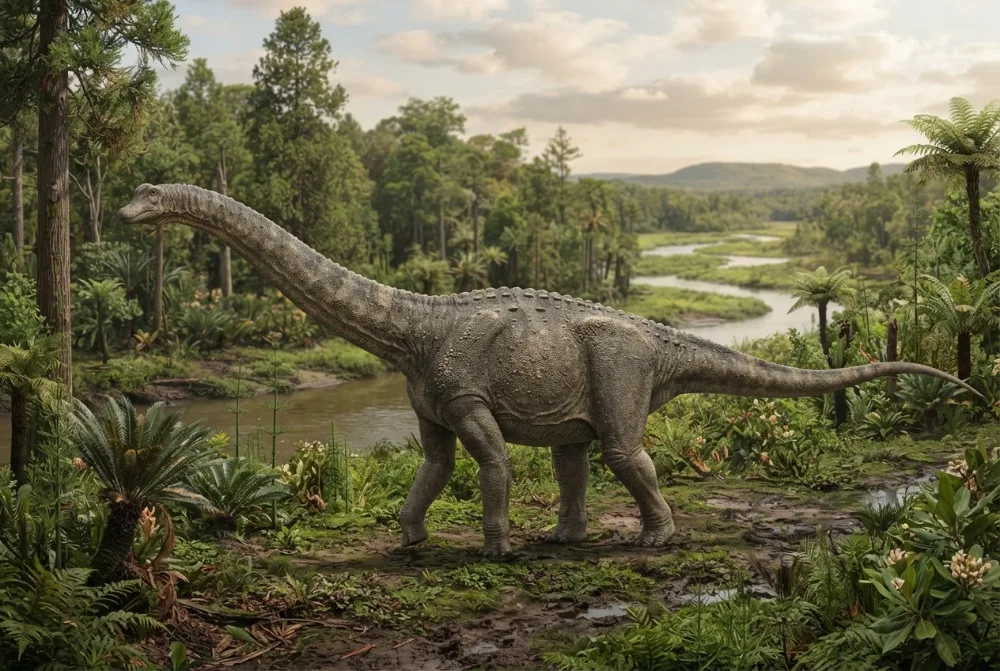
The name Astrophocaudia has a double meaning: 'non-twisting tail' because the tail bones were tightly connected, and 'star tail' because the tail bones look like a three-pointed star from behind.1
Scientists are not sure how big Astrophocaudia was. One study said it was about 10.9 metres (36 feet) long and weighed 2.85 tonnes (6,300 pounds), but another said 18.3 metres (60 feet) long and 20 tonnes (44,000 pounds).1
Most of the bones from one single Astrophocaudia were found together, including 24 tail bones, parts of the neck and back, ribs, a shoulder blade, and a hip bone.1
Astrophocaudia's fossils were first discovered in the 1960s by paleontologist Robert Slaughter, but they were not fully studied until the 2010s.1
The species name slaughteri honors Robert Slaughter, who dug up the bones.1
Mees gevraagde vrae oor Astrophocaudia
?How big was Astrophocaudia?
Scientists are not sure. One study estimated it at 10.9 metres (36 feet) long and 2.85 tonnes (6,300 pounds), while another estimated 18.3 metres (60 feet) long and 20 tonnes (44,000 pounds).1
?What did Astrophocaudia eat?
It was a herbivore, meaning it ate plants.3
?When did Astrophocaudia live?
It lived during the Early Cretaceous Period, about 112 to 106 million years ago.1
Vir dino-kenners
- Wetenskaplike naam
- Astrophocaudia
- Benoem deur
- D'Emic 20133
- Groep
- Langnekke
- Familie / klade
- Somphospondyli3
- Klassifikasie
- Sauropodomorpha > Sauropoda > Macronaria3
- Ouderdom van die rotse
- 113 tot 110 miljoen jaar (Albian)3
- Rotsformasies
- Paluxy3
- Lande
- VSA3
- Fossielrekords
- 1 in The Paleobiology Database3
- Ontdekking
- Astrophocaudia was named in 2012 (published 2013) by Michael D. D'Emic based on fossils found in the 1960s by Robert Slaughter in the Paluxy Formation of Texas.13
- Steeds omstrede
- Scientists are not sure exactly how large Astrophocaudia grew because different estimates give very different sizes.1
Waar die feite vandaan kom
- Astrophocaudia (en.wikipedia.org)
- Astrophocaudia (ru.wikipedia.org)
- Astrophocaudia in The Paleobiology Database (CC BY 4.0): ouderdom, plekke, rotsformasies, klassifikasie.
Elke feit op hierdie bladsy het 'n nommer wat na sy bron wys. As ons iets verkeerd het, jammer, ons is dino-aanhangers, nie 'n wetenskapjoernaal nie. Laat weet ons by [email protected] en ons maak dit reg.
 Rex is honger! Dino Wiki is 'n pa se projek vir sy seun wat mal is oor dino's, gratis met geen advertensies en geen spoorsnyers nie. Grootmense kan vir Rex 'n peuselhappie gee om te help om dit aanlyn te hou.Voer Rex
 Brachiosaurus
 Diplodocus
 Brontosaurus
 Argentinosaurus
 Camarasaurus
 Morosaurus
 Stegosaurus
 Iguanodon
 Archaeopteryx
 Giganotosaurus
 Microraptor
 Deinonychus