 Watter dino is jy? Kwis
 Dinogeveg
 Dinoresies
 Dino-minispeletjies
 Plakkeralbum
 Dino TOP-lyste
 Verras my!
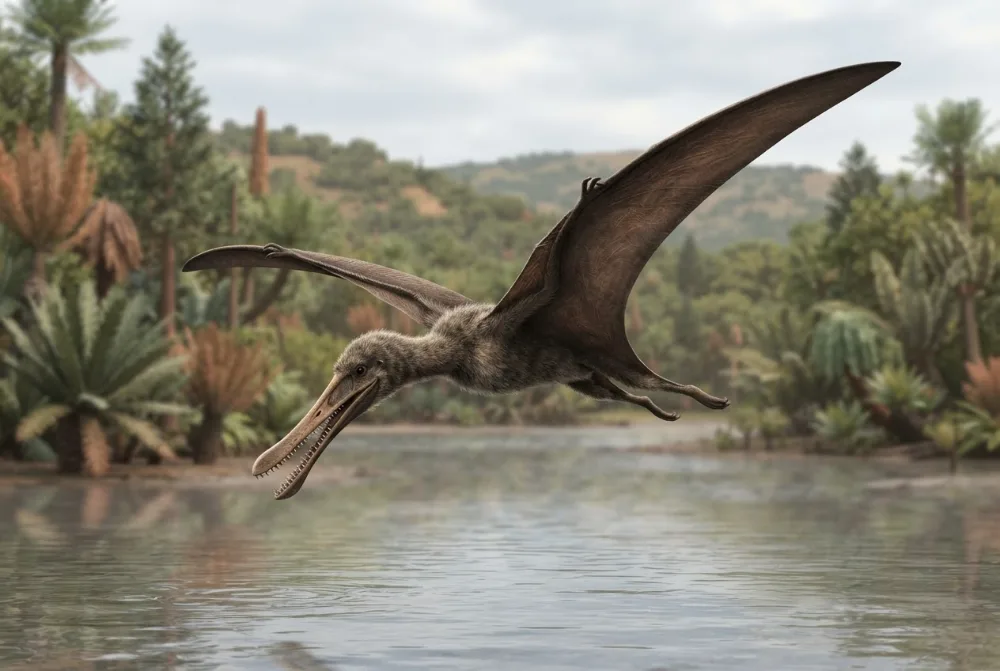
Balaenognathus
Balaenognathus was a flying reptile that lived about 150 million years ago. It had a strange, spoon-shaped snout with hundreds of tiny hooked teeth. It used its beak like a strainer to scoop up tiny shrimp from the water, just like a modern flamingo.12
Wanneer het dit geleef?
Hoe groot was dit?
Hoe lank was dit?
 so lank soos 2 huiskatte van neus tot stert🍌so lank soos 6 piesangs punt aan punt⚽kon in 9,9 sekondes oor 'n hele sokkerveld vlieg
Hoe groot was Balaenognathus vergeleke met JOU?
Net wiskunde in jou blaaier. Niks word gestoor of êrens heen gestuur nie.
Hoe vinnig was dit?


Prettige feite
Balaenognathus had at least 480 teeth, more than most other pterosaurs.1
The tips of its teeth had tiny hooks, which have never been seen in any other pterosaur. These hooks helped trap shrimp so they couldn't escape.12
The front of its snout was shaped like a spatula and had no teeth, so water could flow in easily.1
Its upper jaw was more curved than its lower jaw, so its mouth stayed slightly open at the front even when closed.1
The fossil was found by accident in a quarry in Germany, inside a block of stone that also contained bones of a crocodile-like animal.12
Balaenognathus lived during the Late Jurassic period, about 152 to 149 million years ago.3
It had long legs, which helped it wade through shallow seas while feeding.2
Mees gevraagde vrae oor Balaenognathus
?What did Balaenognathus eat?
It ate tiny shrimp and other small plankton. It used its spoon-shaped beak and hundreds of tiny hooked teeth to strain them out of the water.12
?How big was Balaenognathus?
It was a medium-sized pterosaur with a wingspan of 1.17 metres (3.8 feet). Its body was about 1 metre long.5
Vir dino-kenners
- Wetenskaplike naam
- Balaenognathus
- Benoem deur
- Martill et al. 20236
- Groep
- Vlieënde reptiele
- Familie / klade
- Ctenochasmatidae6
- Klassifikasie
- Pterosauria > Pterodactyloidea6
- Ouderdom van die rotse
- 152 tot 149 miljoen jaar (Kimmeridgian)6
- Lande
- Duitsland6
- Fossielrekords
- 1 in The Paleobiology Database6
- Ontdekking
- Balaenognathus was named by David Martill and colleagues in 2023. The only known fossil was found in September 2011 in a quarry near Wattendorf, Bavaria, Germany, by workers collecting a block of limestone.1
- Steeds omstrede
- Scientists are not sure exactly how Balaenognathus used its hooked teeth and spatula-like snout to filter food, but they think it may have pumped water in and out by moving its long neck.1
Waar die feite vandaan kom
- A new pterodactyloid pterosaur with a unique filter-feeding apparatus from the Late Jurassic of Germany | PalZ | Springer Nature Link (link.springer.com)
- Bizarre filter-feeding pterosaur described from Germany | Natural History Museum (nhm.ac.uk)
- PBDB Taxon (paleobiodb.org)
- Balaenognathus (en.m.wikipedia.org)
- Balaenognathus (Wikipedia) (Wikipedia)
- Balaenognathus in The Paleobiology Database (CC BY 4.0): ouderdom, plekke, rotsformasies, klassifikasie.
Elke feit op hierdie bladsy het 'n nommer wat na sy bron wys. As ons iets verkeerd het, jammer, ons is dino-aanhangers, nie 'n wetenskapjoernaal nie. Laat weet ons by [email protected] en ons maak dit reg.
 Rex is honger! Dino Wiki is 'n pa se projek vir sy seun wat mal is oor dino's, gratis met geen advertensies en geen spoorsnyers nie. Grootmense kan vir Rex 'n peuselhappie gee om te help om dit aanlyn te hou.Voer Rex
 Pteranodon
 Quetzalcoatlus
 Dorygnathus
 Rhamphorhynchus
 Anhanguera
 Pterodactylus
 Brachiosaurus
 Diplodocus
 Allosaurus
 Brontosaurus
 Compsognathus
 Camarasaurus