 Watter dino is jy? Kwis
 Dinogeveg
 Dinoresies
 Dino-minispeletjies
 Plakkeralbum
 Dino TOP-lyste
 Verras my!
Brachypterygius
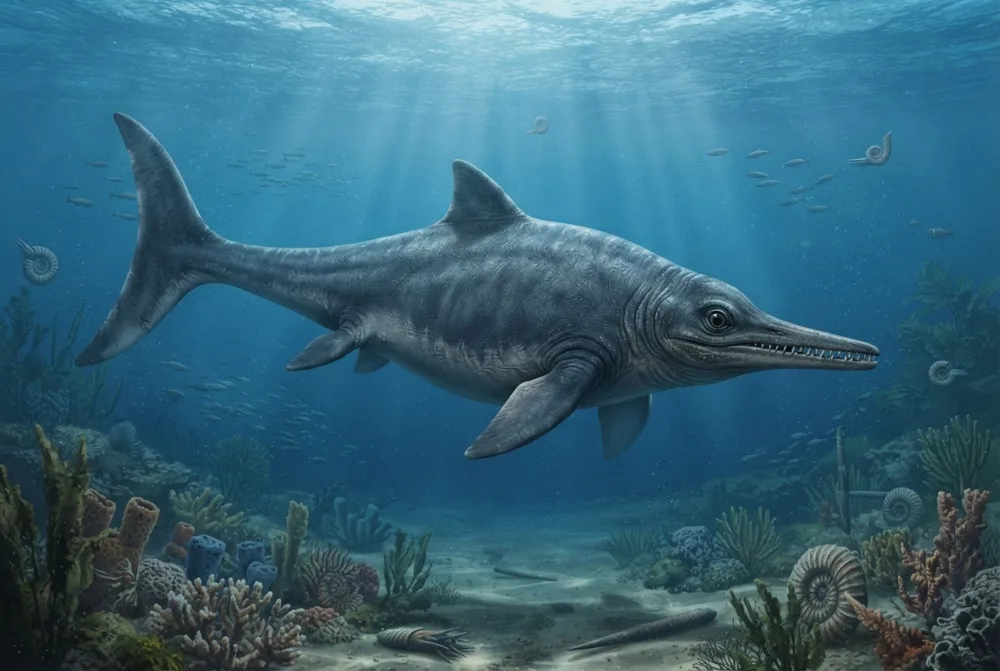
Brachypterygius was a fast-swimming marine reptile that lived in the Late Jurassic seas. It looked a bit like a dolphin but was a reptile, not a fish or a dinosaur. Its short, wide front flippers helped it steer through the water.1
Wanneer het dit geleef?
Hoe groot was dit?
Hoe lank was dit?
 so lank soos 4 honde van neus tot stert🍌so lank soos 22 piesangs punt aan punt🏊kon die lengte van 'n groot swembad (50 m) in 3,8 sekondes swem
Hoe groot was Brachypterygius vergeleke met JOU?
Net wiskunde in jou blaaier. Niks word gestoor of êrens heen gestuur nie.
Hoe vinnig was dit?


Prettige feite
Brachypterygius had a short, wide front flipper with up to six fingers, and some fingers had as many as 16 bones.1
Its skull was between 0.5 and 1.2 metres long, about the size of a big dog's head.1
The first fossil of Brachypterygius was just a single right front flipper, found in England.1
Brachypterygius lived during the Kimmeridgian and Tithonian ages, about 154 to 143 million years ago.3
It is closely related to other ichthyosaurs like Platypterygius and Caypullisaurus.1
Scientists once thought Brachypterygius was the same as another ichthyosaur called Grendelius, but now many think they are different.1
Mees gevraagde vrae oor Brachypterygius
?How big was Brachypterygius?
Brachypterygius was a medium sized ichthyosaur, with a body length up to 4 metres (13 ft) and a skull length of 0.5 to 1.2 metres (1.6 to 3.9 ft).1
?Was Brachypterygius a dinosaur?
No, Brachypterygius was an ichthyosaur, a marine reptile that lived in the sea. It was not a dinosaur, even though it lived at the same time as dinosaurs.1
?What did Brachypterygius eat?
Scientists think Brachypterygius hunted in sunlit waters for slower prey like fish that swam in shoals. Its teeth were larger and more robust than those of some other ichthyosaurs.2
Vir dino-kenners
- Wetenskaplike naam
- Brachypterygius
- Benoem deur
- Huene 19223
- Groep
- Igtiosourusse
- Familie / klade
- Ophthalmosauridae3
- Klassifikasie
- Ichthyosauria > Ichthyosauromorpha3
- Ouderdom van die rotse
- 155 tot 143 miljoen jaar (Kimmeridgian / Tithonian)3
- Rotsformasies
- Kimmeridge Clay, Agardhfjellet3
- Lande
- Verenigde Koninkryk, Rusland, Noorweë3
- Fossielrekords
- 6 in The Paleobiology Database3
- Ook bekend as
- Ochevia, Otschevia (ouer name tel nou as dieselfde dier)3
- Ontdekking
- The first fossil, a right front flipper, was described as Ichthyosaurus extremus by Boulenger in 1904. In 1922, Friedrich von Huene gave it the new name Brachypterygius because of its short, wide flipper.1
- Steeds omstrede
- Scientists still debate whether the species Grendelius mordax is the same as Brachypterygius extremus or a separate animal.1
Waar die feite vandaan kom
- Brachypterygius (en.wikipedia.org)
- Brachypterygius (prehistoric-wildlife.com)
- Brachypterygius in The Paleobiology Database (CC BY 4.0): ouderdom, plekke, rotsformasies, klassifikasie.
Elke feit op hierdie bladsy het 'n nommer wat na sy bron wys. As ons iets verkeerd het, jammer, ons is dino-aanhangers, nie 'n wetenskapjoernaal nie. Laat weet ons by [email protected] en ons maak dit reg.
 Rex is honger! Dino Wiki is 'n pa se projek vir sy seun wat mal is oor dino's, gratis met geen advertensies en geen spoorsnyers nie. Grootmense kan vir Rex 'n peuselhappie gee om te help om dit aanlyn te hou.Voer Rex
 Ichthyosaurus
 Platypterygius
 Stenopterygius
 Khudiakovia
 Ophthalmosaurus
 Chonespondylus
 Brachiosaurus
 Diplodocus
 Allosaurus
 Brontosaurus
 Compsognathus
 Camarasaurus