 Watter dino is jy? Kwis
 Dinogeveg
 Dinoresies
 Dino-minispeletjies
 Plakkeralbum
 Dino TOP-lyste
 Verras my!
Campananeyen
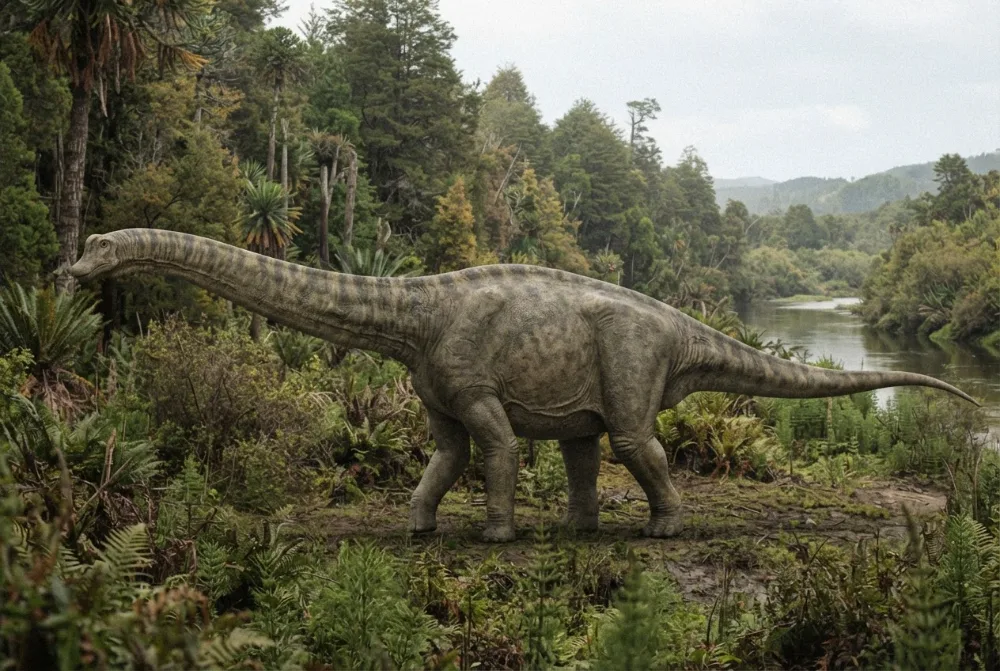
Campananeyen was a long-necked sauropod that lived in a huge desert in what is now Argentina. Its bones were so full of air pockets that scientists named it after the Mapuche word for 'air'. This dinosaur had a very thin and fragile hip bone, which is why its species name means 'the most fragile'.1
Wanneer het dit geleef?
Hoe groot was dit?
Hoe lank was dit?
Hoe hoog was dit?
skatting
Hoe swaar was dit?
 so lank soos 2,5 motors in 'n ry geparkeer🍌so lank soos 58 piesangs punt aan punt
 so swaar soos 120 honde🍉so swaar soos 500 waatlemoene🎒so swaar soos 3 hele skoolklasse vol kinders🐻❄️so swaar soos 6 ysbere🏃kon 100 meter in 16 sekondes hardloop (die vinnigste mens het 9,6 nodig)
Hoe groot was Campananeyen vergeleke met JOU?
Net wiskunde in jou blaaier. Niks word gestoor of êrens heen gestuur nie.
Hoe vinnig was dit?


Prettige feite
Campananeyen had a very thin and fragile ilium (hip bone), so thin that scientists gave it the species name fragilissimus, meaning 'the most fragile'.1
Its bones were extremely pneumatized, meaning they were filled with air pockets, which made the skeleton lighter. The name Campananeyen comes from the Mapuche word for 'air'.1
The quadrate fossa, a large pit on the back of the skull's cheek bone, was 30 to 70 percent larger in Campananeyen than in any other known rebbachisaurid.1
Unlike most rebbachisaurids, Campananeyen had hyposphene-hypantrum joints between its vertebrae, which helped lock the backbone together. Its hyposphene was hollow and ovoid, like in Nigersaurus.1
The sacral ribs of Campananeyen had a unique 'dorsal alar arm' that helped support the leg muscles, especially the muscle that pulls the thigh forward.1
Campananeyen lived in the Kokorkom Desert, a huge sandy desert with some oases, alongside other dinosaurs like the giant predator Giganotosaurus and the long-necked Limaysaurus.1
The first fossils of Campananeyen were found in 2016 but were not named until 2024, when scientists realized they belonged to a new species.1
Mees gevraagde vrae oor Campananeyen
?What did Campananeyen eat?
Campananeyen was a herbivore, meaning it ate plants. It likely used its many closely aligned teeth to eat leaves and other vegetation.4
?How big was Campananeyen?
Scientists do not know exactly how big Campananeyen was because only a fragmentary skeleton has been found. It was a sauropod, so it had a long neck, a large body, and strong limbs.14
?When did Campananeyen live?
Campananeyen lived during the Early Cretaceous Period, about 111 to 106 million years ago. It lived in a desert environment in what is now Argentina.1
?Why is Campananeyen called 'the most fragile'?
Its species name, fragilissimus, means 'the most fragile' in Latin. This is because its hip bone (ilium) was very thin and delicate, filled with air pockets.1
Vir dino-kenners
- Wetenskaplike naam
- Campananeyen
- Benoem deur
- Lerzo et al. 20245
- Groep
- Langnekke
- Familie / klade
- Rebbachisauridae5
- Klassifikasie
- Sauropodomorpha > Sauropoda > Diplodocoidea5
- Ouderdom van die rotse
- 113 tot 110 miljoen jaar (Albian)5
- Rotsformasies
- Candeleros5
- Lande
- Argentinië5
- Fossielrekords
- 1 in The Paleobiology Database5
- Ontdekking
- The Campananeyen holotype specimen was discovered in the Candeleros Formation near Villa El Chocón, Neuquén Province, Argentina. It was first described in 2016 but left unnamed, and then in 2024 scientists Lerzo et al. named it Campananeyen fragilissimus.1
- Steeds omstrede
- Scientists are still debating exactly how Campananeyen is related to other rebbachisaurids, because its fossils are fragmentary and incomplete.2
Waar die feite vandaan kom
- Campananeyen (en.wikipedia.org)
- They all floated in the cretaceous: new rebbachisaurid (Sauropoda, Diplodocoidea) with a highly pneumatized skeleton from the Upper Cretaceous (lower Cenomanian) of Patagonia, Argentina: Historical Biology: Vol 37 , No 8 - Get Access (tandfonline.com)
- Campananeyen fragilissimus | Dinosaur Database by DinoAnimals.com (dinoanimals.com)
- Campananeyen | The Lightweight Sauropod of Late Cretaceous (thedinosaurs.org)
- Campananeyen in The Paleobiology Database (CC BY 4.0): ouderdom, plekke, rotsformasies, klassifikasie.
Elke feit op hierdie bladsy het 'n nommer wat na sy bron wys. As ons iets verkeerd het, jammer, ons is dino-aanhangers, nie 'n wetenskapjoernaal nie. Laat weet ons by [email protected] en ons maak dit reg.
 Rex is honger! Dino Wiki is 'n pa se projek vir sy seun wat mal is oor dino's, gratis met geen advertensies en geen spoorsnyers nie. Grootmense kan vir Rex 'n peuselhappie gee om te help om dit aanlyn te hou.Voer Rex
 Brachiosaurus
 Diplodocus
 Brontosaurus
 Argentinosaurus
 Camarasaurus
 Morosaurus
 Stegosaurus
 Iguanodon
 Archaeopteryx
 Giganotosaurus
 Microraptor
 Deinonychus