 Watter dino is jy? Kwis
 Dinogeveg
 Dinoresies
 Dino-minispeletjies
 Plakkeralbum
 Dino TOP-lyste
 Verras my!
Wanneer het dit geleef?

Hoe groot was dit?
Hoe lank was dit?
Hoe hoog was dit?
skatting
Hoe swaar was dit?

 so lank soos 3 huiskatte van neus tot stert🍌so lank soos 9 piesangs punt aan punt🍉so swaar soos 20 waatlemoene🧸so swaar soos 5 kleuterskoolkinders🎒so swaar soos 3 skoolkinders🏃kon 100 meter in 7,5 sekondes hardloop (die vinnigste mens het 9,6 nodig)
Hoe groot was Chirostenotes vergeleke met JOU?
Net wiskunde in jou blaaier. Niks word gestoor of êrens heen gestuur nie.
Hoe vinnig was dit?


Prettige feite
Chirostenotes belongs to a group called caenagnathids, which are oviraptorosaurs. These dinosaurs are known for their toothless beaks and often had crests on their heads.42
Its name means 'narrow-handed' because its hand bones were long and slender, with three fingers that ended in sharp claws.1
Chirostenotes lived between about 79 and 67 million years ago, during the Late Cretaceous period.1
Fossils of Chirostenotes have been found in the Dinosaur Park Formation in Alberta, Canada, and the Hell Creek Formation in Montana, USA.4
Scientists once thought Chirostenotes was a different dinosaur called Macrophalangia, which means 'big toes'. Now they know it's the same animal.4
A study of a well-preserved jaw showed that Chirostenotes had a strong, shearing bite, like some plant-eating animals today. This supports the idea that it ate tough plants.2
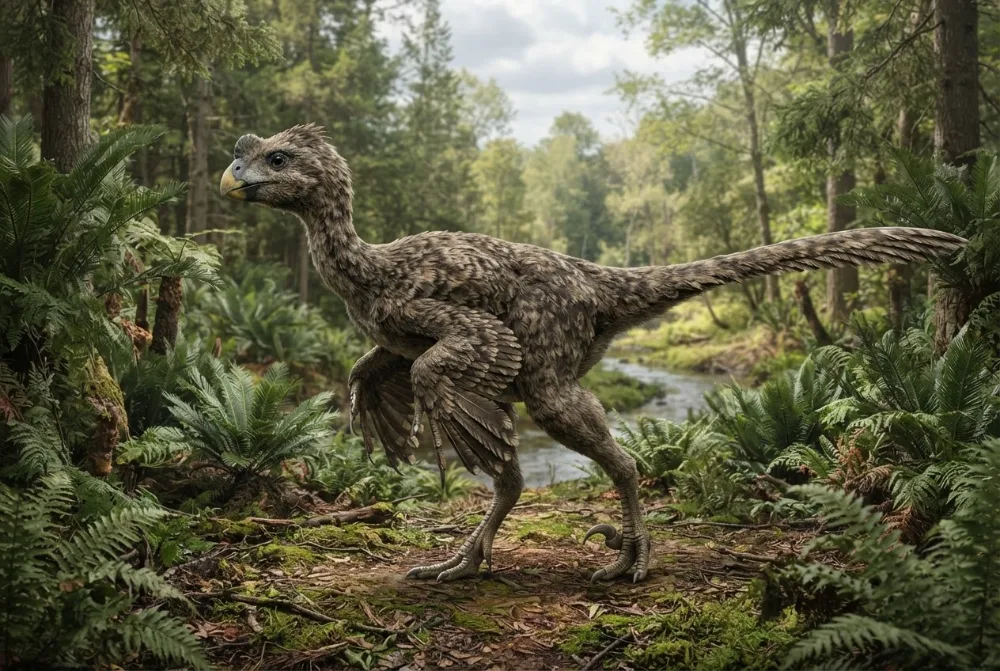
Mees gevraagde vrae oor Chirostenotes
?How big was Chirostenotes?
About 2.5 metres (8.2 ft) long and weighed around 100 kg (220 lbs).3
?What did Chirostenotes eat?
It was an omnivore, eating both plants and small animals like grubs, amphibians, reptiles and mammals.32
?Did Chirostenotes have feathers?
Yes, it was a feathered theropod, and related oviraptorosaurs like Caudipteryx had large primary feathers on their hands.3
?When did Chirostenotes live?
It lived during the Late Cretaceous period, about 79 to 67 million years ago.1
?Why is it called Chirostenotes?
Its name means 'narrow-handed' because its hand bones were long and slender.1
Mite-breker
Mite: Some people think Chirostenotes was a meat-eater like many other theropods.
Waarheid: Chirostenotes was actually an omnivore, eating both plants and small animals. Its toothless beak and jaw shape are better suited for slicing plants than for catching large prey.2
Vir dino-kenners
- Wetenskaplike naam
- Chirostenotes
- Benoem deur
- Gilmore 19244
- Groep
- Snaakse dino's met vere
- Familie / klade
- Caenagnathidae4
- Klassifikasie
- Theropoda > Oviraptorosauria4
- Ouderdom van die rotse
- 84 tot 66 miljoen jaar (Campanian / Maastrichtian)4
- Rotsformasies
- Hell Creek, Dinosaur Park, Aguja4
- Lande
- VSA, Kanada4
- Fossielrekords
- 28 in The Paleobiology Database4
- Ook bekend as
- Macrophalangia (ouer name tel nou as dieselfde dier)4
- Ontdekking
- Chirostenotes was named in 1924 by paleontologist Charles W. Gilmore, based on a pair of hands found in Alberta, Canada. Later, more complete fossils showed it was a caenagnathid.41
- Steeds omstrede
- Scientists are still debating exactly what Chirostenotes ate. Some think it was mostly a plant-eater, while others believe it ate a mix of plants and small animals.2
Waar die feite vandaan kom
- Chirostenotes | Natural History Museum (nhm.ac.uk)
- A previously undescribed caenagnathid mandible from the late Campanian of Alberta, and insights into the diet of Chirostenotes pergracilis (Dinosauria: Oviraptorosauria) (cdnsciencepub.com)
- Chirostenotes (en.wikipedia.org)
- Chirostenotes in The Paleobiology Database (CC BY 4.0): ouderdom, plekke, rotsformasies, klassifikasie.
Elke feit op hierdie bladsy het 'n nommer wat na sy bron wys. As ons iets verkeerd het, jammer, ons is dino-aanhangers, nie 'n wetenskapjoernaal nie. Laat weet ons by [email protected] en ons maak dit reg.
 Rex is honger! Dino Wiki is 'n pa se projek vir sy seun wat mal is oor dino's, gratis met geen advertensies en geen spoorsnyers nie. Grootmense kan vir Rex 'n peuselhappie gee om te help om dit aanlyn te hou.Voer Rex
 Therizinosaurus
 Oviraptor
 Citipes
 Leptorhynchos
 Avimimus
 Caenagnathus
 Tyrannosaurus
 Triceratops
 Velociraptor
 Spinosaurus
 Ankylosaurus
 Parasaurolophus