 Watter dino is jy? Kwis
 Dinogeveg
 Dinoresies
 Dino-minispeletjies
 Plakkeralbum
 Dino TOP-lyste
 Verras my!
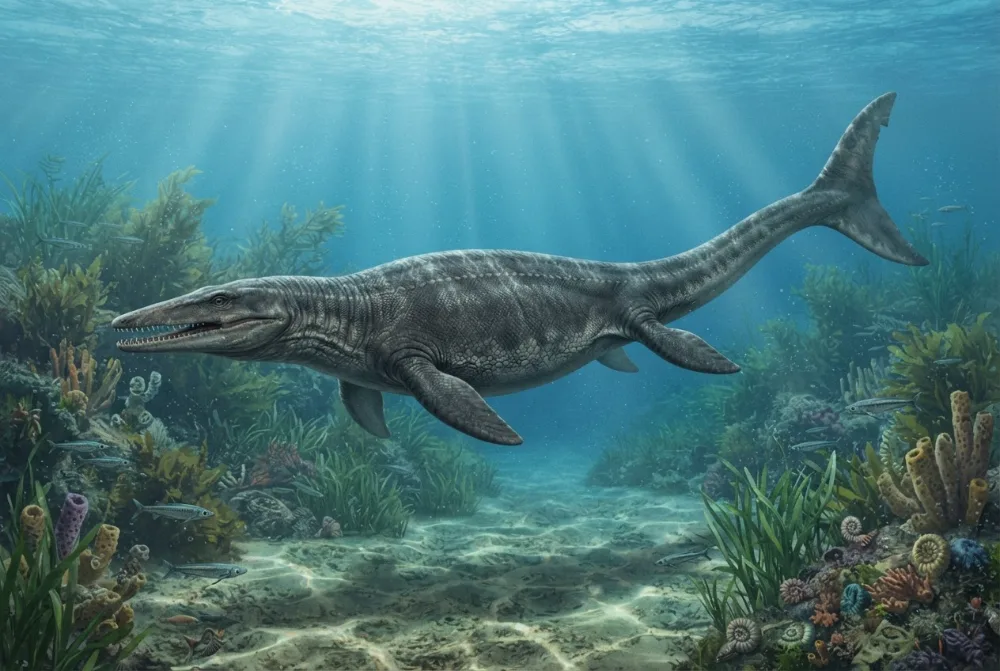
Clidastes
Clidastes was a small, speedy marine lizard that lived in the Late Cretaceous seas. It was one of the smallest mosasaurs, but it was a fast swimmer that chased down fish and squid in shallow waters.1
Wanneer het dit geleef?
Hoe groot was dit?
Hoe lank was dit?
Hoe swaar was dit?
 so lank soos 6 honde van neus tot stert🍌so lank soos 34 piesangs punt aan punt
 so swaar soos 14 huiskatte🍉so swaar soos 11 waatlemoene🧸so swaar soos 3 kleuterskoolkinders🎒so swaar soos 1,5 skoolkinders🏊kon die lengte van 'n groot swembad (50 m) in 5,5 sekondes swem
Hoe groot was Clidastes vergeleke met JOU?
Net wiskunde in jou blaaier. Niks word gestoor of êrens heen gestuur nie.
Hoe vinnig was dit?


Prettige feite
Clidastes had special vertebrae that locked together, making its spine strong and stable for fast swimming.1
It was one of the smallest mosasaurs, only 2 to 4 meters long on average, but some grew up to 6.2 meters.1
Isotope studies on its teeth suggest Clidastes sometimes entered freshwater, like modern sea snakes.1
The first Clidastes fossils were found in Alabama in 1869 by E. D. Cope, and they were beautifully preserved.1
Its tail had extra-strong bones and muscles, which helped it chase down the fastest prey.1
Some scientists think that only one species, Clidastes propython, is valid, but others recognize more.1
Mees gevraagde vrae oor Clidastes
?Was Clidastes a dinosaur?
No, Clidastes was a marine lizard, not a dinosaur. It belonged to a group called mosasaurs, which are reptiles that lived in the sea.13
?How big was Clidastes?
Clidastes was one of the smallest mosasaurs, averaging 2 to 4 metres (6.6 to 13.1 feet) long. The largest specimens reached about 6.2 metres (20 feet).13
?What did Clidastes eat?
Clidastes likely ate cephalopods (like squid), fish, and other small vertebrates. It hunted in shallow water.13
?Could Clidastes swim in freshwater?
Yes, isotope studies on its teeth suggest Clidastes sometimes entered freshwater, similar to modern sea snakes.1
Vir dino-kenners
- Wetenskaplike naam
- Clidastes
- Benoem deur
- Cope 18684
- Groep
- Mosasourusse
- Familie / klade
- Mosasauridae4
- Klassifikasie
- Mosasauroidea4
- Ouderdom van die rotse
- 94 tot 66 miljoen jaar (Turonian / Maastrichtian)4
- Rotsformasies
- Mooreville Chalk, Niobrara, Pierre Shale4
- Lande
- VSA, Swede, Duitsland, Meksiko, Rusland, Jordanië4
- Fossielrekords
- 34 in The Paleobiology Database4
- Ontdekking
- E. D. Cope named Clidastes in 1868, and in 1869 he found the first good fossils in the Mooreville Chalk of Alabama.14
- Steeds omstrede
- Scientists debate whether fossils from Europe and Jordan really belong to Clidastes or to other mosasaurs.1
Waar die feite vandaan kom
- Clidastes (en.wikipedia.org)
- Clidastes - Justapedia (justapedia.org)
- Clidastes Facts for Kids (kids.kiddle.co)
- Clidastes in The Paleobiology Database (CC BY 4.0): ouderdom, plekke, rotsformasies, klassifikasie.
Elke feit op hierdie bladsy het 'n nommer wat na sy bron wys. As ons iets verkeerd het, jammer, ons is dino-aanhangers, nie 'n wetenskapjoernaal nie. Laat weet ons by [email protected] en ons maak dit reg.
 Rex is honger! Dino Wiki is 'n pa se projek vir sy seun wat mal is oor dino's, gratis met geen advertensies en geen spoorsnyers nie. Grootmense kan vir Rex 'n peuselhappie gee om te help om dit aanlyn te hou.Voer Rex
 Mosasaurus
 Prognathodon
 Tylosaurus
 Platecarpus
 Globidens
 Halisaurus
 Tyrannosaurus
 Triceratops
 Velociraptor
 Spinosaurus
 Ankylosaurus
 Parasaurolophus