 Watter dino is jy? Kwis
 Dinogeveg
 Dinoresies
 Dino-minispeletjies
 Plakkeralbum
 Dino TOP-lyste
 Verras my!
Ctenochasma
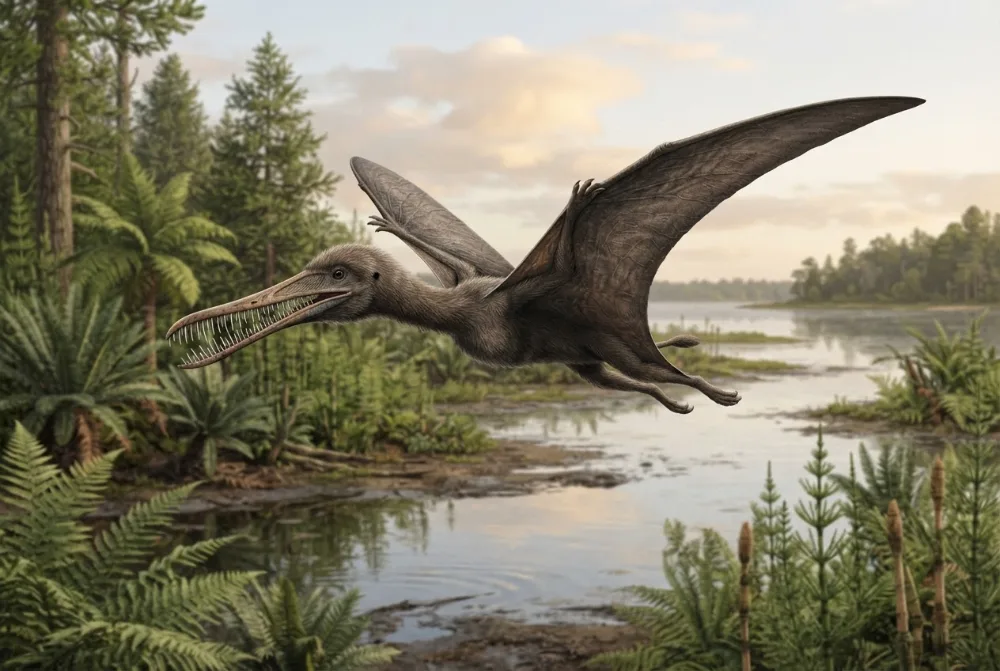
Ctenochasma was a flying reptile with a mouth full of hundreds of long, thin teeth that stuck out like a comb. It used its special beak to scoop up tiny animals from the water, like a spoonbill bird today.1
Wanneer het dit geleef?
Hoe groot was dit?
Hoe wyd was sy vlerke?
 so lank soos 4 huiskatte van neus tot stert⚽kon in 8 sekondes oor 'n hele sokkerveld vlieg
Hoe groot was Ctenochasma vergeleke met JOU?
Net wiskunde in jou blaaier. Niks word gestoor of êrens heen gestuur nie.
Hoe vinnig was dit?


Prettige feite
Ctenochasma had over 400 teeth in adults, all long, thin, and tightly packed together.1
Its teeth stuck outward from the jaws, forming a basket-like shape that helped catch small prey.1
Adult Ctenochasma had a bony crest on top of their skull, but young ones did not.1
Scientists think Ctenochasma was nocturnal, like some seabirds today, based on its eye bones.1
The smallest species, Ctenochasma elegans, had a wingspan of about 1.9 metres (6.2 feet) as an adult.1
Ctenochasma lived during the Late Jurassic period, around 150 to 145 million years ago.1
Mees gevraagde vrae oor Ctenochasma
?Was Ctenochasma a dinosaur?
No, Ctenochasma was a pterosaur, which is a flying reptile and not a dinosaur.1
?How big was Ctenochasma?
The smallest species, Ctenochasma elegans, had a maximum wingspan of about 1.9 metres (6.2 feet) as an adult.1
?What did Ctenochasma eat?
It used its comb-like teeth to strain small invertebrates from the water, similar to how a spoonbill bird feeds today.1
?Did Ctenochasma have a crest?
Yes, adult Ctenochasma had a bony crest along the skull, but young ones did not.1
Vir dino-kenners
- Wetenskaplike naam
- Ctenochasma
- Benoem deur
- Meyer 18512
- Groep
- Vlieënde reptiele
- Familie / klade
- Lophocratia2
- Klassifikasie
- Pterosauria > Pterodactyloidea2
- Ouderdom van die rotse
- 149 tot 137 miljoen jaar (Tithonian / Berriasian)2
- Rotsformasies
- Solnhofen, Solnhofener Plattenkalk, Calcaires tâchetés2
- Lande
- Duitsland, Frankryk2
- Fossielrekords
- 7 in The Paleobiology Database2
- Ontdekking
- German paleontologist Hermann von Meyer named Ctenochasma in 1851, based on a lower jaw full of teeth. He first thought it was a crocodilian, not a pterosaur.1
- Steeds omstrede
- Scientists debate whether all the different species of Ctenochasma are really just growth stages of one species, but a 2007 study showed three distinct species based on tooth number and shape.1
Waar die feite vandaan kom
- Ctenochasma (en.wikipedia.org)
- Ctenochasma in The Paleobiology Database (CC BY 4.0): ouderdom, plekke, rotsformasies, klassifikasie.
Elke feit op hierdie bladsy het 'n nommer wat na sy bron wys. As ons iets verkeerd het, jammer, ons is dino-aanhangers, nie 'n wetenskapjoernaal nie. Laat weet ons by [email protected] en ons maak dit reg.
 Rex is honger! Dino Wiki is 'n pa se projek vir sy seun wat mal is oor dino's, gratis met geen advertensies en geen spoorsnyers nie. Grootmense kan vir Rex 'n peuselhappie gee om te help om dit aanlyn te hou.Voer Rex
 Pteranodon
 Quetzalcoatlus
 Dorygnathus
 Rhamphorhynchus
 Anhanguera
 Pterodactylus
 Stegosaurus
 Iguanodon
 Archaeopteryx
 Giganotosaurus
 Microraptor
 Deinonychus