 Watter dino is jy? Kwis
 Dinogeveg
 Dinoresies
 Dino-minispeletjies
 Plakkeralbum
 Dino TOP-lyste
 Verras my!
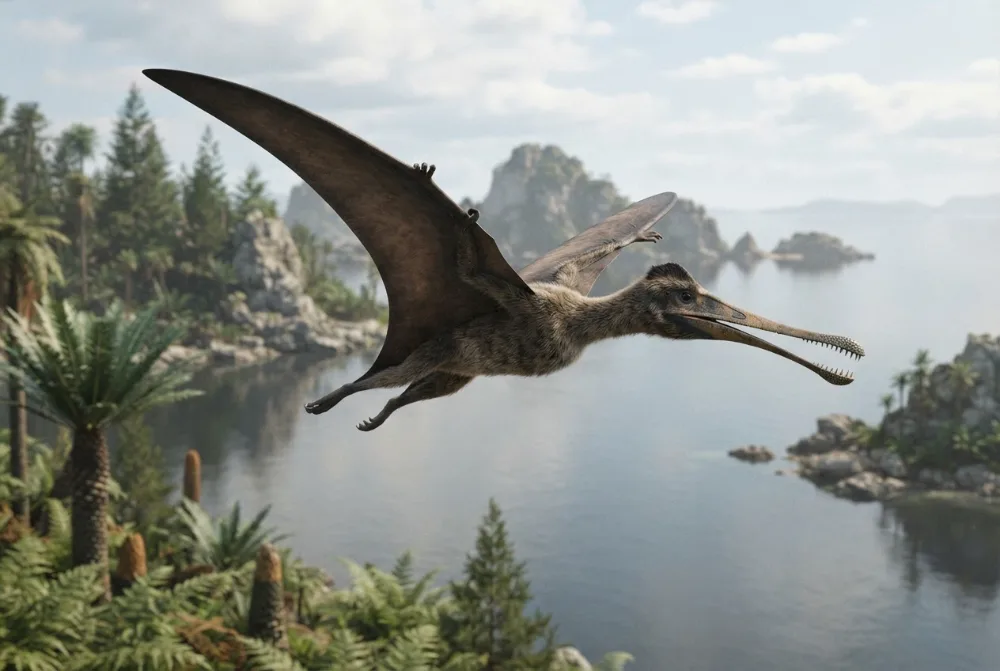
Cycnorhamphus
Cycnorhamphus was a pterosaur, a flying reptile that lived during the Late Jurassic. It had a strange beak with peg-like teeth at the tips and curved jaws that left a gap. Scientists think it might have used its beak to crush hard-shelled animals like mollusks.1
Wanneer het dit geleef?
Hoe groot was dit?
Hoe wyd was sy vlerke?
 so lank soos 2,5 huiskatte van neus tot stert⚽kon in 9,5 sekondes oor 'n hele sokkerveld vlieg
Hoe groot was Cycnorhamphus vergeleke met JOU?
Net wiskunde in jou blaaier. Niks word gestoor of êrens heen gestuur nie.
Hoe vinnig was dit?


Prettige feite
Cycnorhamphus lived about 152 million years ago during the Late Jurassic.1
Its name means 'swan beak' because of the shape of its snout.1
The first fossil was found in Germany in 1855 and named Pterodactylus suevicus by Friedrich August Quenstedt.1
A well-preserved skull nicknamed 'The Painten Pelican' helped scientists understand its unusual jaw.1
Adult Cycnorhamphus had blunter, stouter teeth at the tips of their jaws than juveniles.1
The jaws had a gap behind the teeth, and soft tissue structures filled that gap in the upper jaw.1
Some scientists think Cycnorhamphus used its beak like openbill storks to crush hard invertebrates.1
Mees gevraagde vrae oor Cycnorhamphus
?How big was Cycnorhamphus?
Cycnorhamphus had a wingspan of about 1.5 metres (4.9 feet).4
?What did Cycnorhamphus eat?
Scientists think it probably ate shellfish, using its beak to crush hard invertebrates like mollusks, similar to openbill storks.14
?Why did Cycnorhamphus have a gap in its jaws?
Nobody knows for sure. Ideas include trapping jellyfish, opening seashells, or just for show.4
?Is Cycnorhamphus a dinosaur?
No, Cycnorhamphus is a pterosaur, a flying reptile that lived during the Late Jurassic, not a dinosaur.1
Mite-breker
Mite: Cycnorhamphus had long jaws with many teeth like other pterosaurs.
Waarheid: It actually had short, peg-like teeth only at the tips of its jaws, with a curved gap behind them.1
Vir dino-kenners
- Wetenskaplike naam
- Cycnorhamphus
- Benoem deur
- Seeley 18705
- Groep
- Vlieënde reptiele
- Familie / klade
- Lophocratia5
- Klassifikasie
- Pterosauria > Pterodactyloidea5
- Ouderdom van die rotse
- 152 tot 145 miljoen jaar (Kimmeridgian / Tithonian)5
- Rotsformasies
- Nusplingen Limestone, Liegende Bankkalk, Solnhofen5
- Lande
- Duitsland5
- Fossielrekords
- 3 in The Paleobiology Database5
- Ontdekking
- The first fossil was found near Nusplingen in Germany and named Pterodactylus suevicus by Friedrich August Quenstedt in 1855. In 1870, Harry Govier Seeley gave it the new genus name Cycnorhamphus.1
- Steeds omstrede
- Scientists are still unsure exactly how Cycnorhamphus used its unusual beak and jaw gap.1
Waar die feite vandaan kom
- Cycnorhamphus (en.wikipedia.org)
- PBDB Taxon (paleobiodb.org)
- Cycnorhamphus, Pterofiltrus (reptileevolution.com)
- Cycnorhamphus - Thomas Henry Huxley Paleozoological Gardens (hpz.zhejiangopterus.org)
- Cycnorhamphus in The Paleobiology Database (CC BY 4.0): ouderdom, plekke, rotsformasies, klassifikasie.
Elke feit op hierdie bladsy het 'n nommer wat na sy bron wys. As ons iets verkeerd het, jammer, ons is dino-aanhangers, nie 'n wetenskapjoernaal nie. Laat weet ons by [email protected] en ons maak dit reg.
 Rex is honger! Dino Wiki is 'n pa se projek vir sy seun wat mal is oor dino's, gratis met geen advertensies en geen spoorsnyers nie. Grootmense kan vir Rex 'n peuselhappie gee om te help om dit aanlyn te hou.Voer Rex
 Pteranodon
 Quetzalcoatlus
 Dorygnathus
 Rhamphorhynchus
 Anhanguera
 Pterodactylus
 Brachiosaurus
 Diplodocus
 Allosaurus
 Brontosaurus
 Compsognathus
 Camarasaurus