 Watter dino is jy? Kwis
 Dinogeveg
 Dinoresies
 Dino-minispeletjies
 Plakkeralbum
 Dino TOP-lyste
 Verras my!
Djupedalia
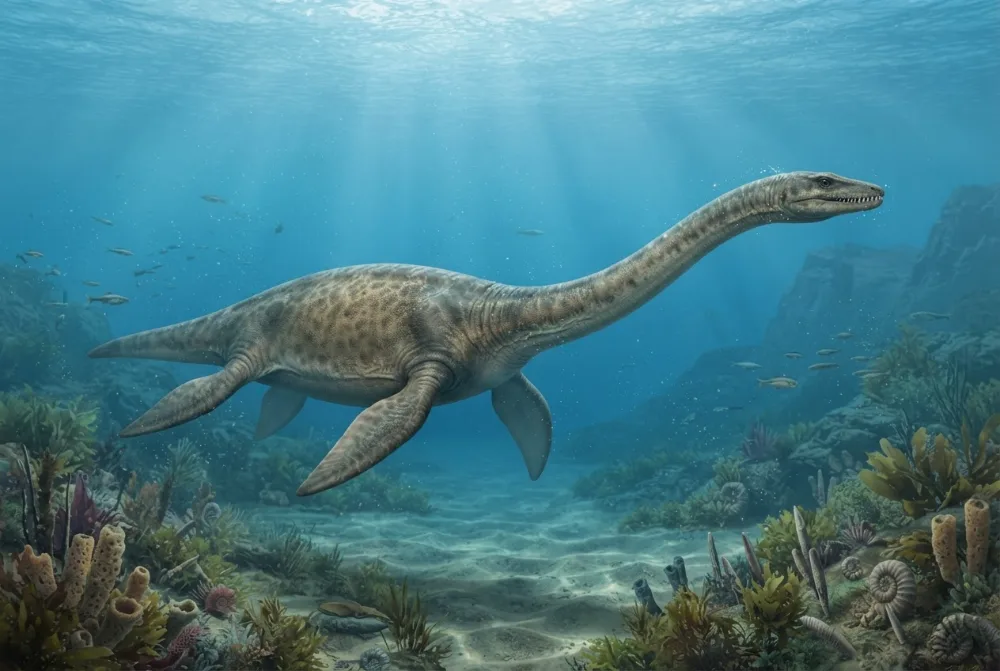
Djupedalia was a long-necked marine reptile that swam in the warm, shallow seas near Svalbard, Norway, about 150 million years ago. It was not a dinosaur, but a plesiosaur, a type of ocean predator. With its small head and long neck, it likely snapped up fish and squid while paddling through the water.42
Wanneer het dit geleef?
Hoe groot was dit?
Hoe lank was dit?
 so lank soos 6 honde van neus tot stert🍌so lank soos 33 piesangs punt aan punt🏊kon die lengte van 'n groot swembad (50 m) in 6,7 sekondes swem
Hoe groot was Djupedalia vergeleke met JOU?
Net wiskunde in jou blaaier. Niks word gestoor of êrens heen gestuur nie.
Hoe vinnig was dit?


Prettige feite
Djupedalia is known from a single juvenile skeleton that is one of the most complete marine reptile fossils ever found in Spitsbergen.2
Its neck bones were special: the neural spines (the parts that stick up from the vertebrae) were shifted far back, and the postzygapophyses (the joints that connect vertebrae) were very long.2
Djupedalia had femora (thigh bones) that were longer than its humeri (upper arm bones), which is unusual for plesiosaurs.2
The fossil was found about 20 metres below a rock layer called the Dorsoplanites bed, which is full of ammonite shells.2
Djupedalia lived during the Tithonian age, about 150 to 145 million years ago, in the Late Jurassic period.1
Mite-breker
Mite: Some people might think Djupedalia was a dinosaur because it lived in the sea and had a long neck.
Waarheid: Djupedalia was a plesiosaur, a marine reptile, not a dinosaur. Dinosaurs lived on land, while plesiosaurs swam in the ocean.4
Vir dino-kenners
- Wetenskaplike naam
- Djupedalia
- Benoem deur
- Knutsen et al. 20124
- Groep
- Plesiosourusse
- Familie / klade
- Cryptoclididae4
- Klassifikasie
- Plesiosauria > Sauropterygia4
- Ouderdom van die rotse
- 149 tot 143 miljoen jaar (Tithonian)4
- Rotsformasies
- Agardhfjellet4
- Lande
- Noorweë4
- Fossielrekords
- 1 in The Paleobiology Database4
- Ontdekking
- Djupedalia was named in 2012 by Espen M. Knutsen, Patrick S. Druckenmiller, and Jørn H. Hurum. The fossil was excavated in the summer of 2009 by the University of Oslo Natural History Museum from the Slottsmøya Member near Janusfjellet mountain.2
- Steeds omstrede
- Scientists are still debating exactly how Djupedalia is related to other plesiosaurs, since it shares features with several different groups from England and other places.2
Waar die feite vandaan kom
- Djupedalia (en.wikipedia.org)
- A new plesiosauroid (Reptilia: Sauropterygia) from the Agardhfjellet Formation (Middle Volgian) of central Spitsbergen, Norway (foreninger.uio.no)
- PaleoCodex :: Djupedalia (paleocodex.com)
- Djupedalia in The Paleobiology Database (CC BY 4.0): ouderdom, plekke, rotsformasies, klassifikasie.
Elke feit op hierdie bladsy het 'n nommer wat na sy bron wys. As ons iets verkeerd het, jammer, ons is dino-aanhangers, nie 'n wetenskapjoernaal nie. Laat weet ons by [email protected] en ons maak dit reg.
 Rex is honger! Dino Wiki is 'n pa se projek vir sy seun wat mal is oor dino's, gratis met geen advertensies en geen spoorsnyers nie. Grootmense kan vir Rex 'n peuselhappie gee om te help om dit aanlyn te hou.Voer Rex
 Elasmosaurus
 Pliosaurus
 Plesiosaurus
 Cimoliasaurus
 Colymbosaurus
 Trinacromerum
 Brachiosaurus
 Diplodocus
 Allosaurus
 Brontosaurus
 Compsognathus
 Camarasaurus