 Watter dino is jy? Kwis
 Dinogeveg
 Dinoresies
 Dino-minispeletjies
 Plakkeralbum
 Dino TOP-lyste
 Verras my!
Eustreptospondylus
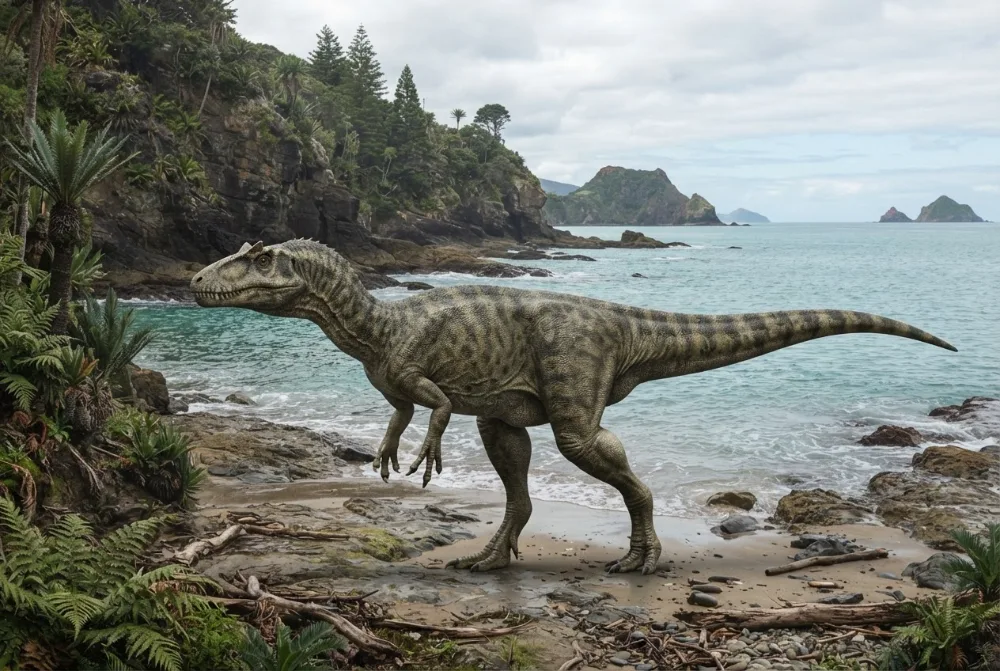
Eustreptospondylus was a meat-eating dinosaur that lived on islands in the Jurassic sea. It was about as long as a small car and probably hunted small animals or ate dead ones washed up on the beach.1
Wanneer het dit geleef?
Hoe groot was dit?
Hoe lank was dit?
Hoe hoog was dit?
Hoe swaar was dit?
 so lank soos 6 honde van neus tot stert🍌so lank soos 33 piesangs punt aan punt🍉so swaar soos 100 waatlemoene🧸so swaar soos 26 kleuterskoolkinders🎒so swaar soos 16 skoolkinders🏃kon 100 meter in 8 sekondes hardloop (die vinnigste mens het 9,6 nodig)
Hoe groot was Eustreptospondylus vergeleke met JOU?
Net wiskunde in jou blaaier. Niks word gestoor of êrens heen gestuur nie.
Hoe vinnig was dit?


Prettige feite
The first skeleton found was the most complete large meat-eating dinosaur skeleton known at the time, and it is still the most complete large Jurassic European theropod.1
It lived on islands, because Europe was a group of islands back then. Some scientists think it could swim short distances between islands, like a Komodo dragon.1
Its skull had a pointed snout and a large horizontal nostril. It did not have a horn on its face.1
Grooves in its jaw joints let it open its mouth extra wide when it lowered its lower jaws.1
No teeth were found with the skeleton, but the size of the tooth sockets shows that the third tooth in the lower jaw was extra big.1
The known fossil was found in a marine layer, which means it ended up in the sea. That is why some scientists think it could swim, but others think it just washed out to sea after dying.1
Mees gevraagde vrae oor Eustreptospondylus
?How big was Eustreptospondylus?
The known skeleton was from a subadult about 4.63 metres (15.2 ft) long and weighed about 218 kilograms (481 lb). A full-grown adult may have reached around 6 metres (20 ft) and weighed 0.5 tonnes.1
?What did Eustreptospondylus eat?
It was a carnivore that ate smaller dinosaurs and pterosaurs, and may have scavenged dead fish, marine reptiles, and other dinosaurs.1
?Could Eustreptospondylus swim?
Some scientists think it could swim short distances between islands, like a Komodo dragon, because its fossil was found on what was an island. Others think it just washed out to sea after dying.1
?When did Eustreptospondylus live?
It lived during the Middle to Late Jurassic period, about 166 to 154 million years ago.1
?Where was Eustreptospondylus found?
Its fossils were found in southern England, near Oxford, in a marine clay layer.1
?Is Eustreptospondylus a dinosaur?
Yes, it is a theropod dinosaur, a meat-eating dinosaur that walked on two legs.1
Mite-breker
Mite: Eustreptospondylus was a slow, clumsy scavenger that only ate dead animals.
Waarheid: It was a meat-eater that probably hunted small animals and also scavenged. Its body shows it was an active predator, and it may have foraged on shorelines.1
Vir dino-kenners
- Wetenskaplike naam
- Eustreptospondylus
- Benoem deur
- Walker 19643
- Groep
- Vleisvretende dino's
- Familie / klade
- Megalosauridae3
- Klassifikasie
- Theropoda3
- Ouderdom van die rotse
- 165 tot 162 miljoen jaar (Callovian)3
- Rotsformasies
- Oxford Clay3
- Lande
- Verenigde Koninkryk3
- Fossielrekords
- 1 in The Paleobiology Database3
- Ontdekking
- Workers found the skeleton in 1870 at Summertown Brick Pit near Oxford, England. It was described in 1871 by John Phillips, but it got its own name, Eustreptospondylus oxoniensis, from Alick Walker in 1964.1
- Steeds omstrede
- Scientists still debate whether Eustreptospondylus could swim between islands or if its body just washed out to sea after death.1
Waar die feite vandaan kom
- Eustreptospondylus (en.wikipedia.org)
- enchantedlearning.com (enchantedlearning.com)
- Eustreptospondylus in The Paleobiology Database (CC BY 4.0): ouderdom, plekke, rotsformasies, klassifikasie.
Elke feit op hierdie bladsy het 'n nommer wat na sy bron wys. As ons iets verkeerd het, jammer, ons is dino-aanhangers, nie 'n wetenskapjoernaal nie. Laat weet ons by [email protected] en ons maak dit reg.
 Rex is honger! Dino Wiki is 'n pa se projek vir sy seun wat mal is oor dino's, gratis met geen advertensies en geen spoorsnyers nie. Grootmense kan vir Rex 'n peuselhappie gee om te help om dit aanlyn te hou.Voer Rex
 Allosaurus
 Carnotaurus
 Dilophosaurus
 Giganotosaurus
 Compsognathus
 Paronychodon
 Ichthyosaurus
 Khudiakovia
 Ophthalmosaurus
 Pterodactylus
 Peloneustes
 Rhamphocephalus