 Watter dino is jy? Kwis
 Dinogeveg
 Dinoresies
 Dino-minispeletjies
 Plakkeralbum
 Dino TOP-lyste
 Verras my!
Hatzegopteryx
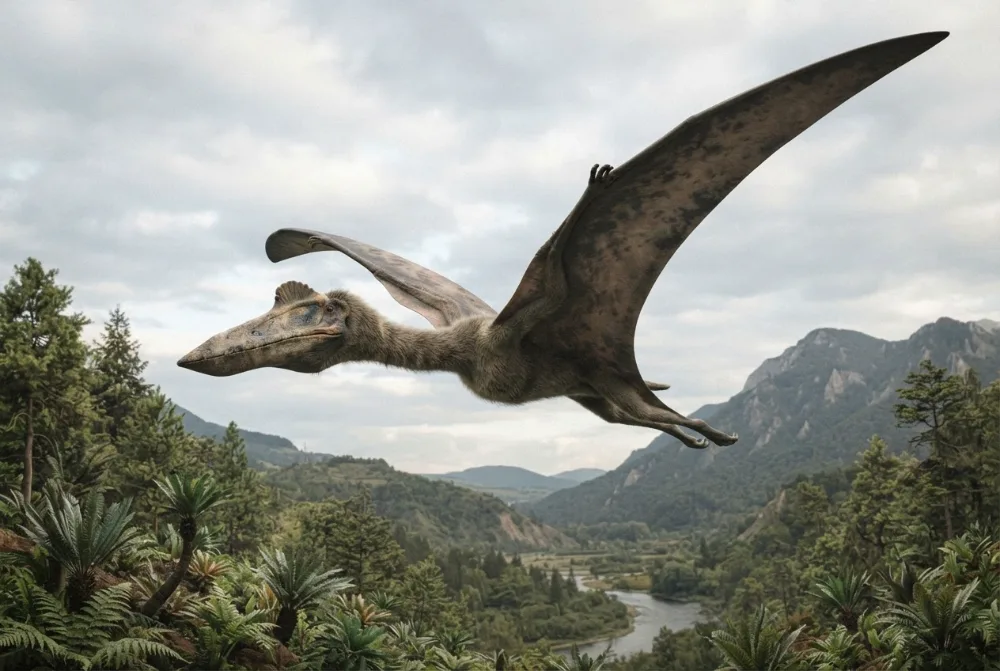
Hatzegopteryx was a giant flying reptile that lived on an island in what is now Romania. It had a huge, strong skull and a short, muscular neck, and it was probably the top predator on its island home.1
Wanneer het dit geleef?
Hoe groot was dit?
Hoe wyd was sy vlerke?
Hoe swaar was dit?

 vlerke so wyd soos 2,5 motors in 'n ry🍉so swaar soos 50 waatlemoene🧸so swaar soos 13 kleuterskoolkinders🎒so swaar soos 8 skoolkinders⚽kon in 3,9 sekondes oor 'n hele sokkerveld vlieg
Hoe groot was Hatzegopteryx vergeleke met JOU?
Net wiskunde in jou blaaier. Niks word gestoor of êrens heen gestuur nie.
Hoe vinnig was dit?


Prettige feite
Hatzegopteryx had a skull that was about 2.5 meters (8 feet) long, one of the largest skulls of any non-marine animal.1
Its neck was only 1.5 meters (5 feet) long, which is half the length of other giant pterosaurs with the same wingspan.1
The bones of Hatzegopteryx were filled with tiny pits and hollows, making them lightweight but strong, like Styrofoam.1
It lived on Hațeg Island, a subtropical island in the ancient Tethys Sea, where dinosaurs were small due to island dwarfism.1
Hatzegopteryx was probably the top predator on its island because there were no large meat-eating dinosaurs there.1
The first fossils of Hatzegopteryx were found in the late 1970s by students, but were at first mistaken for dinosaur bones.1
Mees gevraagde vrae oor Hatzegopteryx
?How big was Hatzegopteryx?
It had a wingspan of about 10 to 12 meters (33 to 39 feet), making it one of the biggest pterosaurs ever.1
?Could Hatzegopteryx fly?
Yes, it could fly. Its wing bones were similar to other flying pterosaurs, and its skull was lightweight thanks to a spongy internal structure.14
?What did Hatzegopteryx eat?
It was a predator that probably ate dwarf dinosaurs like titanosaurs and iguanodontians, and it could tackle prey too big to swallow whole.1
?Is Hatzegopteryx a dinosaur?
No, it is a pterosaur, which is a flying reptile and not a dinosaur.1
?When did Hatzegopteryx live?
It lived about 72 million years ago, during the Late Cretaceous Period.1
?Where was Hatzegopteryx found?
Its fossils were found in Transylvania, Romania, on what was once Hațeg Island.1
?How heavy was Hatzegopteryx?
Its weight has been estimated at around 250 kilograms (550 pounds).4
?Was Hatzegopteryx bigger than Quetzalcoatlus?
It was about the same size or slightly smaller. Both had wingspans around 10 to 12 meters, but Hatzegopteryx had a shorter, stronger neck.1
?Why did Hatzegopteryx have a short neck?
Its short, thick neck was very strong and helped it hunt large prey, like dwarf dinosaurs, by catching them.15
?Could Hatzegopteryx swim?
Nobody knows for sure, but it probably spent most of its time on land hunting, like other azhdarchid pterosaurs.1
Mite-breker
Mite: Hatzegopteryx was too heavy to fly.
Waarheid: Its bones had a spongy, lightweight internal structure that made the skull strong but light enough for flight.1
Vir dino-kenners
- Wetenskaplike naam
- Hatzegopteryx
- Benoem deur
- Buffetaut et al. 20026
- Groep
- Vlieënde reptiele
- Familie / klade
- Azhdarchidae6
- Klassifikasie
- Pterosauria > Pterodactyloidea > Azhdarchidae6
- Ouderdom van die rotse
- 72 tot 66 miljoen jaar (Maastrichtian)6
- Rotsformasies
- Densuș-Ciula, Sebeş, Râul Mare6
- Lande
- Roemenië6
- Fossielrekords
- 4 in The Paleobiology Database6
- Ontdekking
- Hatzegopteryx was named in 2002 by paleontologists Eric Buffetaut, Dan Grigorescu, and Zoltan Csiki, based on skull fragments and a wing bone found in Romania.1
- Steeds omstrede
- Scientists are not sure exactly how wide its wingspan was, with estimates ranging from 10 to 12 meters (33 to 39 feet).1
Waar die feite vandaan kom
- Hatzegopteryx (en.wikipedia.org)
- PBDB Taxon (paleobiodb.org)
- A new giant pterosaur with a robust skull from the latest cretaceous of Romania (pubmed.ncbi.nlm.nih.gov)
- Eons | When a Giant Pterosaur Ruled the European Islands | Season 4 | Episode 23 | PBS (pbs.org)
- Neck biomechanics indicate that giant Transylvanian azhdarchid pterosaurs were short-necked arch predators (pmc.ncbi.nlm.nih.gov)
- Hatzegopteryx in The Paleobiology Database (CC BY 4.0): ouderdom, plekke, rotsformasies, klassifikasie.
Elke feit op hierdie bladsy het 'n nommer wat na sy bron wys. As ons iets verkeerd het, jammer, ons is dino-aanhangers, nie 'n wetenskapjoernaal nie. Laat weet ons by [email protected] en ons maak dit reg.
 Rex is honger! Dino Wiki is 'n pa se projek vir sy seun wat mal is oor dino's, gratis met geen advertensies en geen spoorsnyers nie. Grootmense kan vir Rex 'n peuselhappie gee om te help om dit aanlyn te hou.Voer Rex
 Pteranodon
 Quetzalcoatlus
 Dorygnathus
 Rhamphorhynchus
 Anhanguera
 Pterodactylus
 Tyrannosaurus
 Triceratops
 Velociraptor
 Spinosaurus
 Ankylosaurus
 Parasaurolophus