 Watter dino is jy? Kwis
 Dinogeveg
 Dinoresies
 Dino-minispeletjies
 Plakkeralbum
 Dino TOP-lyste
 Verras my!
Helicoprion
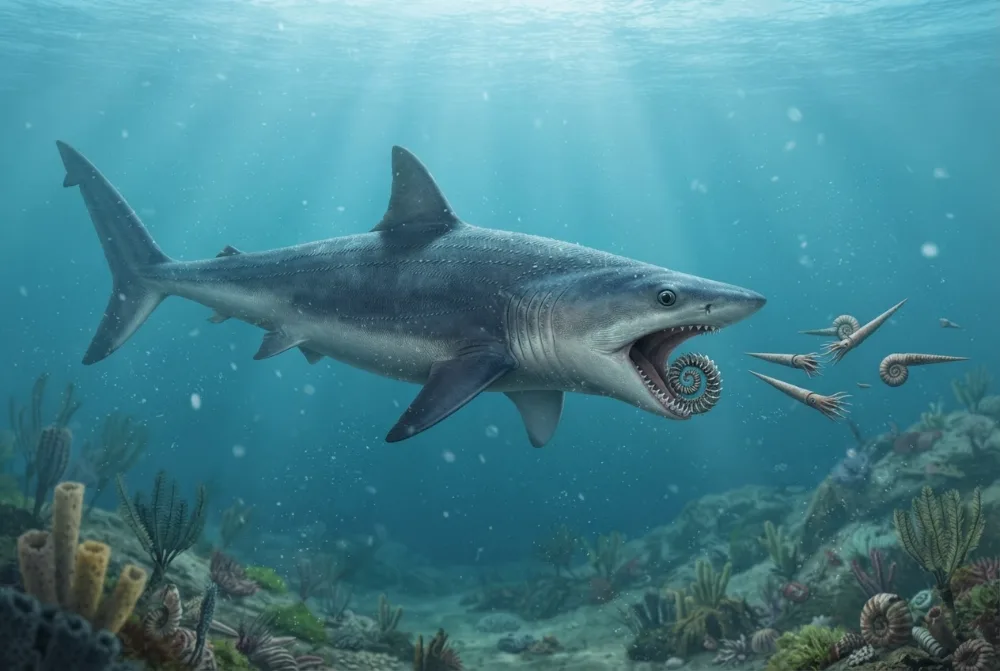
Helicoprion was a shark-like fish that lived in the Permian seas. It had a strange, spiral-shaped tooth whorl in its lower jaw that looked like a buzz-saw. This helped it catch and eat soft prey like squid and other cephalopods.12
Wanneer het dit geleef?
Hoe groot was dit?
Hoe lank was dit?
 so lank soos 2,5 motors in 'n ry geparkeer🍌so lank soos 67 piesangs punt aan punt🏊kon die lengte van 'n groot swembad (50 m) in 6 sekondes swem
Hoe groot was Helicoprion vergeleke met JOU?
Net wiskunde in jou blaaier. Niks word gestoor of êrens heen gestuur nie.
Hoe vinnig was dit?


Prettige feite
Helicoprion is known mostly from its spiral tooth whorls, because its skeleton was made of cartilage and did not fossilize easily.12
The tooth whorl sat in the lower jaw, and each tooth had a different job: front teeth hooked prey, middle teeth pierced and cut, and back teeth pushed food into the throat.12
Helicoprion lived during the Permian Period, about 290 to 270 million years ago, which is before the dinosaurs.1
Scientists think Helicoprion was an apex predator in its environment, and it may have gathered in deep inland seas like the Phosphoria Sea (now Idaho) to breed or hunt.1
The name Helicoprion comes from Greek words meaning 'spiral saw', because of its coiled tooth whorl.1
Helicoprion could grow up to 12 metres (39 feet) long, about as long as a school bus.1
Mees gevraagde vrae oor Helicoprion
?Was Helicoprion a dinosaur?
No, Helicoprion was a shark-like cartilaginous fish, not a dinosaur. It lived in the Permian seas long before the first dinosaurs appeared.1
?How big was Helicoprion?
Helicoprion is estimated to have reached lengths between 5 and 12 metres, about as long as a school bus.1
?What did Helicoprion eat?
Helicoprion ate soft-bodied prey like squid, belemnoids, and other cephalopods. It may also have eaten hard-shelled ammonoids and nautiloids by pulling the body out of the shell.12
?When did Helicoprion live?
Helicoprion lived from the Early to the Middle Permian, about 290 to 270 million years ago. That is before the dinosaurs.1
?Where was Helicoprion found?
Helicoprion fossils have been found all over the world, including in the United States (especially Idaho), Russia, Australia, China, and Japan. It lived in many seas.12
?How did Helicoprion use its tooth whorl?
The tooth whorl sat in the lower jaw and worked like a saw. Front teeth hooked prey, middle teeth pierced and cut, and back teeth pushed food into the throat.12
?Why did Helicoprion have a spiral tooth?
The spiral tooth whorl helped Helicoprion catch and eat soft prey like squid. It could also help shell hard-shelled animals by pulling the body out of the shell.12
?Is Helicoprion still alive?
No, Helicoprion went extinct about 270 million years ago, at the end of the Middle Permian. It is only known from fossils.1
?How fast could Helicoprion swim?
Maybe up to about 30 km/h (19 mph). This is a guess: nobody knows for sure. Its body was probably shaped like a tuna or mackerel shark, so it was likely a fast swimmer.1
?What would happen if Helicoprion was alive today?
If Helicoprion were alive today, it would be a large, fast-swimming predator that ate squid and fish. But it lived in the Permian and is extinct, so we can only imagine.1
Vir dino-kenners
- Wetenskaplike naam
- Helicoprion
- Benoem deur
- Karpinsky 18993
- Groep
- Prehistoriese legendes
- Familie / klade
- Helicoprionidae3
- Klassifikasie
- Chondrichthyes > Eugeneodontiformes > Helicoprionidae3
- Ouderdom van die rotse
- 299 tot 254 miljoen jaar (Asselian / Wuchiapingian)3
- Rotsformasies
- Phosphoria, Assistance, Bone Spring3
- Lande
- VSA, Kanada, Japan, Meksiko, Australië, Kazakstan3
- Fossielrekords
- 35 in The Paleobiology Database3
- Ontdekking
- Helicoprion was first named in 1899 by Russian geologist Alexander Karpinsky, based on fossils found in Russia and Australia. The type species is Helicoprion bessonowi.13
- Steeds omstrede
- Scientists are still unsure about the exact shape of Helicoprion's body, because almost no skeleton has been found, only tooth whorls.12
Waar die feite vandaan kom
- Helicoprion (en.wikipedia.org)
- Helicoprion - The Australian Museum (australian.museum)
- Helicoprion in The Paleobiology Database (CC BY 4.0): ouderdom, plekke, rotsformasies, klassifikasie.
Elke feit op hierdie bladsy het 'n nommer wat na sy bron wys. As ons iets verkeerd het, jammer, ons is dino-aanhangers, nie 'n wetenskapjoernaal nie. Laat weet ons by [email protected] en ons maak dit reg.
 Rex is honger! Dino Wiki is 'n pa se projek vir sy seun wat mal is oor dino's, gratis met geen advertensies en geen spoorsnyers nie. Grootmense kan vir Rex 'n peuselhappie gee om te help om dit aanlyn te hou.Voer Rex
 Megalodon
 Sabre-toothed cat
 Dimetrodon
 Woolly mammoth
 Arthropleura
 Deinosuchus