 Watter dino is jy? Kwis
 Dinogeveg
 Dinoresies
 Dino-minispeletjies
 Plakkeralbum
 Dino TOP-lyste
 Verras my!
Wanneer het dit geleef?

Hoe groot was dit?
Hoe lank was dit?
Hoe hoog was dit?
skatting
Hoe swaar was dit?
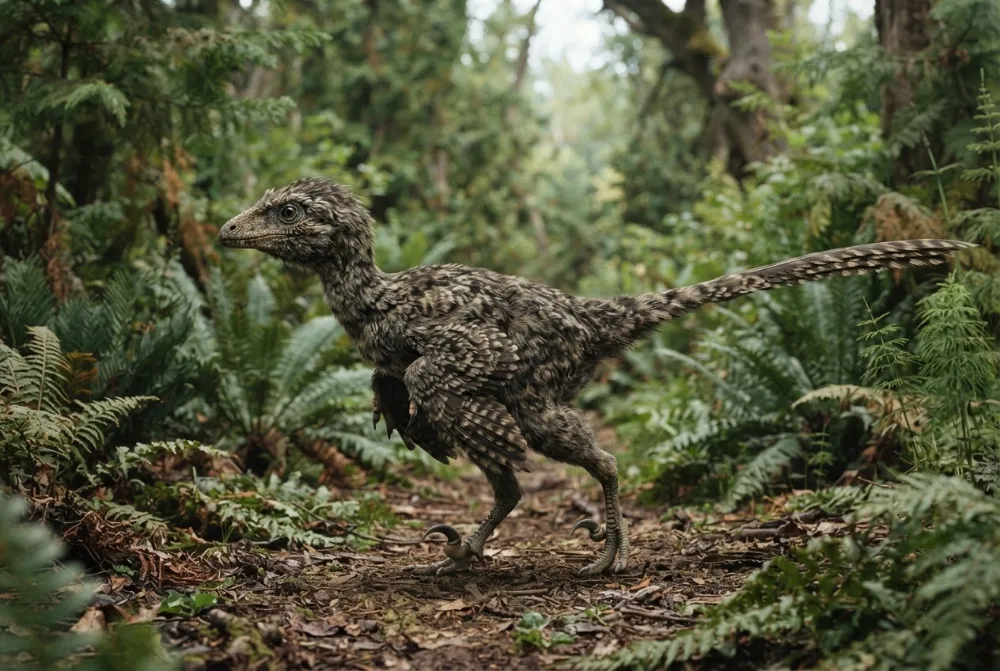
 so lank soos 2 huiskatte van neus tot stert🍌so lank soos 6 piesangs punt aan punt🪶ligter as 'n huiskat🍌so swaar soos 16 piesangs🪑klein genoeg om onder 'n stoel deur te loop🏃kon 100 meter in 15 sekondes hardloop (die vinnigste mens het 9,6 nodig)
Hoe groot was Hesperonychus vergeleke met JOU?
Net wiskunde in jou blaaier. Niks word gestoor of êrens heen gestuur nie.
Hoe vinnig was dit?


Prettige feite
Hesperonychus weighed only about 1.9 kilograms, which is less than a house cat.1
It is the smallest carnivorous non-avian dinosaur known from North America.1
Hesperonychus belongs to a group called Microraptorinae, which includes the four-winged Microraptor from China.1
Its fossils were first collected in 1982 but were not studied until 25 years later.1
Hesperonychus lived about 75 million years ago during the Late Cretaceous.1
Even though it was fully grown, its hip bones were fused together, showing it was an adult.1
Mees gevraagde vrae oor Hesperonychus
?How big was Hesperonychus?
About 1 metre long and weighed between 1.5 and 2 kilograms, roughly the size of a large cat.31
?What did Hesperonychus eat?
It was a meat-eater. It ate small animals like lizards, mammals, and insects.31
?Did Hesperonychus have feathers?
Yes, it almost certainly had feathers. It belonged to a group of feathered dinosaurs called Microraptorinae, which includes the four-winged Microraptor.31
?Could Hesperonychus fly?
Probably not. Scientists think it was more like a ground-running predator, not a glider like its relative Microraptor.3
Vir dino-kenners
- Wetenskaplike naam
- Hesperonychus
- Benoem deur
- Longrich and Currie 20094
- Groep
- Raptors
- Familie / klade
- Dromaeosauridae4
- Klassifikasie
- Theropoda > Dromaeosauridae4
- Ouderdom van die rotse
- 84 tot 72 miljoen jaar (Campanian)4
- Rotsformasies
- Dinosaur Park, Oldman4
- Lande
- Kanada4
- Fossielrekords
- 4 in The Paleobiology Database4
- Ontdekking
- The holotype was collected in 1982 by Dr. Elizabeth Nicholls, but it was not described until 2009 by Nicholas Longrich and Philip Currie. The species name honors Elizabeth Nicholls.13
- Steeds omstrede
- Scientists are not sure exactly how many small dromaeosaurids lived in North America, because only isolated bones have been found so far.1
Waar die feite vandaan kom
- A microraptorine (Dinosauria, Dromaeosauridae) from the Late Cretaceous of North America (pmc.ncbi.nlm.nih.gov)
- A microraptorine (Dinosauria, Dromaeosauridae) from the Late Cretaceous of North America (pnas.org)
- Hesperonychus (en.wikipedia.org)
- Hesperonychus in The Paleobiology Database (CC BY 4.0): ouderdom, plekke, rotsformasies, klassifikasie.
Elke feit op hierdie bladsy het 'n nommer wat na sy bron wys. As ons iets verkeerd het, jammer, ons is dino-aanhangers, nie 'n wetenskapjoernaal nie. Laat weet ons by [email protected] en ons maak dit reg.
 Rex is honger! Dino Wiki is 'n pa se projek vir sy seun wat mal is oor dino's, gratis met geen advertensies en geen spoorsnyers nie. Grootmense kan vir Rex 'n peuselhappie gee om te help om dit aanlyn te hou.Voer Rex
 Velociraptor
 Microraptor
 Deinonychus
 Asiamericana
 Richardoestesia
 Saurornitholestes
 Tyrannosaurus
 Triceratops
 Spinosaurus
 Ankylosaurus
 Parasaurolophus
 Pteranodon