 Watter dino is jy? Kwis
 Dinogeveg
 Dinoresies
 Dino-minispeletjies
 Plakkeralbum
 Dino TOP-lyste
 Verras my!
Ikqaumishan
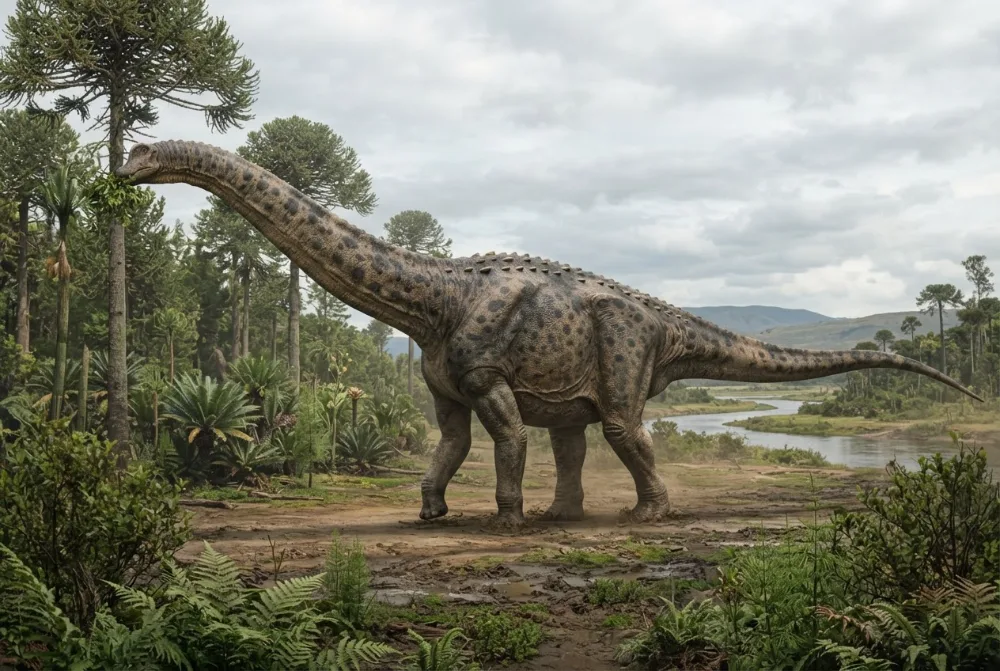
Ikqaumishan was a huge, long-necked plant-eater that stomped around what is now Pakistan and India near the very end of the dinosaur age. It belonged to a group called titanosaurs, which included some of the biggest land animals ever. It probably used its long neck to munch leaves high in trees.21
Wanneer het dit geleef?
Hoe groot was dit?
Hoe lank was dit?
 so lank soos 22 motors in 'n ry geparkeer🍌so lank soos 560 piesangs punt aan punt🏃kon 100 meter in 24 sekondes hardloop (die vinnigste mens het 9,6 nodig)
Hoe groot was Ikqaumishan vergeleke met JOU?
Net wiskunde in jou blaaier. Niks word gestoor of êrens heen gestuur nie.
Hoe vinnig was dit?


Prettige feite
Ikqaumishan is known from a partial upper arm bone called a humerus, which was found in Pakistan.2
It lived about 72 to 66 million years ago, during the Maastrichtian age, which is the very last part of the dinosaur era.2
Its upper arm bone had a special ridge that was straight and set inward, which is different from many other titanosaurs.1
The place where it was found was near the equator about 9 degrees south, so it lived in a warm, tropical area.1
Ikqaumishan is one of several new titanosaurs described from Pakistan in 2023, showing that this region had many giant plant-eaters.1
Its fossils were found in rocks that formed in a river environment, so it probably walked along ancient floodplains.2
Mees gevraagde vrae oor Ikqaumishan
?What is Ikqaumishan?
Ikqaumishan is a genus of titanosaurian sauropod dinosaur from the Late Cretaceous. It was a huge, long-necked plant-eater.41
?How big was Ikqaumishan?
The exact size is not known, but it was a large titanosaur. The only known fossil is a partial upper arm bone, so scientists can only estimate its size.43
?When did Ikqaumishan live?
Ikqaumishan lived during the Maastrichtian age, about 72 to 66 million years ago, near the very end of the dinosaur age.41
?What did Ikqaumishan eat?
Ikqaumishan was a herbivore, meaning it ate plants. It probably used its long neck to munch leaves high in trees.41
?Where was Ikqaumishan found?
Ikqaumishan fossils were found in Pakistan and India. The main bone, a partial humerus, came from the Vitakri Formation in Balochistan, Pakistan.31
?Is Ikqaumishan a dinosaur?
Yes, Ikqaumishan is a dinosaur. It belongs to the group called titanosaurs, which were long-necked sauropod dinosaurs.41
?Why is it called Ikqaumishan?
The name honors former Prime Minister Imran Khan and journalist Imran Khan, and comes from Urdu/Saraiki words meaning 'nation' and 'respect'.3
Mite-breker
Mite: Some people think all dinosaurs lived in North America or Africa, but Ikqaumishan shows that giant sauropods also lived in South Asia.
Waarheid: Ikqaumishan is a real dinosaur from Pakistan and India, proving that titanosaurs thrived in many parts of the ancient world.2
Vir dino-kenners
- Wetenskaplike naam
- Ikqaumishan
- Benoem deur
- Malkani 20234
- Groep
- Langnekke
- Familie / klade
- Gspsauridae4
- Klassifikasie
- Sauropodomorpha > Sauropoda > Titanosauria > Macronaria4
- Ouderdom van die rotse
- 72 tot 66 miljoen jaar (Maastrichtian)4
- Rotsformasies
- Vitakri, Lameta4
- Lande
- Pakistan, Indië4
- Fossielrekords
- 3 in The Paleobiology Database4
- Ontdekking
- Ikqaumishan was named by paleontologist M. S. Malkani in 2023. The first fossil, a partial humerus, was found in the Sangiali locality in the Vitakri Formation, Pakistan.21
- Steeds omstrede
- Scientists are still debating exactly how many different titanosaur species lived in Pakistan, because many are known from only a few bones.1
Waar die feite vandaan kom
- A Glance on the Mineral Deposits and Stratigraphic Sequential Variations and Structures in Different Sections of Indus Basin (Pakistan): New Titanosaurian Sauropod Dinosaurs from the Latest Maastrichtian Vitakri Formation of Pakistan (scirp.org)
- PBDB Taxon (paleobiodb.org)
- Untitled Document (paleofile.com)
- Ikqaumishan in The Paleobiology Database (CC BY 4.0): ouderdom, plekke, rotsformasies, klassifikasie.
Elke feit op hierdie bladsy het 'n nommer wat na sy bron wys. As ons iets verkeerd het, jammer, ons is dino-aanhangers, nie 'n wetenskapjoernaal nie. Laat weet ons by [email protected] en ons maak dit reg.
 Rex is honger! Dino Wiki is 'n pa se projek vir sy seun wat mal is oor dino's, gratis met geen advertensies en geen spoorsnyers nie. Grootmense kan vir Rex 'n peuselhappie gee om te help om dit aanlyn te hou.Voer Rex
 Brachiosaurus
 Diplodocus
 Brontosaurus
 Argentinosaurus
 Camarasaurus
 Morosaurus
 Tyrannosaurus
 Triceratops
 Velociraptor
 Spinosaurus
 Ankylosaurus
 Parasaurolophus