 Watter dino is jy? Kwis
 Dinogeveg
 Dinoresies
 Dino-minispeletjies
 Plakkeralbum
 Dino TOP-lyste
 Verras my!
Jobaria
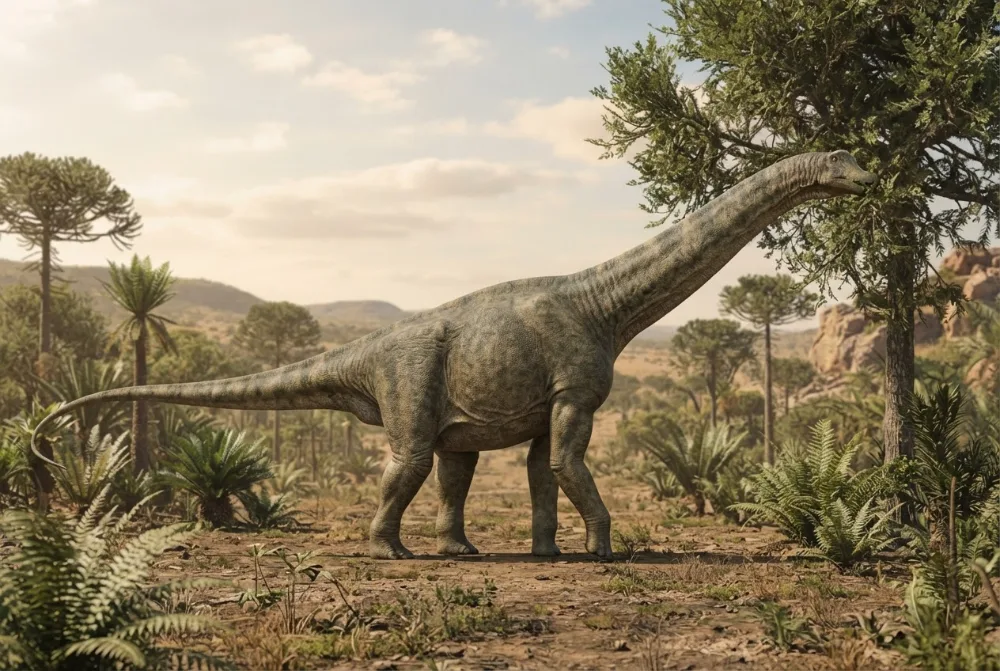
Jobaria was a huge, long-necked plant eater that stomped through the Sahara Desert millions of years ago. It was one of the most complete sauropod skeletons ever found, so scientists know a lot about it!1
Wanneer het dit geleef?
Hoe groot was dit?
Hoe lank was dit?
Hoe hoog was dit?
Hoe swaar was dit?

 so lank soos 5 motors in 'n ry geparkeer🍌so lank soos 120 piesangs punt aan puntso swaar soos 15 motors🍉so swaar soos 4500 waatlemoene🎒so swaar soos 28 hele skoolklasse vol kinders🐻❄️so swaar soos 50 ysbere🏢hoog genoeg om op vloer 2 by 'n venster in te loer🏃kon 100 meter in 30 sekondes hardloop (die vinnigste mens het 9,6 nodig)
Hoe groot was Jobaria vergeleke met JOU?
Net wiskunde in jou blaaier. Niks word gestoor of êrens heen gestuur nie.
Hoe vinnig was dit?


Prettige feite
Jobaria is one of the most complete sauropods ever found, with over 95% of its skeleton preserved.1
Its backbone and tail were simpler than those of later sauropods like Diplodocus, which had complex vertebrae and a whiplash tail.1
Scientists think Jobaria could rear up on its hind legs, like elephants can, because its weight was supported more by its back legs.1
Jobaria lived during the Middle Jurassic, about 167 to 161 million years ago, though some sources say Early Cretaceous.12
The name Jobaria comes from a mythical giant beast called Jobar, whose bones some Tuareg people thought the fossils were.1
Jobaria was discovered in 1997 during a four-month expedition led by paleontologist Paul Sereno.1
Mees gevraagde vrae oor Jobaria
?How big was Jobaria?
About 18.2 metres (60 feet) long and weighing around 22.4 tonnes (24.7 short tons), though some scientists give a smaller estimate of 16 metres (52 feet) and 16 tonnes (18 short tons).1
?What did Jobaria eat?
It was a plant eater, or herbivore, chomping on leaves and other vegetation.2
?Could Jobaria rear up on its hind legs?
Yes, scientists think it could, like elephants do, because its weight was supported more by its back legs.1
?When did Jobaria live?
It lived during the Middle Jurassic Period, about 167 to 161 million years ago, though some older sources say Early Cretaceous.1
Mite-breker
Mite: Some people think Jobaria lived during the Early Cretaceous, about 132 million years ago.
Waarheid: Scientists now think the rocks where it was found are actually Middle Jurassic, about 167 to 161 million years old.1
Vir dino-kenners
- Wetenskaplike naam
- Jobaria
- Benoem deur
- Sereno et al. 19995
- Groep
- Langnekke
- Familie / klade
- Eusauropoda5
- Klassifikasie
- Sauropodomorpha > Sauropoda5
- Ouderdom van die rotse
- 162 tot 143 miljoen jaar (Oxfordian / Tithonian)5
- Rotsformasies
- Tiourarén5
- Lande
- Niger5
- Fossielrekords
- 2 in The Paleobiology Database5
- Ontdekking
- Jobaria was discovered in 1997 by a team led by Paul Sereno, during an expedition in the Sahara Desert. It was found in a mass-death site in Niger, and the species was named Jobaria tiguidensis in 1999.15
- Steeds omstrede
- Scientists are still debating exactly where Jobaria fits in the sauropod family tree. Some think it is a basal macronarian, while others think it is a non-neosauropod eusauropod.1
Waar die feite vandaan kom
- Jobaria (en.wikipedia.org)
- Jobaria | Natural History Museum (nhm.ac.uk)
- Discoveries | Paul Sereno - Paleontologist | The University of Chicago (paulsereno.uchicago.edu)
- paulsereno.uchicago.edu (paulsereno.uchicago.edu)
- Jobaria in The Paleobiology Database (CC BY 4.0): ouderdom, plekke, rotsformasies, klassifikasie.
Elke feit op hierdie bladsy het 'n nommer wat na sy bron wys. As ons iets verkeerd het, jammer, ons is dino-aanhangers, nie 'n wetenskapjoernaal nie. Laat weet ons by [email protected] en ons maak dit reg.
 Rex is honger! Dino Wiki is 'n pa se projek vir sy seun wat mal is oor dino's, gratis met geen advertensies en geen spoorsnyers nie. Grootmense kan vir Rex 'n peuselhappie gee om te help om dit aanlyn te hou.Voer Rex
 Brachiosaurus
 Diplodocus
 Brontosaurus
 Argentinosaurus
 Camarasaurus
 Morosaurus
 Allosaurus
 Compsognathus
 Camptosaurus
 Nanosaurus
 Rhamphorhynchus
 Ceratosaurus