 Watter dino is jy? Kwis
 Dinogeveg
 Dinoresies
 Dino-minispeletjies
 Plakkeralbum
 Dino TOP-lyste
 Verras my!
Kamuysaurus
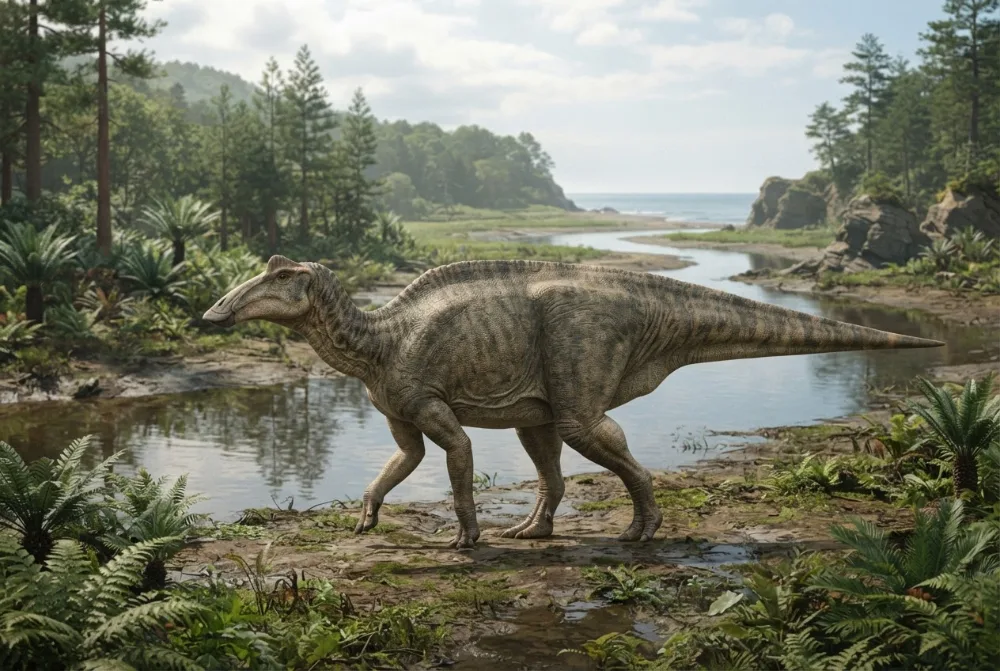
Kamuysaurus was a duck-billed dinosaur that lived in what is now Japan. It had a flat, toothless beak and hundreds of cheek teeth for chewing plants. This dinosaur is one of the most complete skeletons ever found in Japan.12
Wanneer het dit geleef?
Hoe groot was dit?
Hoe lank was dit?
Hoe hoog was dit?
skatting
Hoe swaar was dit?
 so lank soos 2 motors in 'n ry geparkeer🍌so lank soos 50 piesangs punt aan punt
 omtrent so swaar soos 'n olifant🍉so swaar soos 1000 waatlemoene🎒so swaar soos 6 hele skoolklasse vol kinders🐻❄️so swaar soos 11 ysbere🏃kon 100 meter in 16 sekondes hardloop (die vinnigste mens het 9,6 nodig)
Hoe groot was Kamuysaurus vergeleke met JOU?
Net wiskunde in jou blaaier. Niks word gestoor of êrens heen gestuur nie.
Hoe vinnig was dit?


Prettige feite
The skeleton is over 60% complete and includes the skull, making it one of the most complete dinosaur skeletons from Japan.1
It lived about 72 to 70 million years ago during the early Maastrichtian age.1
Kamuysaurus belongs to a group of duck-billed dinosaurs called Edmontosaurini, which also includes Edmontosaurus.2
The dinosaur was named after the Ainu word 'kamuy', meaning deity or god.1
It was an adult at least nine years old when it died.1
Mees gevraagde vrae oor Kamuysaurus
?How big was Kamuysaurus?
It was about 8 metres long and weighed 4 to 5.3 tonnes.1
?What did Kamuysaurus eat?
It was a plant-eater. It had a toothless beak and rows of cheek teeth for chewing tough plants.1
?When did Kamuysaurus live?
It lived about 72 to 70 million years ago, during the early Maastrichtian age of the Late Cretaceous.1
?Was Kamuysaurus a dinosaur?
Yes, it was a duck-billed dinosaur called a hadrosaur, but it was not a meat-eater.1
?Did Kamuysaurus have a crest?
It may have had a small, flat crest on its head, similar to the crest of Brachylophosaurus.24
?Where was Kamuysaurus found?
It was found in marine rocks in Hokkaido, Japan. Its body likely washed out to sea after it died.1
Vir dino-kenners
- Wetenskaplike naam
- Kamuysaurus
- Benoem deur
- Kobayashi et al. 20195
- Groep
- Eendbekke
- Familie / klade
- Hadrosauridae5
- Klassifikasie
- Ornithischia > Ornithopoda > Iguanodontia > Hadrosauridae5
- Ouderdom van die rotse
- 72 tot 66 miljoen jaar (Maastrichtian)5
- Rotsformasies
- Hakobuchi5
- Lande
- Japan5
- Fossielrekords
- 1 in The Paleobiology Database5
- Ontdekking
- Amateur paleontologist Yoshiyuki Horita found the tail in 2003. Teams from the Hobetsu Museum and Hokkaido University Museum dug up the rest of the skeleton in 2013 and 2014. It was named Kamuysaurus japonicus in 2019 by Yoshitsugu Kobayashi and colleagues.12
- Steeds omstrede
- Scientists are not sure if Kamuysaurus had a small crest on its head, because the bones at the front of the skull are missing.2
Waar die feite vandaan kom
- Kamuysaurus (en.wikipedia.org)
- A New Hadrosaurine (Dinosauria: Hadrosauridae) from the Marine Deposits of the Late Cretaceous Hakobuchi Formation, Yezo Group, Japan | Scientific Reports (nature.com)
- PBDB Taxon (paleobiodb.org)
- A new duck-billed dinosaur, Kamuysaurus japonicus, identified | Hokkaido University (global.hokudai.ac.jp)
- Kamuysaurus in The Paleobiology Database (CC BY 4.0): ouderdom, plekke, rotsformasies, klassifikasie.
Elke feit op hierdie bladsy het 'n nommer wat na sy bron wys. As ons iets verkeerd het, jammer, ons is dino-aanhangers, nie 'n wetenskapjoernaal nie. Laat weet ons by [email protected] en ons maak dit reg.
 Rex is honger! Dino Wiki is 'n pa se projek vir sy seun wat mal is oor dino's, gratis met geen advertensies en geen spoorsnyers nie. Grootmense kan vir Rex 'n peuselhappie gee om te help om dit aanlyn te hou.Voer Rex
 Parasaurolophus
 Edmontosaurus
 Saurolophus
 Hypacrosaurus
 Corythosaurus
 Kritosaurus
 Tyrannosaurus
 Triceratops
 Velociraptor
 Spinosaurus
 Ankylosaurus
 Pteranodon