 Watter dino is jy? Kwis
 Dinogeveg
 Dinoresies
 Dino-minispeletjies
 Plakkeralbum
 Dino TOP-lyste
 Verras my!
Kazaklambia
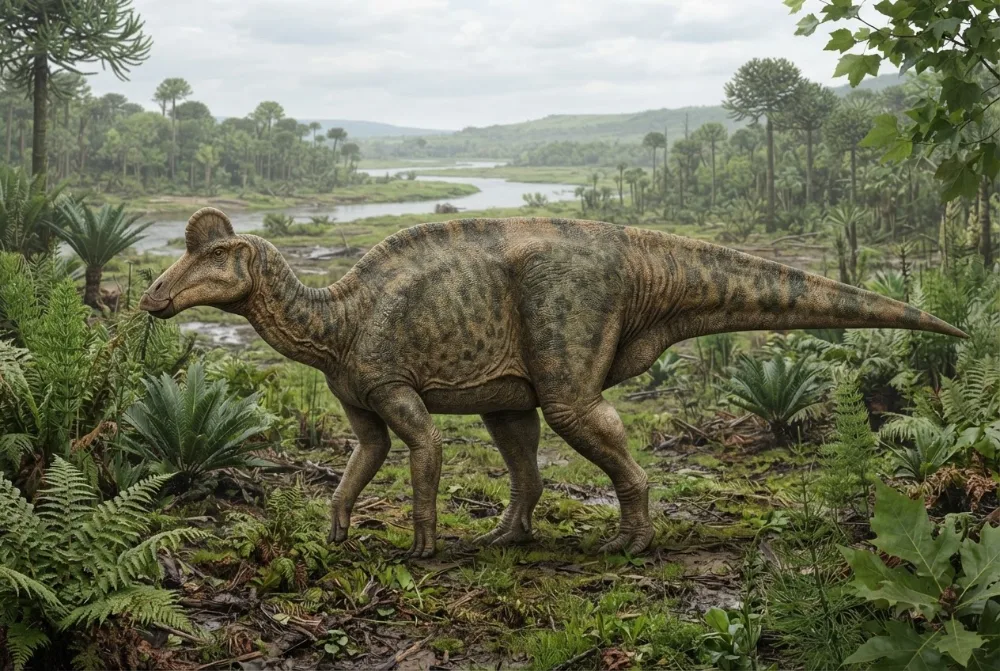
Kazaklambia was a duck-billed dinosaur that lived in what is now Kazakhstan. It was a plant-eater and one of the oldest members of its group, the lambeosaurines. Its nearly complete skeleton helped scientists learn a lot about it.1
Wanneer het dit geleef?
Hoe groot was dit?
Hoe lank was dit?
Hoe hoog was dit?
skatting
Hoe swaar was dit?
 so lank soos 5 honde van neus tot stert🍌so lank soos 26 piesangs punt aan punt🍉so swaar soos 100 waatlemoene🧸so swaar soos 26 kleuterskoolkinders🎒so swaar soos 16 skoolkinders🏃kon 100 meter in 9,2 sekondes hardloop (die vinnigste mens het 9,6 nodig)
Hoe groot was Kazaklambia vergeleke met JOU?
Net wiskunde in jou blaaier. Niks word gestoor of êrens heen gestuur nie.
Hoe vinnig was dit?


Prettige feite
Kazaklambia is known from a nearly complete skeleton, missing only the snout, hands, left foot, and tail tip. It is the most complete dinosaur ever found in Kazakhstan and the whole former Soviet Union.1
This dinosaur was first thought to be a species of Procheneosaurus, but scientists later realized it was a different animal and gave it a new name in 2013.1
Kazaklambia lived about 86 to 84 million years ago, during the Santonian stage of the Late Cretaceous.1
The skeleton of Kazaklambia is from a juvenile, so scientists are not sure how big adults would have been.1
Kazaklambia is one of the oldest known lambeosaurines, a group of duck-billed dinosaurs with hollow crests on their heads.1
Its discovery helped support the idea that lambeosaurine dinosaurs first evolved in Asia before spreading to North America.1
Mees gevraagde vrae oor Kazaklambia
?What did Kazaklambia eat?
Kazaklambia was a herbivore, meaning it ate plants. It was a duck-billed dinosaur, so it likely used its beak to crop vegetation.14
?How big was Kazaklambia?
Scientists are not sure how big Kazaklambia grew because the only known skeleton is from a juvenile. Its size as an adult is unknown.14
Vir dino-kenners
- Wetenskaplike naam
- Kazaklambia
- Benoem deur
- Bell and Brink 20135
- Groep
- Eendbekke
- Familie / klade
- Hadrosauridae5
- Klassifikasie
- Ornithischia > Ornithopoda > Iguanodontia > Hadrosauridae5
- Ouderdom van die rotse
- 90 tot 84 miljoen jaar (Coniacian / Santonian)5
- Rotsformasies
- Dabrazhin5
- Lande
- Kazakstan5
- Fossielrekords
- 1 in The Paleobiology Database5
- Ontdekking
- The skeleton was found in 1961 at the Syuk-Syuk locality in southern Kazakhstan. It was named Procheneosaurus convincens by Soviet paleontologist Anatoly Rozhdestvensky in 1968, and renamed Kazaklambia by Phil Bell and Kirstin Brink in 2013.1
- Steeds omstrede
- Scientists are not sure exactly how Kazaklambia is related to other lambeosaurines because the only known specimen is a juvenile.1
Waar die feite vandaan kom
- Kazaklambia (en.wikipedia.org)
- Kazaklambia convincens | Dinosaur Database by DinoAnimals.com (dinoanimals.com)
- Episode 377: Correcting misconceptions of paleontology with Roy Plotnick - I Know Dino: The Big Dinosaur Podcast (iknowdino.com)
- KAZAKLAMBIA : DinoChecker dinosaur archive (dinochecker.com)
- Kazaklambia in The Paleobiology Database (CC BY 4.0): ouderdom, plekke, rotsformasies, klassifikasie.
Elke feit op hierdie bladsy het 'n nommer wat na sy bron wys. As ons iets verkeerd het, jammer, ons is dino-aanhangers, nie 'n wetenskapjoernaal nie. Laat weet ons by [email protected] en ons maak dit reg.
 Rex is honger! Dino Wiki is 'n pa se projek vir sy seun wat mal is oor dino's, gratis met geen advertensies en geen spoorsnyers nie. Grootmense kan vir Rex 'n peuselhappie gee om te help om dit aanlyn te hou.Voer Rex
 Parasaurolophus
 Edmontosaurus
 Saurolophus
 Hypacrosaurus
 Corythosaurus
 Kritosaurus
 Tyrannosaurus
 Triceratops
 Velociraptor
 Spinosaurus
 Ankylosaurus
 Pteranodon