 Watter dino is jy? Kwis
 Dinogeveg
 Dinoresies
 Dino-minispeletjies
 Plakkeralbum
 Dino TOP-lyste
 Verras my!
Kentrosaurus
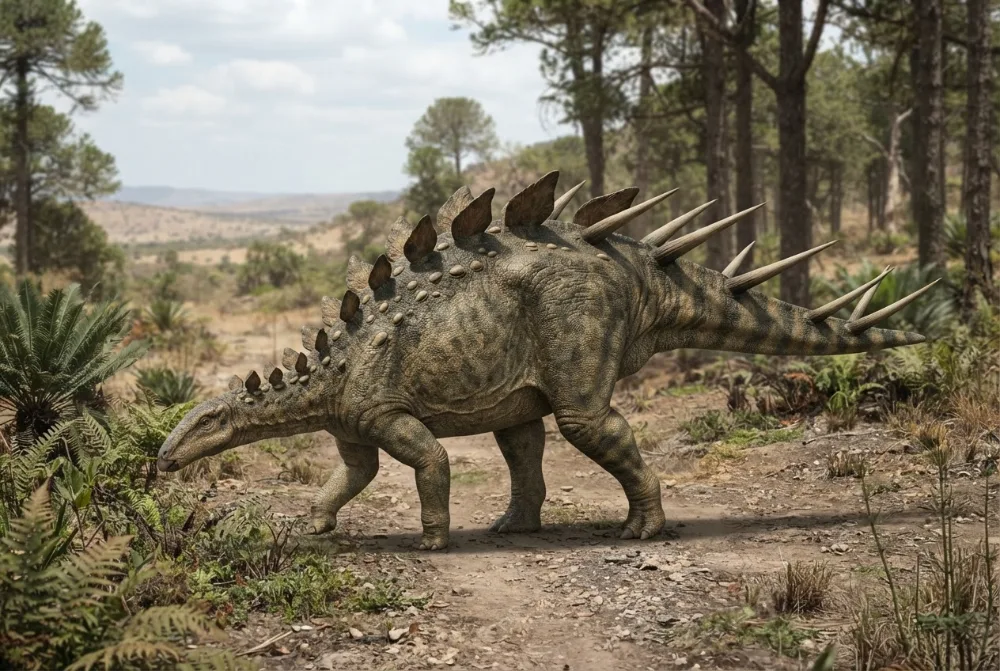
Kentrosaurus was a plated dinosaur that lived in what is now Tanzania, Africa, about 152 million years ago. It had a row of small plates on its neck and back that turned into long, sharp spikes on its tail. It used those tail spikes to fight off hungry meat-eaters!1
Wanneer het dit geleef?
Hoe groot was dit?
Hoe lank was dit?
Hoe hoog was dit?
Hoe swaar was dit?

 so lank soos 5 honde van neus tot stert🍌so lank soos 28 piesangs punt aan puntso swaar soos 80 honde🍉so swaar soos 320 waatlemoene🧸so swaar soos 84 kleuterskoolkinders🎒so swaar soos 50 skoolkinders🐻❄️so swaar soos 4 ysbere🏃kon 100 meter in 18 sekondes hardloop (die vinnigste mens het 9,6 nodig)
Hoe groot was Kentrosaurus vergeleke met JOU?
Net wiskunde in jou blaaier. Niks word gestoor of êrens heen gestuur nie.
Hoe vinnig was dit?


Prettige feite
Kentrosaurus had a long spike on each shoulder, in addition to the spikes on its tail.1
The name Kentrosaurus was almost changed because it sounded like Centrosaurus, a horned dinosaur. But the spelling is different, so Kentrosaurus stayed.1
Scientists think there were two types of Kentrosaurus, one with stouter thigh bones and one with slimmer ones. This might mean males and females looked different.1
Over 1200 bones of Kentrosaurus were found in Tanzania by German expeditions between 1909 and 1912.1
Kentrosaurus lived alongside giant long-necked sauropods like Giraffatitan and Tornieria.1
The plates on its neck and back were probably covered in horn, like a cow's horn.1
Mees gevraagde vrae oor Kentrosaurus
?How big was Kentrosaurus?
Kentrosaurus was about 4 to 5 metres (13 to 16 feet) long and weighed roughly 700 to 1,600 kilograms (1,500 to 3,500 pounds). Some specimens suggest even larger individuals existed.13
?What did Kentrosaurus eat?
Kentrosaurus was a herbivore, meaning it ate plants. It used its toothless beak to bite off leaves and other plant material, which it swallowed in large chunks without much chewing.14
?Did Kentrosaurus have spikes?
Yes, Kentrosaurus had a double row of spikes along its back, from its mid-section to the tip of its tail, plus a long spike on each shoulder. These spikes were likely used for defense.14
?Could Kentrosaurus swim?
There is no direct evidence that Kentrosaurus could swim. It was a land-dwelling dinosaur that walked on four legs, and its body was not specially adapted for swimming.1
?Was Kentrosaurus bigger than a T. rex?
No, Kentrosaurus was much smaller than Tyrannosaurus rex. Kentrosaurus was about 4 to 5 metres long, while T. rex could be over 12 metres long; they lived in different times and places.1
?Did Kentrosaurus have feathers?
No, Kentrosaurus did not have feathers. It had bony plates and spikes covered in horn, and its skin was likely scaly, like other stegosaurs.1
?When did Kentrosaurus live?
Kentrosaurus lived during the Late Jurassic period, about 152 million years ago, in what is now Tanzania, Africa.1
?Why did Kentrosaurus have plates?
The plates on Kentrosaurus's neck and back might have been for temperature regulation, since they contained blood vessels, or for protection and display. No one knows for sure.4
Mite-breker
Mite: Some people think Kentrosaurus had all its spikes and plates in a single row down its back.
Waarheid: Scientists think Kentrosaurus had two rows of plates and spikes, one on each side of its back.1
Vir dino-kenners
- Wetenskaplike naam
- Kentrosaurus
- Benoem deur
- Hennig 19155
- Groep
- Dino's met plate
- Familie / klade
- Stegosauridae5
- Klassifikasie
- Ornithischia > Stegosauria > Thyreophora5
- Ouderdom van die rotse
- 162 tot 143 miljoen jaar (Oxfordian / Tithonian)5
- Rotsformasies
- Tendaguru5
- Lande
- Tanzanië5
- Fossielrekords
- 27 in The Paleobiology Database5
- Ook bekend as
- Doryphorosaurus, Kentrurosaurus (ouer name tel nou as dieselfde dier)5
- Ontdekking
- German paleontologist Edwin Hennig named Kentrosaurus in 1915. The first fossils were found by the German Tendaguru Expedition in 1909.15
- Steeds omstrede
- Scientists are not sure exactly where each plate and spike was placed on the body, because most were found scattered.1
Waar die feite vandaan kom
- Kentrosaurus (en.wikipedia.org)
- Kentrosaurus | Natural History Museum (nhm.ac.uk)
- Kentrosaurus | dinosaur genus | Britannica (britannica.com)
- Kentrosaurus - Dinosaur - Enchanted Learning Software (enchantedlearning.com)
- Kentrosaurus in The Paleobiology Database (CC BY 4.0): ouderdom, plekke, rotsformasies, klassifikasie.
Elke feit op hierdie bladsy het 'n nommer wat na sy bron wys. As ons iets verkeerd het, jammer, ons is dino-aanhangers, nie 'n wetenskapjoernaal nie. Laat weet ons by [email protected] en ons maak dit reg.
 Rex is honger! Dino Wiki is 'n pa se projek vir sy seun wat mal is oor dino's, gratis met geen advertensies en geen spoorsnyers nie. Grootmense kan vir Rex 'n peuselhappie gee om te help om dit aanlyn te hou.Voer Rex
 Stegosaurus
 Diracodon
 Hypsirophus
 Dacentrurus
 Miragaia
 Hesperosaurus
 Brachiosaurus
 Diplodocus
 Allosaurus
 Brontosaurus
 Compsognathus
 Camarasaurus