 Watter dino is jy? Kwis
 Dinogeveg
 Dinoresies
 Dino-minispeletjies
 Plakkeralbum
 Dino TOP-lyste
 Verras my!
Lagenanectes
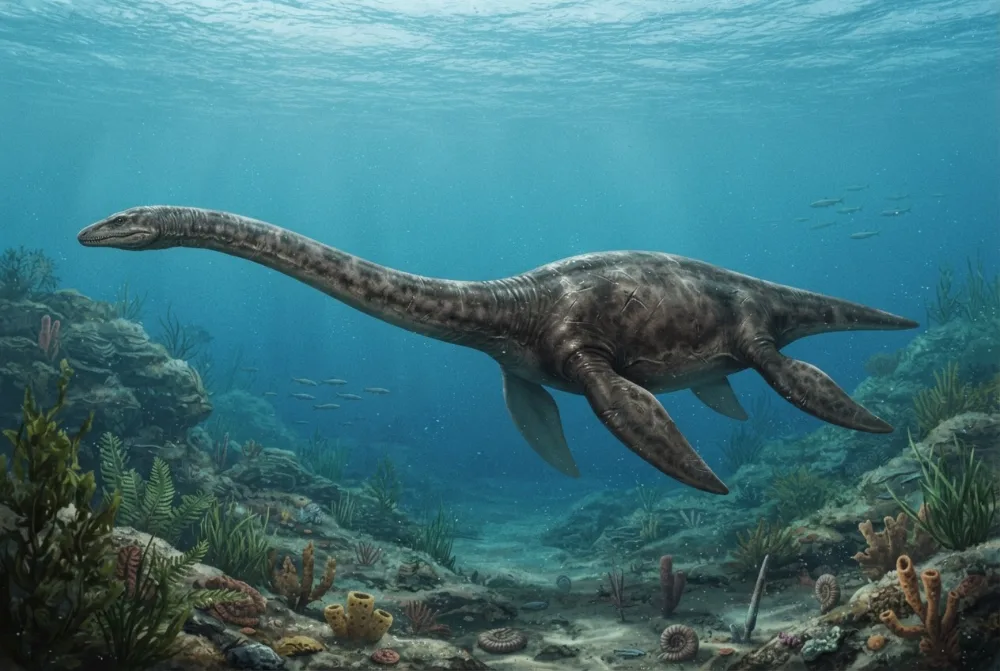
Lagenanectes was a long-necked marine reptile that swam in the seas of what is now Germany. It was not a dinosaur, but a plesiosaur, and it used its four flippers to paddle through the water. This ancient creature grew to about 8 meters long, as long as a school bus!21
Wanneer het dit geleef?
Hoe groot was dit?
Hoe lank was dit?
 so lank soos 8 honde van neus tot stert🍌so lank soos 44 piesangs punt aan punt🏊kon die lengte van 'n groot swembad (50 m) in 7,5 sekondes swem
Hoe groot was Lagenanectes vergeleke met JOU?
Net wiskunde in jou blaaier. Niks word gestoor of êrens heen gestuur nie.
Hoe vinnig was dit?


Prettige feite
Lagenanectes is one of the earliest known elasmosaurids, a group of plesiosaurs with very long necks. It lived about 130 million years ago during the Early Cretaceous.21
The front part of its lower jaw had a unique platform with dents, and the tooth sockets pointed sideways. This is different from most other plesiosaurs.1
Grooves on the top of its skull may have held electroreceptors, which helped Lagenanectes detect prey hidden in the dark water.1
The only known fossil of Lagenanectes shows signs of bone disease. The back of the skull and first neck vertebra had bony outgrowths, possibly from a bacterial infection.21
The fossil was discovered in 1964 by a private collector named Kurt Wiedenroth in a clay pit near Sarstedt, Germany. The pit no longer exists.21
Lagenanectes was named in 2017, more than 50 years after its discovery. Scientists finally studied the bones and realized it was a new genus.1
Vir dino-kenners
- Wetenskaplike naam
- Lagenanectes
- Benoem deur
- Sachs et al. 20174
- Groep
- Plesiosourusse
- Familie / klade
- Elasmosauridae4
- Klassifikasie
- Plesiosauria > Elasmosauridae > Sauropterygia4
- Ouderdom van die rotse
- 133 tot 126 miljoen jaar (Hauterivian)4
- Rotsformasies
- Stadthagen4
- Lande
- Duitsland4
- Fossielrekords
- 1 in The Paleobiology Database4
- Ontdekking
- Lagenanectes was discovered in 1964 by fossil collector Kurt Wiedenroth in a clay pit near Sarstedt, Germany. It was named and described as a new genus and species by Sven Sachs, Jahn J. Hornung and Benjamin P. Kear in 2017.21
- Steeds omstrede
- The exact age of the Lagenanectes fossil is uncertain. It could be from the lower Hauterivian to lower Barremian stages, but scientists think it is most likely upper Hauterivian.21
Waar die feite vandaan kom
- Lagenanectes (en.wikipedia.org)
- Lagenanectes richterae, an early elasmosaurid from Germany (sachspal.de)
- PBDB Taxon (paleobiodb.org)
- Lagenanectes in The Paleobiology Database (CC BY 4.0): ouderdom, plekke, rotsformasies, klassifikasie.
Elke feit op hierdie bladsy het 'n nommer wat na sy bron wys. As ons iets verkeerd het, jammer, ons is dino-aanhangers, nie 'n wetenskapjoernaal nie. Laat weet ons by [email protected] en ons maak dit reg.
 Rex is honger! Dino Wiki is 'n pa se projek vir sy seun wat mal is oor dino's, gratis met geen advertensies en geen spoorsnyers nie. Grootmense kan vir Rex 'n peuselhappie gee om te help om dit aanlyn te hou.Voer Rex
 Elasmosaurus
 Pliosaurus
 Plesiosaurus
 Cimoliasaurus
 Colymbosaurus
 Trinacromerum
 Stegosaurus
 Iguanodon
 Archaeopteryx
 Giganotosaurus
 Microraptor
 Deinonychus