 Watter dino is jy? Kwis
 Dinogeveg
 Dinoresies
 Dino-minispeletjies
 Plakkeralbum
 Dino TOP-lyste
 Verras my!
Latenivenatrix
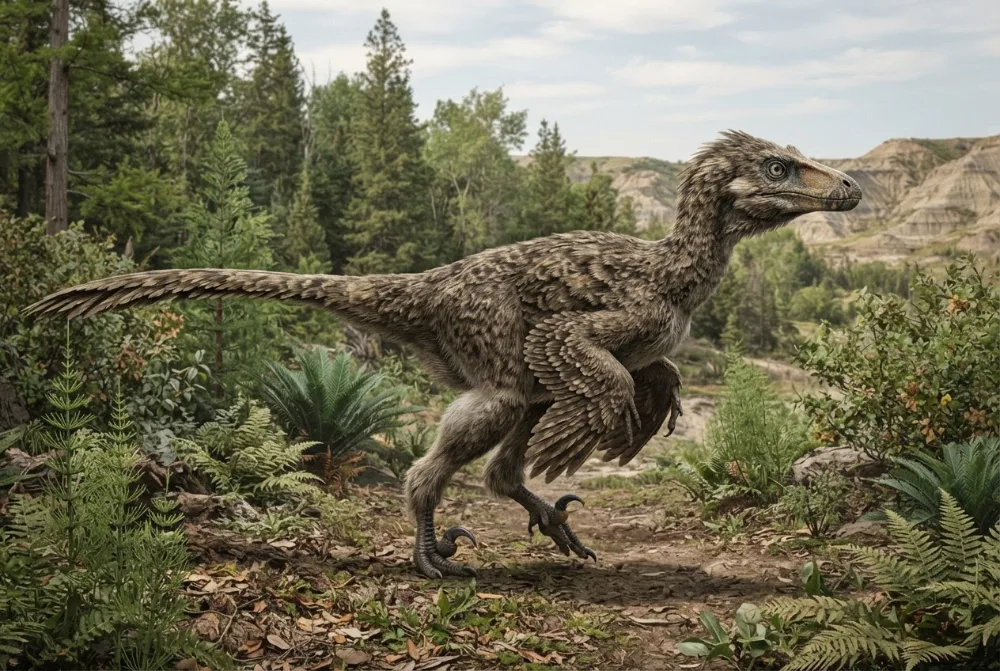
Latenivenatrix was a large, bird-like dinosaur that lived in what is now Canada. It was one of the biggest troodontids ever found, and it probably ate both plants and meat. Scientists are still debating whether it was really its own species or just a different name for another dinosaur called Stenonychosaurus.14
Wanneer het dit geleef?
Hoe groot was dit?
Hoe lank was dit?
Hoe hoog was dit?
 so lank soos 4 honde van neus tot stert🍌so lank soos 19 piesangs punt aan punt🏃kon 100 meter in 7,1 sekondes hardloop (die vinnigste mens het 9,6 nodig)
Hoe groot was Latenivenatrix vergeleke met JOU?
Net wiskunde in jou blaaier. Niks word gestoor of êrens heen gestuur nie.
Hoe vinnig was dit?


Prettige feite
Latenivenatrix is the largest known troodontid, reaching up to 3.5 meters (11.5 feet) in length.1
Its name means 'hiding huntress' in Latin, because it was a stealthy predator.1
The first fossil of Latenivenatrix was found in 1968 by Irene Vanderloh in Alberta, Canada.1
Some scientists think Latenivenatrix might actually be the same species as Stenonychosaurus, not a separate dinosaur.1
Latenivenatrix had a special pelvis with a pubis bone that was tilted backward at a 17-degree angle.1
Mees gevraagde vrae oor Latenivenatrix
?How big was Latenivenatrix?
It was about 3 to 3.5 metres (9.8 to 11.5 ft) long, making it the largest known troodontid. Its skull was about 45 centimetres (18 in) long.1
?What did Latenivenatrix eat?
It was probably a semi-omnivore, meaning it ate both plants and meat. It was a bird-like dinosaur that likely hunted small prey and also ate plants.1
?Is Latenivenatrix a dinosaur?
Yes, it is a dinosaur. It belongs to a group of bird-like dinosaurs called troodontids.1
?When did Latenivenatrix live?
It lived about 75.5 million years ago during the Cretaceous Period. Its fossils were found in Alberta, Canada.1
?What does the name Latenivenatrix mean?
It means 'hiding huntress' in Latin, because it was a stealthy predator.3
?Could Latenivenatrix fly?
No, it could not fly. As a troodontid, it probably lost the ability to fly and was a biped that walked on two legs.1
Mite-breker
Mite: Latenivenatrix is definitely a unique dinosaur species.
Waarheid: Some scientists argue that Latenivenatrix is actually a junior synonym of Stenonychosaurus, meaning it may not be a separate species.1
Vir dino-kenners
- Wetenskaplike naam
- Latenivenatrix
- Benoem deur
- van der Reest and Currie 20174
- Groep
- Raptors
- Familie / klade
- Troodontidae4
- Klassifikasie
- Theropoda > Troodontidae4
- Ouderdom van die rotse
- 84 tot 72 miljoen jaar (Campanian)4
- Rotsformasies
- Dinosaur Park4
- Lande
- Kanada4
- Fossielrekords
- 4 in The Paleobiology Database4
- Ontdekking
- Latenivenatrix was named in 2017 by paleontologists Aaron van der Reest and Philip Currie. The type specimen was originally collected in 1968 and had been assigned to other troodontids before being recognized as a new genus.14
- Steeds omstrede
- Scientists still debate whether Latenivenatrix is a valid genus or just a synonym of Stenonychosaurus.1
Waar die feite vandaan kom
- Latenivenatrix (en.wikipedia.org)
- Two New Cretaceous Dinosaur Species Discovered in Canada | Sci.News (sci.news)
- Paleo Profile: The Hiding Hunter | Scientific American (scientificamerican.com)
- Latenivenatrix in The Paleobiology Database (CC BY 4.0): ouderdom, plekke, rotsformasies, klassifikasie.
Elke feit op hierdie bladsy het 'n nommer wat na sy bron wys. As ons iets verkeerd het, jammer, ons is dino-aanhangers, nie 'n wetenskapjoernaal nie. Laat weet ons by [email protected] en ons maak dit reg.
 Rex is honger! Dino Wiki is 'n pa se projek vir sy seun wat mal is oor dino's, gratis met geen advertensies en geen spoorsnyers nie. Grootmense kan vir Rex 'n peuselhappie gee om te help om dit aanlyn te hou.Voer Rex
 Velociraptor
 Microraptor
 Deinonychus
 Asiamericana
 Richardoestesia
 Saurornitholestes
 Tyrannosaurus
 Triceratops
 Spinosaurus
 Ankylosaurus
 Parasaurolophus
 Pteranodon