 Watter dino is jy? Kwis
 Dinogeveg
 Dinoresies
 Dino-minispeletjies
 Plakkeralbum
 Dino TOP-lyste
 Verras my!
Lusonectes
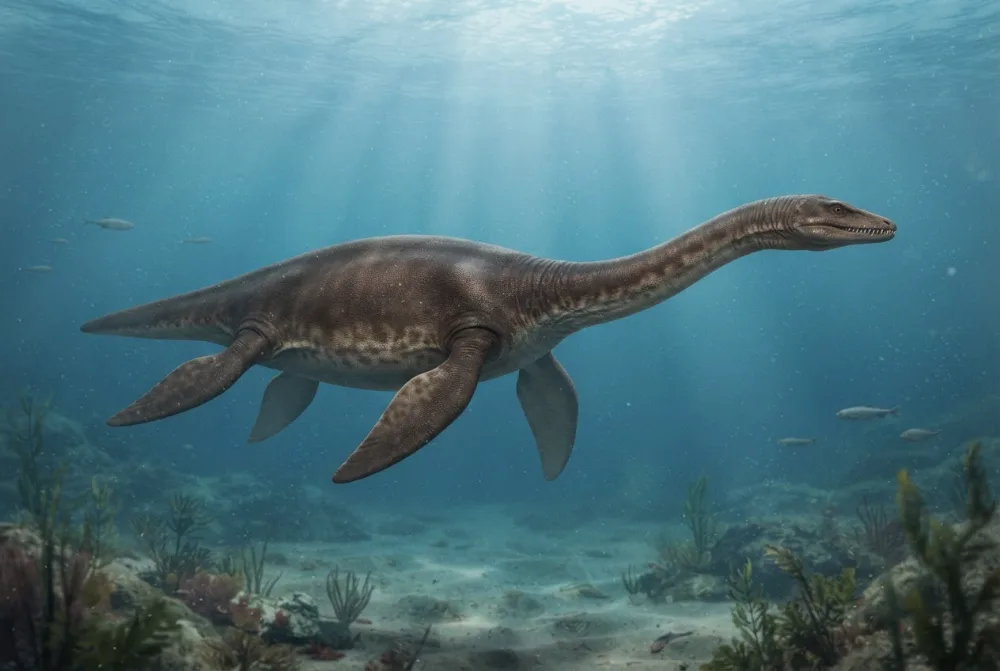
Lusonectes was a marine reptile that swam in the warm Jurassic seas near what is now Portugal. It had a long snout and sharp teeth to catch fish and other slippery prey.2
Wanneer het dit geleef?
Hoe vinnig was dit?


Prettige feite
Lusonectes is the only plesiosaur from Portugal that scientists can identify as a distinct species.1
Its name comes from Latin and Greek words meaning 'Portuguese swimmer'.1
The only fossil found is a partial skull, which is about 127 millimeters (5 inches) long.1
Lusonectes lived about 184 to 175 million years ago, during the Early Jurassic period.3
It was first described in 1897 by French paleontologist Henri Émile Sauvage, who thought it was a Plesiosaurus.2
Lusonectes is one of the few plesiosaurs from the Early Jurassic found outside the United Kingdom and Germany.2
Vir dino-kenners
- Wetenskaplike naam
- Lusonectes
- Benoem deur
- Smith et al. 20123
- Groep
- Plesiosourusse
- Familie / klade
- Plesiosauridae3
- Klassifikasie
- Plesiosauria > Sauropterygia3
- Ouderdom van die rotse
- 184 tot 175 miljoen jaar (Toarcian)3
- Rotsformasies
- São Gião3
- Lande
- Portugal3
- Fossielrekords
- 1 in The Paleobiology Database3
- Ontdekking
- The fossil was first described in 1897 by French paleontologist Henri Émile Sauvage, who called it Plesiosaurus sp. In 2012, scientists Smith, Araújo, and Mateus gave it the new name Lusonectes sauvagei.2
- Steeds omstrede
- Scientists are not sure whether Lusonectes was an early pliosaurid or a plesiosauroid, because the only fossil is a poorly preserved partial skull.2
Waar die feite vandaan kom
- A new plesiosauroid from the Toarcian (Lower Jurassic) (app.pan.pl)
- The osteology, taxonomy, and phylogenetic affinities of the Early Jurassic plesiosaur Lusonectes sauvagei - PMC (pmc.ncbi.nlm.nih.gov)
- Lusonectes in The Paleobiology Database (CC BY 4.0): ouderdom, plekke, rotsformasies, klassifikasie.
Elke feit op hierdie bladsy het 'n nommer wat na sy bron wys. As ons iets verkeerd het, jammer, ons is dino-aanhangers, nie 'n wetenskapjoernaal nie. Laat weet ons by [email protected] en ons maak dit reg.
 Rex is honger! Dino Wiki is 'n pa se projek vir sy seun wat mal is oor dino's, gratis met geen advertensies en geen spoorsnyers nie. Grootmense kan vir Rex 'n peuselhappie gee om te help om dit aanlyn te hou.Voer Rex
 Elasmosaurus
 Pliosaurus
 Plesiosaurus
 Cimoliasaurus
 Colymbosaurus
 Trinacromerum
 Dilophosaurus
 Stenopterygius
 Dorygnathus
 Lufengosaurus
 Scutellosaurus
 Yunnanosaurus