 Watter dino is jy? Kwis
 Dinogeveg
 Dinoresies
 Dino-minispeletjies
 Plakkeralbum
 Dino TOP-lyste
 Verras my!
Maaradactylus
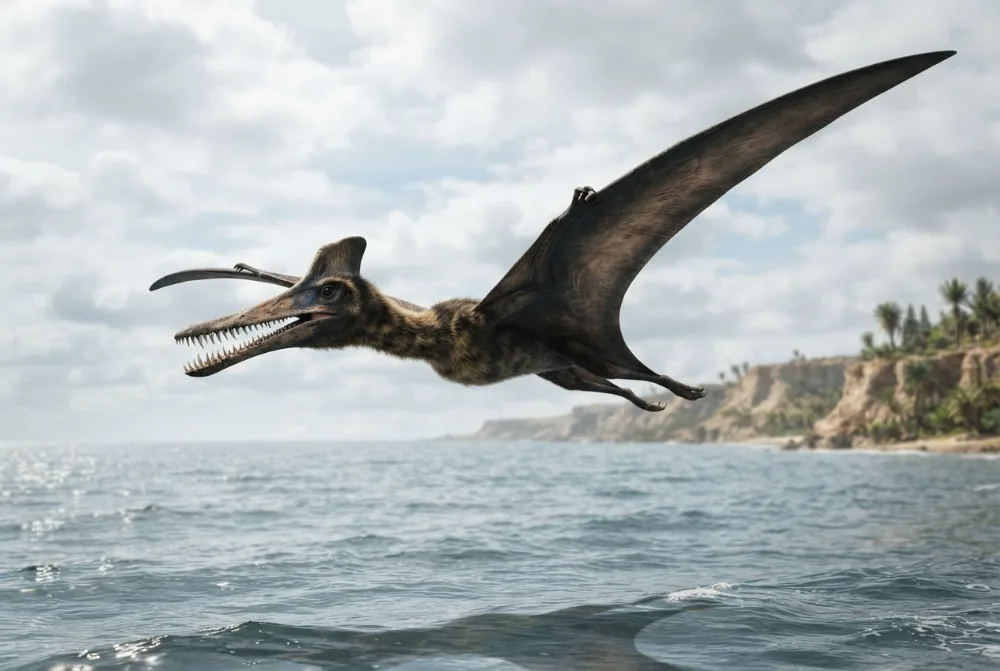
Maaradactylus was a flying reptile with a long, tooth-filled snout and a tall crest on its head. It glided over the ancient sea in what is now Brazil, scooping up fish with its many sharp teeth. Its wings were long and thin, perfect for soaring above the water.1
Wanneer het dit geleef?
Hoe groot was dit?
Hoe wyd was sy vlerke?
 vlerke so wyd soos 3 fietse in 'n ry⚽kon in 5,1 sekondes oor 'n hele sokkerveld vlieg
Hoe groot was Maaradactylus vergeleke met JOU?
Net wiskunde in jou blaaier. Niks word gestoor of êrens heen gestuur nie.
Hoe vinnig was dit?


Prettige feite
The skull of Maaradactylus is one of the largest of any anhanguerid pterosaur, measuring 75 centimetres (30 inches) long.1
It had at least 36 pairs of teeth in its upper jaw, more than any other anhanguerid pterosaur.1
The tip of its snout was expanded and rounded, a bit like a spoon, and the front teeth pointed forward while the rest pointed downward.1
Maaradactylus lived during the Early Cretaceous period, about 119 to 113 million years ago.4
The small teeth at the back of its mouth were arranged in triplets, a feature unique to this animal.1
Mees gevraagde vrae oor Maaradactylus
?Was Maaradactylus a dinosaur?
No, Maaradactylus was a pterosaur, a flying reptile that lived during the time of dinosaurs. It is not a dinosaur.1
?How big was Maaradactylus?
Its skull was 75 centimetres long, one of the largest of any anhanguerid pterosaur. The rest of its body is not known, but it was a large flying animal.1
?What did Maaradactylus eat?
It likely ate fish, scooping them up with its long, tooth-filled snout as it glided over the sea.1
?When did Maaradactylus live?
It lived during the Early Cretaceous period, about 119 to 113 million years ago, in what is now Brazil.1
Vir dino-kenners
- Wetenskaplike naam
- Maaradactylus
- Benoem deur
- Bantim et al. 20144
- Groep
- Vlieënde reptiele
- Familie / klade
- Anhangueridae4
- Klassifikasie
- Pterosauria > Pterodactyloidea4
- Ouderdom van die rotse
- 120 tot 113 miljoen jaar (Aptian)4
- Rotsformasies
- Romualdo4
- Lande
- Brasilië4
- Fossielrekords
- 3 in The Paleobiology Database4
- Ontdekking
- The first fossil, a skull with the first two neck bones, was found in 2010 in the Romualdo Formation of Brazil. It was named Maaradactylus kellneri in 2014 by Renan Bantim and colleagues, honoring pterosaur expert Alexander Kellner.12
- Steeds omstrede
- Scientists are not sure if the species once called Coloborhynchus spielbergi really belongs to Maaradactylus or to another genus like Anhanguera.1
Waar die feite vandaan kom
- Maaradactylus (en.wikipedia.org)
- A new toothed pterosaur (Pterodactyloidea: Anhangueridae) from the Early Cretaceous Romualdo Formation, NE Brazil (mapress.com)
- Maaradactylus kellneri - Atlas Virtual da Pré-História (atlasvirtual.com.br)
- Maaradactylus in The Paleobiology Database (CC BY 4.0): ouderdom, plekke, rotsformasies, klassifikasie.
Elke feit op hierdie bladsy het 'n nommer wat na sy bron wys. As ons iets verkeerd het, jammer, ons is dino-aanhangers, nie 'n wetenskapjoernaal nie. Laat weet ons by [email protected] en ons maak dit reg.
 Rex is honger! Dino Wiki is 'n pa se projek vir sy seun wat mal is oor dino's, gratis met geen advertensies en geen spoorsnyers nie. Grootmense kan vir Rex 'n peuselhappie gee om te help om dit aanlyn te hou.Voer Rex
 Pteranodon
 Quetzalcoatlus
 Dorygnathus
 Rhamphorhynchus
 Anhanguera
 Pterodactylus
 Stegosaurus
 Iguanodon
 Archaeopteryx
 Giganotosaurus
 Microraptor
 Deinonychus