 Watter dino is jy? Kwis
 Dinogeveg
 Dinoresies
 Dino-minispeletjies
 Plakkeralbum
 Dino TOP-lyste
 Verras my!
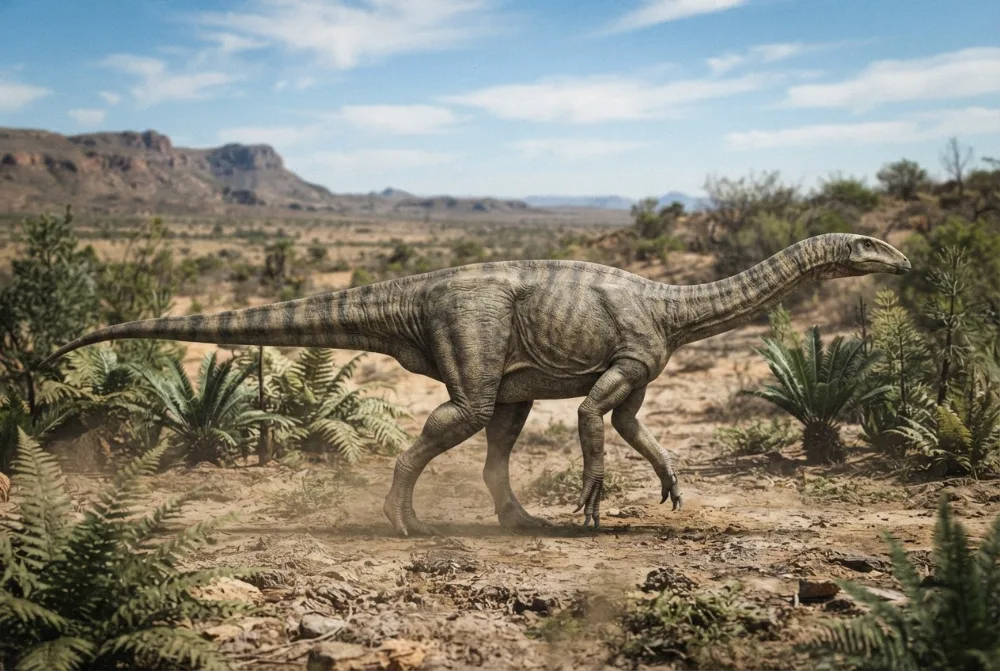
Massospondylus
Massospondylus was an early long-necked dinosaur that lived in southern Africa during the Early Jurassic. It had a small head, a long neck and tail, and a slender body. This dinosaur walked on two legs and used its sharp thumb claws to pull down branches or dig up plants.1
Wanneer het dit geleef?
Hoe groot was dit?
Hoe lank was dit?
Hoe hoog was dit?
Hoe swaar was dit?
 so lank soos 6 honde van neus tot stert🍌so lank soos 33 piesangs punt aan punt🍉so swaar soos 27 waatlemoene🧸so swaar soos 7 kleuterskoolkinders🎒so swaar soos 4 skoolkinders🏃kon 100 meter in 8,8 sekondes hardloop (die vinnigste mens het 9,6 nodig)
Hoe groot was Massospondylus vergeleke met JOU?
Net wiskunde in jou blaaier. Niks word gestoor of êrens heen gestuur nie.
Hoe vinnig was dit?


Prettige feite
Massospondylus was one of the first dinosaurs to be named, described by Richard Owen in 1854.1
Its name means 'longer vertebra' because Owen thought the neck bones were tail bones.1
Fossil eggs and embryos of Massospondylus have been found, and they are among the oldest known dinosaur eggs.1
The eggshell of Massospondylus was extremely thin, less than 0.1 mm (0.0039 in) thick.1
Baby Massospondylus had proportionally longer arms and a larger head than adults, suggesting they may have walked on four legs when young.1
Massospondylus could speed up or slow down its growth depending on how much food was available.1
The oldest known Massospondylus was about 20 years old when it died.1
Mees gevraagde vrae oor Massospondylus
?How big was Massospondylus?
Massospondylus was about 4 to 6 metres (13 to 20 feet) long, with a small head, long neck and tail, and a slender body. It weighed around 150 kilograms (330 pounds) according to the Natural History Museum.13
?What did Massospondylus eat?
It was probably a herbivore (plant-eater), though some scientists think it may have been omnivorous. It used its sharp thumb claws to pull down branches or dig up plants, and it may have swallowed stones to help grind tough leaves in its stomach.12
?Did Massospondylus walk on two legs or four?
It is now considered to have been bipedal (walked on two legs), though it was long thought to be quadrupedal. Some studies suggest babies may have walked on four legs, but newer research says it was bipedal at all ages.1
?When did Massospondylus live?
It lived during the Early Jurassic, about 201 to 184 million years ago.13
?Where was Massospondylus found?
Fossils have been found in southern Africa, including South Africa, Lesotho, and Zimbabwe, and also in Namibia. Some fossils from the US and Argentina were once assigned to it but are now considered different dinosaurs.12
?Did Massospondylus lay eggs?
Yes, it laid eggs, and some of the oldest known dinosaur eggs and embryos belong to this genus. The eggshells were extremely thin, less than 0.1 mm (0.004 in) thick.1
Mite-breker
Mite: Massospondylus was a four-legged (quadrupedal) dinosaur.
Waarheid: Scientists now think Massospondylus walked on two legs (bipedal), though babies may have been four-legged.1
Vir dino-kenners
- Wetenskaplike naam
- Massospondylus
- Benoem deur
- Owen 18544
- Groep
- Langnekke
- Familie / klade
- Massospondylidae4
- Klassifikasie
- Sauropodomorpha4
- Ouderdom van die rotse
- 237 tot 175 miljoen jaar (Carnian / Toarcian)4
- Rotsformasies
- Elliot, Mpandi, Forest Sandstone4
- Lande
- Suid-Afrika, Zimbabwe, Lesotho, Namibië4
- Fossielrekords
- 80 in The Paleobiology Database4
- Ontdekking
- The first fossils of Massospondylus were found in 1853 or 1854 by Joseph Millard Orpen and his brothers on a farm in the Drakensberg mountains near Harrismith, South Africa. Their father donated the fossils to the Hunterian Museum in London, where Richard Owen described and named the dinosaur in 1854.1
- Steeds omstrede
- Scientists are still debating whether Massospondylus was purely a plant-eater or also ate small animals or carrion.1
Waar die feite vandaan kom
- Massospondylus (en.wikipedia.org)
- enchantedlearning.com (enchantedlearning.com)
- Massospondylus | Natural History Museum (nhm.ac.uk)
- Massospondylus in The Paleobiology Database (CC BY 4.0): ouderdom, plekke, rotsformasies, klassifikasie.
Elke feit op hierdie bladsy het 'n nommer wat na sy bron wys. As ons iets verkeerd het, jammer, ons is dino-aanhangers, nie 'n wetenskapjoernaal nie. Laat weet ons by [email protected] en ons maak dit reg.
 Rex is honger! Dino Wiki is 'n pa se projek vir sy seun wat mal is oor dino's, gratis met geen advertensies en geen spoorsnyers nie. Grootmense kan vir Rex 'n peuselhappie gee om te help om dit aanlyn te hou.Voer Rex
 Brachiosaurus
 Diplodocus
 Brontosaurus
 Argentinosaurus
 Camarasaurus
 Morosaurus
 Nothosaurus
 Coelophysis
 Podokesaurus
 Simosaurus
 Eudimorphodon
 Herrerasaurus