 Watter dino is jy? Kwis
 Dinogeveg
 Dinoresies
 Dino-minispeletjies
 Plakkeralbum
 Dino TOP-lyste
 Verras my!
Wanneer het dit geleef?

Hoe groot was dit?
Hoe lank was dit?
Hoe hoog was dit?
Hoe swaar was dit?

 so lank soos 8 honde van neus tot stert🍌so lank soos 44 piesangs punt aan puntso swaar soos 170 honde🍉so swaar soos 680 waatlemoene🎒so swaar soos 4 hele skoolklasse vol kinders🐻❄️so swaar soos 8 ysbere🏃kon 100 meter in 15 sekondes hardloop (die vinnigste mens het 9,6 nodig)
Hoe groot was Olorotitan vergeleke met JOU?
Net wiskunde in jou blaaier. Niks word gestoor of êrens heen gestuur nie.
Hoe vinnig was dit?


Prettige feite
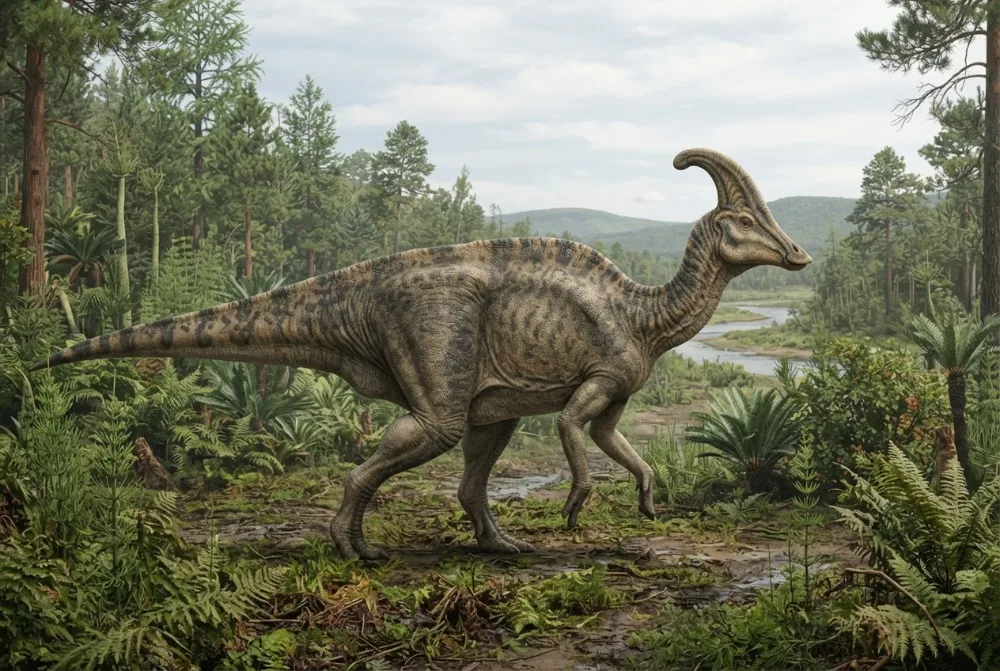
Olorotitan had a very long neck for a duck-billed dinosaur, with 18 neck bones. That is why its name means 'titanic swan'.12
Its hollow head crest was tall and helmet-shaped, made from expanded skull bones that held the nasal passages.12
The skeleton of Olorotitan is the most complete lambeosaurine (a type of duck-billed dinosaur) ever found outside North America.12
Olorotitan lived about 72 to 66 million years ago, during the Maastrichtian age of the Late Cretaceous.3
It was one of the last non-bird dinosaurs to go extinct, dying out in the great extinction event 66 million years ago.1
The tail of Olorotitan had extra connections between the bones in its upper part, which may have made that section stiff.2
Olorotitan is closely related to the North American dinosaurs Corythosaurus and Hypacrosaurus.2
Mees gevraagde vrae oor Olorotitan
?How big was Olorotitan?
Olorotitan grew up to 8 metres (26 feet) long, up to 3.5 metres (11 feet) tall, and weighed between 2.6 and 3.4 metric tons.1
?What did Olorotitan eat?
Olorotitan was a plant-eater. It used its strong beak and hundreds of constantly replaced teeth to grind tough plants.1
?When did Olorotitan live?
Olorotitan lived about 72 to 66 million years ago, during the Maastrichtian age of the Late Cretaceous. It was one of the last non-bird dinosaurs to go extinct.1
?Where was Olorotitan found?
Olorotitan fossils were found in the Amur region of eastern Russia, near the Amur River. The first nearly complete skeleton was discovered between 1999 and 2001.1
?Why did Olorotitan have a crest?
The tall, hollow crest on its head was made from skull bones that held the nasal passages. It probably helped Olorotitan identify others of its kind by sight and sound.1
?Is Olorotitan a dinosaur?
Yes, Olorotitan is a dinosaur. It is a type of duck-billed dinosaur called a lambeosaurine hadrosaurid.1
Vir dino-kenners
- Wetenskaplike naam
- Olorotitan
- Benoem deur
- Godefroit et al. 20033
- Groep
- Eendbekke
- Familie / klade
- Hadrosauridae3
- Klassifikasie
- Ornithischia > Ornithopoda > Iguanodontia > Hadrosauridae3
- Ouderdom van die rotse
- 72 tot 66 miljoen jaar (Maastrichtian)3
- Rotsformasies
- Udurchukan3
- Lande
- Rusland3
- Fossielrekords
- 1 in The Paleobiology Database3
- Ontdekking
- Olorotitan was named by Pascal Godefroit and colleagues in 2003. The nearly complete skeleton was dug up between 1999 and 2001 in the Udurchukan Formation at Kundur, Russia.12
- Steeds omstrede
- Scientists are not sure if the extra connections between the tail bones were a normal feature or a sign of disease.2
Waar die feite vandaan kom
- Olorotitan (en.wikipedia.org)
- doi:10.1016/S1631-0683(03)00017-4 (sciencepress.mnhn.fr)
- Olorotitan in The Paleobiology Database (CC BY 4.0): ouderdom, plekke, rotsformasies, klassifikasie.
Elke feit op hierdie bladsy het 'n nommer wat na sy bron wys. As ons iets verkeerd het, jammer, ons is dino-aanhangers, nie 'n wetenskapjoernaal nie. Laat weet ons by [email protected] en ons maak dit reg.
 Rex is honger! Dino Wiki is 'n pa se projek vir sy seun wat mal is oor dino's, gratis met geen advertensies en geen spoorsnyers nie. Grootmense kan vir Rex 'n peuselhappie gee om te help om dit aanlyn te hou.Voer Rex
 Parasaurolophus
 Edmontosaurus
 Saurolophus
 Hypacrosaurus
 Corythosaurus
 Kritosaurus
 Tyrannosaurus
 Triceratops
 Velociraptor
 Spinosaurus
 Ankylosaurus
 Pteranodon