 Watter dino is jy? Kwis
 Dinogeveg
 Dinoresies
 Dino-minispeletjies
 Plakkeralbum
 Dino TOP-lyste
 Verras my!
Opisthocoelicaudia
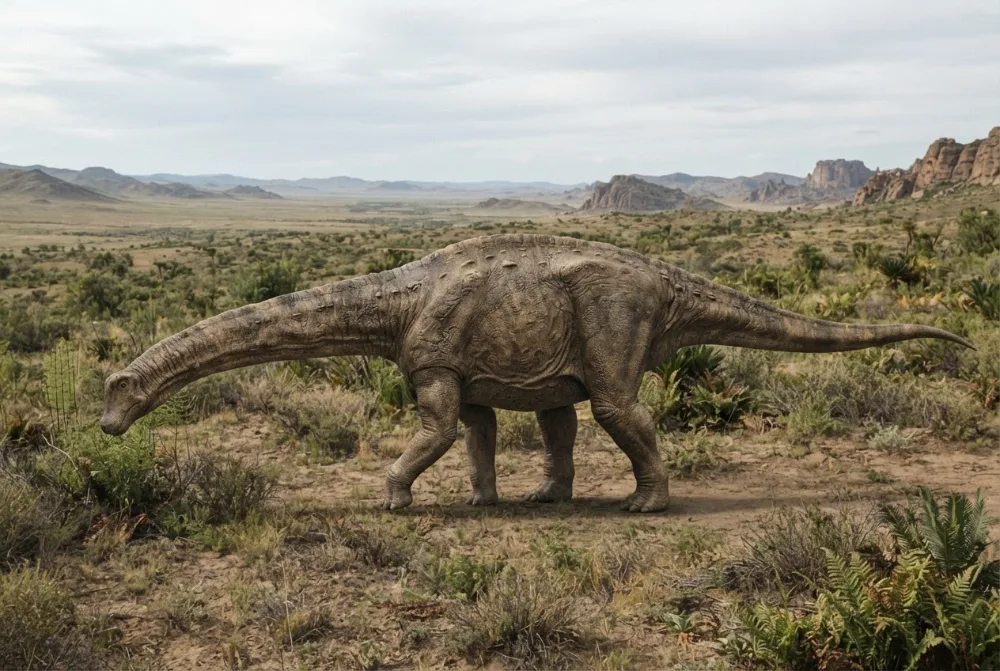
Opisthocoelicaudia was a big, long-necked plant eater that lived in the Late Cretaceous. It had a barrel-shaped body and four thick legs, like an elephant. Scientists found a nearly complete skeleton without the head and neck, so they know a lot about its body.1
Wanneer het dit geleef?
Hoe groot was dit?
Hoe lank was dit?
Hoe hoog was dit?
Hoe swaar was dit?

 so lank soos 3 motors in 'n ry geparkeer🍌so lank soos 72 piesangs punt aan puntso swaar soos 17 motors🍉so swaar soos 5100 waatlemoene🎒so swaar soos 32 hele skoolklasse vol kinders🐻❄️so swaar soos 56 ysbere🏃kon 100 meter in 28 sekondes hardloop (die vinnigste mens het 9,6 nodig)
Hoe groot was Opisthocoelicaudia vergeleke met JOU?
Net wiskunde in jou blaaier. Niks word gestoor of êrens heen gestuur nie.
Hoe vinnig was dit?


Prettige feite
Its tail vertebrae were shaped like ball-and-socket joints, which is unusual and gives it the name 'posterior cavity tail'.1
The skeleton had tooth marks from big meat-eating dinosaurs, which probably ate the carcass and carried away the head and neck.1
It could probably rear up on its hind legs to reach higher food, because its tail was strong and could act like a tripod.12
Its back vertebrae had split spines, creating a double row of bumps along its spine, a feature also seen in Diplodocus.1
It had six hip vertebrae, one more than most sauropods, which made its hips extra strong.1
The neck was about 5 meters (16 feet) long, which is medium for a sauropod.1
Mees gevraagde vrae oor Opisthocoelicaudia
?How big was Opisthocoelicaudia?
It was a relatively small sauropod, measuring about 11.4 to 13 metres (37 to 43 feet) long. Its body mass has been estimated at between 8.4 and 25.4 tonnes in different studies.1
?What did Opisthocoelicaudia eat?
Like other sauropods, it was a herbivore that ate plants. It probably fed on a variety of vegetation in its floodplain and riverine environment.3
?When did Opisthocoelicaudia live?
It lived during the Late Cretaceous Period, specifically in the ?Upper Campanian or Lower Maastrichtian, about 72 to 66 million years ago.12
?Where was Opisthocoelicaudia found?
Its fossils were discovered in the Gobi Desert of Mongolia, in the Nemegt Formation. The type specimen was found at Altan Uul in Ömnögovi Province.1
?Could Opisthocoelicaudia rear up on its hind legs?
Yes, scientists think it could rear up on its hind legs to reach higher food. Its strong tail could act like a tripod to support its weight.1
?Is Opisthocoelicaudia a dinosaur?
Yes, it is a sauropod dinosaur. It belongs to the group Titanosauria and lived during the Late Cretaceous.1
Mite-breker
Mite: Some people think Opisthocoelicaudia was a kind of camarasaur, but scientists now know it was a titanosaur.
Waarheid: It was first classified as a camarasaurid, but later studies placed it in Titanosauria, a group of sauropods.1
Vir dino-kenners
- Wetenskaplike naam
- Opisthocoelicaudia
- Benoem deur
- Borsuk-Bialynicka 19774
- Groep
- Langnekke
- Familie / klade
- Saltasauridae4
- Klassifikasie
- Sauropodomorpha > Sauropoda > Titanosauria > Macronaria4
- Ouderdom van die rotse
- 72 tot 66 miljoen jaar (Maastrichtian)4
- Rotsformasies
- Nemegt4
- Lande
- Mongolië4
- Fossielrekords
- 1 in The Paleobiology Database4
- Ontdekking
- It was discovered in 1965 by a Polish-Mongolian expedition in the Gobi Desert. Polish paleontologist Maria Magdalena Borsuk-Białynicka named it in 1977.12
- Steeds omstrede
- Scientists debate whether Opisthocoelicaudia and Nemegtosaurus are actually the same species, because only the skull of Nemegtosaurus is known and Opisthocoelicaudia lacks a skull.1
Waar die feite vandaan kom
- Opisthocoelicaudia (en.wikipedia.org)
- A NEW CAMARASAURID SAUROPOD OPISTHOCOELICAUDIA SKARZYNSKII GEN. N., SP. N. FROM THE UPPER CRETACEOUS OF MONGOLIA (palaeontologia.pan.pl)
- Opisthocoelicaudia: a Late Cretaceous Mongolian titanosaur (en.alegsaonline.com)
- Opisthocoelicaudia in The Paleobiology Database (CC BY 4.0): ouderdom, plekke, rotsformasies, klassifikasie.
Elke feit op hierdie bladsy het 'n nommer wat na sy bron wys. As ons iets verkeerd het, jammer, ons is dino-aanhangers, nie 'n wetenskapjoernaal nie. Laat weet ons by [email protected] en ons maak dit reg.
 Rex is honger! Dino Wiki is 'n pa se projek vir sy seun wat mal is oor dino's, gratis met geen advertensies en geen spoorsnyers nie. Grootmense kan vir Rex 'n peuselhappie gee om te help om dit aanlyn te hou.Voer Rex
 Brachiosaurus
 Diplodocus
 Brontosaurus
 Argentinosaurus
 Camarasaurus
 Morosaurus
 Tyrannosaurus
 Triceratops
 Velociraptor
 Spinosaurus
 Ankylosaurus
 Parasaurolophus