 Watter dino is jy? Kwis
 Dinogeveg
 Dinoresies
 Dino-minispeletjies
 Plakkeralbum
 Dino TOP-lyste
 Verras my!
Ornithocheirus
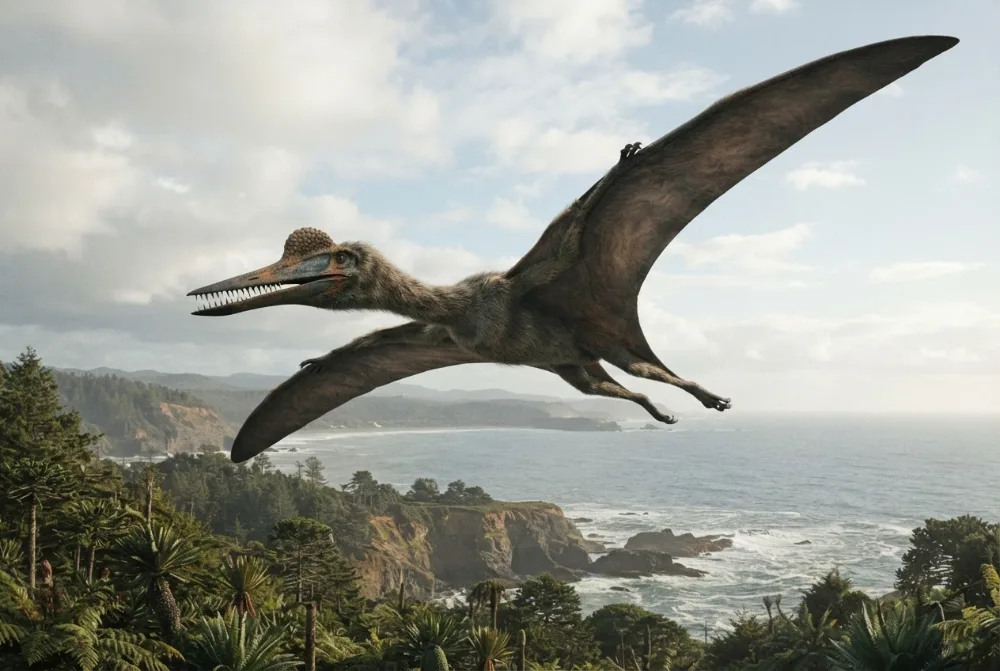
Ornithocheirus was a flying reptile that lived during the Early Cretaceous, about 110 million years ago. It had a long, narrow beak with a bumpy crest on top and sharp teeth for catching fish. Even though it was not a dinosaur, it was one of the biggest flying animals of its time.1
Wanneer het dit geleef?
Hoe groot was dit?
Hoe lank was dit?
Hoe swaar was dit?
 so lank soos 2,5 honde van neus tot stert🍌so lank soos 14 piesangs punt aan punt
 so swaar soos 11 huiskatte🍉so swaar soos 9 waatlemoene🧸so swaar soos 2,5 kleuterskoolkinders🎒so swaar soos 1,5 skoolkinders⚽kon in 5,1 sekondes oor 'n hele sokkerveld vlieg
Hoe groot was Ornithocheirus vergeleke met JOU?
Net wiskunde in jou blaaier. Niks word gestoor of êrens heen gestuur nie.
Hoe vinnig was dit?


Prettige feite
Ornithocheirus means 'bird hand' because scientists first thought its wing bones looked like a bird's hand.1
Only one species is considered valid today: Ornithocheirus simus. Many other fossils once called Ornithocheirus are now placed in different genera.1
Its fossils were found in the Cambridge Greensand of England, a layer of rock that was once a sandy seabed about 110 million years old.1
Ornithocheirus had a keel-shaped crest on its snout, which may have been used for display or to help it steer in flight.1
Its teeth were mostly straight up and down, not angled outward like those of some of its relatives.1
Early paleontologists like Richard Owen argued about its name. Owen preferred Criorhynchus ('ram beak') because he did not like the idea of evolution.1
Some fossils once thought to be birds, like Cimoliornis and Palaeornis, turned out to be Ornithocheirus or its relatives.1
Mees gevraagde vrae oor Ornithocheirus
?How big was Ornithocheirus?
It was a medium-sized pterosaur with a wingspan of about 5 metres (16 feet) and a body mass of about 20 kilograms (44 pounds).1
?Was Ornithocheirus a dinosaur?
No, Ornithocheirus was a pterosaur, a flying reptile, not a dinosaur.1
?What did Ornithocheirus eat?
It ate fish, which it caught with its sharp teeth while flying over the sea.1
?When did Ornithocheirus live?
It lived during the Early Cretaceous period, about 110 million years ago.1
?Where was Ornithocheirus found?
Its fossils were found in the Cambridge Greensand of England, and possibly also in Morocco.1
?Why did Ornithocheirus have a crest?
Scientists think the keel-shaped crest on its snout may have been used for display or to help it steer in flight.1
?How fast could Ornithocheirus fly?
Nobody knows for sure, but as a large pterosaur it was probably a strong flier that could cover long distances.1
?Is Ornithocheirus the biggest pterosaur?
No, it was not the biggest. A related pterosaur called Tropeognathus had a wingspan of about 8.2 metres (27 feet), making it the largest toothed pterosaur known.1
Mite-breker
Mite: Many people think Ornithocheirus had a wingspan of 12 metres (40 feet), making it the largest flying reptile ever.
Waarheid: That number is exaggerated. Scientists now estimate its wingspan was about 4.5 to 6.1 metres (15 to 20 feet), making it a medium-sized pterosaur.1
Vir dino-kenners
- Wetenskaplike naam
- Ornithocheirus
- Benoem deur
- Seeley 18695
- Groep
- Vlieënde reptiele
- Familie / klade
- Ornithocheiroidea5
- Klassifikasie
- Pterosauria > Pterodactyloidea5
- Ouderdom van die rotse
- 133 tot 90 miljoen jaar (Hauterivian / Turonian)5
- Rotsformasies
- West Melbury Marly Chalk, Calcaires à Spatangues, Zig Zag Chalk5
- Lande
- Verenigde Koninkryk, Frankryk, Portugal, DR Kongo, Rusland, Duitsland5
- Fossielrekords
- 12 in The Paleobiology Database5
- Ook bekend as
- Cimoliornis, Criorhynchus, Palaeornis (ouer name tel nou as dieselfde dier)5
- Ontdekking
- The first fossils were found in the 1800s in England and named Pterodactylus simus by Richard Owen in 1861. Harry Seeley later gave it the genus name Ornithocheirus in 1869.12
- Steeds omstrede
- Scientists still debate which fossils truly belong to Ornithocheirus and which belong to similar pterosaurs like Coloborhynchus or Tropeognathus.13
Waar die feite vandaan kom
- Ornithocheirus (en.wikipedia.org)
- PBDB Taxon (paleobiodb.org)
- Taxonomic review of the Ornithocheirus complex (Pterosauria) from the Cretaceous of England (zookeys.pensoft.net)
- Ornithocheirus — size, diet & habitat | DinoLifePedia (dinolifepedia.com)
- Ornithocheirus in The Paleobiology Database (CC BY 4.0): ouderdom, plekke, rotsformasies, klassifikasie.
Elke feit op hierdie bladsy het 'n nommer wat na sy bron wys. As ons iets verkeerd het, jammer, ons is dino-aanhangers, nie 'n wetenskapjoernaal nie. Laat weet ons by [email protected] en ons maak dit reg.
 Rex is honger! Dino Wiki is 'n pa se projek vir sy seun wat mal is oor dino's, gratis met geen advertensies en geen spoorsnyers nie. Grootmense kan vir Rex 'n peuselhappie gee om te help om dit aanlyn te hou.Voer Rex
 Pteranodon
 Quetzalcoatlus
 Dorygnathus
 Rhamphorhynchus
 Anhanguera
 Pterodactylus
 Stegosaurus
 Iguanodon
 Archaeopteryx
 Giganotosaurus
 Microraptor
 Deinonychus