 Watter dino is jy? Kwis
 Dinogeveg
 Dinoresies
 Dino-minispeletjies
 Plakkeralbum
 Dino TOP-lyste
 Verras my!
Simolestes
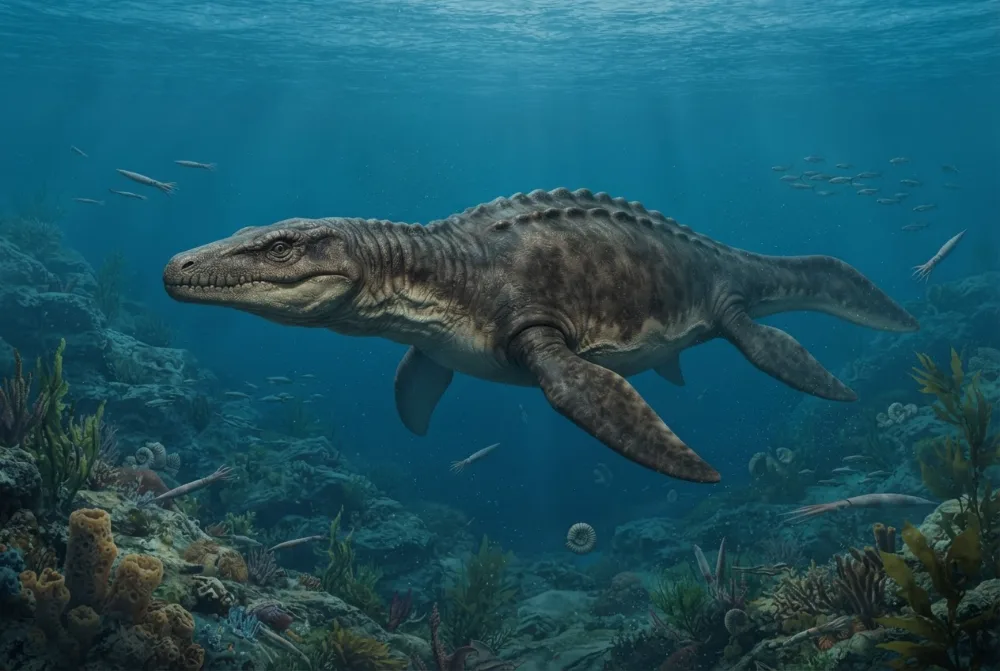
Simolestes was a pliosaur, a kind of short-necked plesiosaur that lived in the Jurassic seas. It had a short, high, and wide skull built to handle twisting forces when hunting. It probably ate squid-like animals and ammonites.1
Wanneer het dit geleef?
Hoe groot was dit?
Hoe lank was dit?
 so lank soos 5 honde van neus tot stert🍌so lank soos 26 piesangs punt aan punt🏊kon die lengte van 'n groot swembad (50 m) in 6,4 sekondes swem
Hoe groot was Simolestes vergeleke met JOU?
Net wiskunde in jou blaaier. Niks word gestoor of êrens heen gestuur nie.
Hoe vinnig was dit?


Prettige feite
Simolestes had salt-secreting glands, which helped it drink seawater and keep its salt balance.1
The type specimen of Simolestes vorax is an almost complete but crushed skeleton found in the Oxford Clay of England.1
Simolestes lived from the Middle to Late Jurassic, about 171 to 145 million years ago.1
Scientists think Simolestes might have hunted in deeper waters or at night, because its prey (cephalopods) move up at night to feed.1
The species Simolestes keileni from France was moved to a new genus called Lorrainosaurus in 2023.1
Mees gevraagde vrae oor Simolestes
?How big was Simolestes?
The largest Simolestes vorax specimens reached about 4.6 metres (15 feet) long, based on a head to body ratio similar to Liopleurodon.1
?What did Simolestes eat?
Simolestes probably ate squid-like animals, belemnites, and ammonites. Its exact feeding habits are unclear, but it likely hunted in deeper waters or at night.1
?Was Simolestes a dinosaur?
No, Simolestes was a pliosaur, a type of short-necked plesiosaur, which is a marine reptile, not a dinosaur.1
?When did Simolestes live?
Simolestes lived during the Middle to Late Jurassic, about 171 to 145 million years ago.1
Vir dino-kenners
- Wetenskaplike naam
- Simolestes
- Benoem deur
- Andrews 19092
- Groep
- Plesiosourusse
- Familie / klade
- Pliosauridae2
- Klassifikasie
- Plesiosauria > Pliosauridae > Sauropterygia2
- Ouderdom van die rotse
- 169 tot 143 miljoen jaar (Bajocian / Tithonian)2
- Rotsformasies
- Umia, Oxford Clay, Marnes de Gravelotte (=La Gravclotte Marls)2
- Lande
- Indië, Verenigde Koninkryk, Frankryk2
- Fossielrekords
- 5 in The Paleobiology Database2
- Ontdekking
- Simolestes was named by C. W. Andrews in 1909 based on a skeleton from the Oxford Clay of Peterborough, England.12
- Steeds omstrede
- Scientists are unsure about the exact feeding habits of Simolestes, though the current consensus is that it ate cephalopods.1
Waar die feite vandaan kom
- Simolestes (en.wikipedia.org)
- Simolestes in The Paleobiology Database (CC BY 4.0): ouderdom, plekke, rotsformasies, klassifikasie.
Elke feit op hierdie bladsy het 'n nommer wat na sy bron wys. As ons iets verkeerd het, jammer, ons is dino-aanhangers, nie 'n wetenskapjoernaal nie. Laat weet ons by [email protected] en ons maak dit reg.
 Rex is honger! Dino Wiki is 'n pa se projek vir sy seun wat mal is oor dino's, gratis met geen advertensies en geen spoorsnyers nie. Grootmense kan vir Rex 'n peuselhappie gee om te help om dit aanlyn te hou.Voer Rex
 Elasmosaurus
 Pliosaurus
 Plesiosaurus
 Cimoliasaurus
 Colymbosaurus
 Trinacromerum
 Brachiosaurus
 Diplodocus
 Allosaurus
 Brontosaurus
 Compsognathus
 Camarasaurus