 Watter dino is jy? Kwis
 Dinogeveg
 Dinoresies
 Dino-minispeletjies
 Plakkeralbum
 Dino TOP-lyste
 Verras my!
Tropeognathus
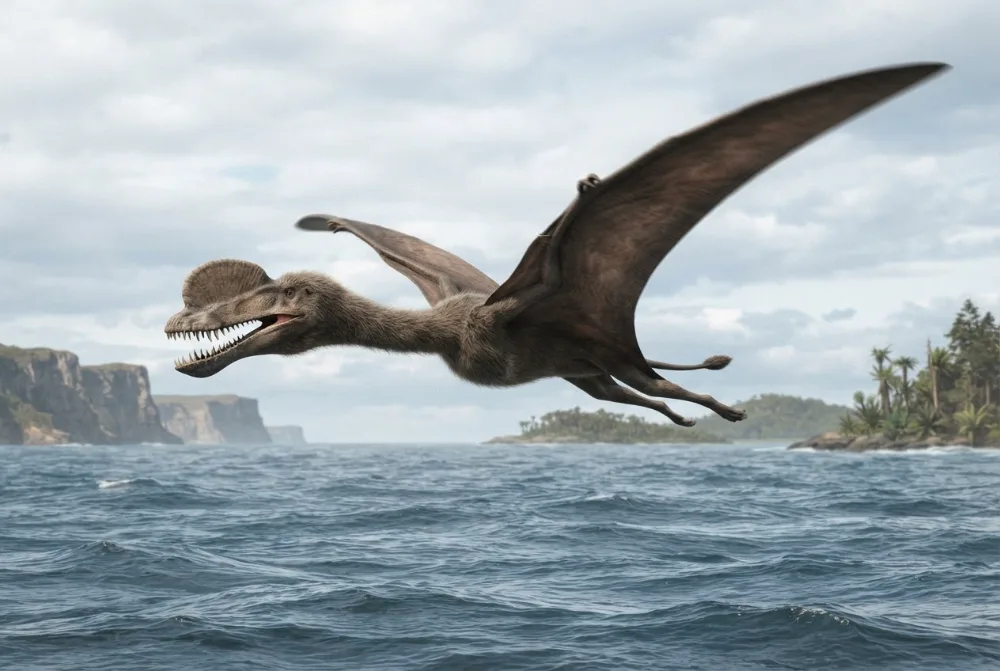
Tropeognathus was a giant flying reptile that soared over ancient seas. It had a big crest on its snout and a mouth full of teeth for catching fish.41
Wanneer het dit geleef?
Hoe groot was dit?
Hoe wyd was sy vlerke?
 vlerke so wyd soos 5 fietse in 'n ry⚽kon in 4,4 sekondes oor 'n hele sokkerveld vlieg
Hoe groot was Tropeognathus vergeleke met JOU?
Net wiskunde in jou blaaier. Niks word gestoor of êrens heen gestuur nie.
Hoe vinnig was dit?


Prettige feite
Tropeognathus is one of the largest pterosaurs ever found in the southern continents (Gondwana).1
A huge specimen (MN 6594-V) had a wingspan of about 8.26 to 8.7 metres, as wide as a small airplane.1
It lived during the Early Cretaceous, about 119 to 113 million years ago.2
Tropeognathus had a low, blunt crest on the top of its skull, unlike some other pterosaurs with tall crests.1
Its name means 'keel jaw', because of the ridge on its lower jaw that looks like a boat's keel.4
The first fossil of Tropeognathus was a skull and lower jaw found in Brazil.4
Mees gevraagde vrae oor Tropeognathus
?How big was Tropeognathus?
Tropeognathus had a wingspan of about 8.26 to 8.7 metres (27.1 to 28.5 feet), about as wide as a small airplane.31
?Was Tropeognathus a dinosaur?
No, Tropeognathus was a pterosaur, a flying reptile, not a dinosaur. Pterosaurs are a separate group of reptiles that lived alongside dinosaurs.3
?What did Tropeognathus eat?
Tropeognathus ate fish, which it caught with its long jaws full of teeth while flying over ancient seas.3
?Could Tropeognathus fly?
Yes, Tropeognathus could fly. It was a flying reptile with a wingspan of about 8.5 metres (28 feet), making it one of the largest flying animals of its time.3
?Why did Tropeognathus have a crest?
Tropeognathus had a crest on its snout and a smaller one on its lower jaw, likely used for display, especially in males, and possibly for species recognition.3
?When did Tropeognathus live?
Tropeognathus lived during the Early Cretaceous, about 119 to 113 million years ago.3
?Where was Tropeognathus found?
Fossils of Tropeognathus were found in the Romualdo Formation in northeastern Brazil, in South America.3
?Was Tropeognathus bigger than a T. rex?
No, Tropeognathus was a flying reptile, not a dinosaur, and it was much smaller than a T. rex. T. rex was about 12 metres long, while Tropeognathus had a wingspan of about 8.5 metres (28 feet).3
Vir dino-kenners
- Wetenskaplike naam
- Tropeognathus
- Benoem deur
- Wellnhofer 19874
- Groep
- Vlieënde reptiele
- Familie / klade
- Anhangueridae4
- Klassifikasie
- Pterosauria > Pterodactyloidea4
- Ouderdom van die rotse
- 120 tot 113 miljoen jaar (Aptian)4
- Rotsformasies
- Romualdo4
- Lande
- Brasilië4
- Fossielrekords
- 2 in The Paleobiology Database4
- Ontdekking
- Tropeognathus was named by Peter Wellnhofer in 1987 based on a skull and lower jaw from the Romualdo Formation in Brazil.4
- Steeds omstrede
- Scientists are not sure if some very large pterosaur bones from the same area belong to Tropeognathus or to a different, even bigger species.1
Waar die feite vandaan kom
- scielo.br (scielo.br)
- PBDB Taxon (paleobiodb.org)
- Tropeognathus (en.wikipedia.org)
- Tropeognathus in The Paleobiology Database (CC BY 4.0): ouderdom, plekke, rotsformasies, klassifikasie.
Elke feit op hierdie bladsy het 'n nommer wat na sy bron wys. As ons iets verkeerd het, jammer, ons is dino-aanhangers, nie 'n wetenskapjoernaal nie. Laat weet ons by [email protected] en ons maak dit reg.
 Rex is honger! Dino Wiki is 'n pa se projek vir sy seun wat mal is oor dino's, gratis met geen advertensies en geen spoorsnyers nie. Grootmense kan vir Rex 'n peuselhappie gee om te help om dit aanlyn te hou.Voer Rex
 Pteranodon
 Quetzalcoatlus
 Dorygnathus
 Rhamphorhynchus
 Anhanguera
 Pterodactylus
 Stegosaurus
 Iguanodon
 Archaeopteryx
 Giganotosaurus
 Microraptor
 Deinonychus