 Watter dino is jy? Kwis
 Dinogeveg
 Dinoresies
 Dino-minispeletjies
 Plakkeralbum
 Dino TOP-lyste
 Verras my!
Tsintaosaurus
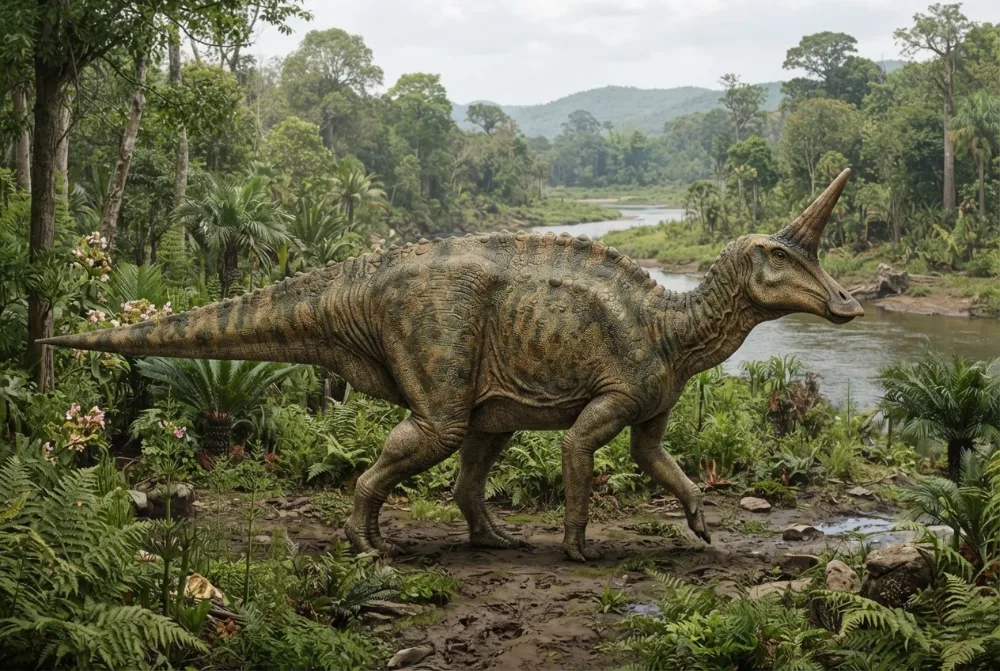
Tsintaosaurus was a duck-billed dinosaur that lived in China during the Late Cretaceous. It had a strange, hollow crest on its head that looked a bit like a unicorn horn. This plant-eater could walk on four legs or run on two to escape predators.21
Wanneer het dit geleef?
Hoe groot was dit?
Hoe lank was dit?
Hoe hoog was dit?
Hoe swaar was dit?
 so lank soos 2,5 motors in 'n ry geparkeer🍌so lank soos 67 piesangs punt aan punt
 so swaar soos 120 honde🍉so swaar soos 500 waatlemoene🎒so swaar soos 3 hele skoolklasse vol kinders🐻❄️so swaar soos 6 ysbere🏃kon 100 meter in 14 sekondes hardloop (die vinnigste mens het 9,6 nodig)
Hoe groot was Tsintaosaurus vergeleke met JOU?
Net wiskunde in jou blaaier. Niks word gestoor of êrens heen gestuur nie.
Hoe vinnig was dit?


Prettige feite
Tsintaosaurus was first thought to have a unicorn-like horn, but scientists now think the crest was actually part of a larger, hollow structure on its snout.2
The crest was hollow and may have been used to make loud honking sounds to communicate with other Tsintaosaurus.2
It lived about 84 to 71 million years ago, during the Campanian stage of the Late Cretaceous.1
Tsintaosaurus is known from skulls and a partial skeleton, so scientists are still learning about its body.1
Like other hadrosaurs, Tsintaosaurus probably traveled in herds for protection.2
The name Tsintaosaurus comes from the old spelling of Qingdao, the city near where it was found.2
Mees gevraagde vrae oor Tsintaosaurus
?How big was Tsintaosaurus?
About 8.3 metres (27 feet) long and weighed 2.5 tonnes (2.8 short tons), according to Wikipedia. The Natural History Museum gives a length of 12.0 metres, so estimates vary.21
?What did Tsintaosaurus eat?
It was a plant-eater. It had a duck-like beak and strong teeth for chewing vegetation.21
?Why did Tsintaosaurus have a crest?
The crest was hollow and may have been used to make loud honking sounds to communicate. It might also have helped attract mates, and the hollow tube made the crest lighter.24
?Could Tsintaosaurus swim?
It had a large tail that may have helped it swim, according to the Australian Museum. It probably lived near lakes and rivers.4
Mite-breker
Mite: Tsintaosaurus had a single, solid horn like a unicorn.
Waarheid: The crest was actually hollow and was the back part of a larger, flat crest that ran from the tip of the snout.2
Vir dino-kenners
- Wetenskaplike naam
- Tsintaosaurus
- Benoem deur
- Young 19585
- Groep
- Eendbekke
- Familie / klade
- Hadrosauridae5
- Klassifikasie
- Ornithischia > Ornithopoda > Iguanodontia > Hadrosauridae5
- Ouderdom van die rotse
- 84 tot 72 miljoen jaar (Campanian)5
- Rotsformasies
- Jingangkou5
- Lande
- China5
- Fossielrekords
- 4 in The Paleobiology Database5
- Ontdekking
- Chinese paleontologist C. C. Young named Tsintaosaurus in 1958 after fossils were found near Laiyang, Shandong, China.21
- Steeds omstrede
- Scientists still debate the exact shape and function of Tsintaosaurus's head crest, because only a few fossils have been found.2
Waar die feite vandaan kom
- Tsintaosaurus | Natural History Museum (nhm.ac.uk)
- Tsintaosaurus (en.wikipedia.org)
- Tsintaosaurus: Discover more about this Dinosaur | Dinosaurland (dinosaurland.es)
- Dinosaurs - Tsintaosaurus spinorhinus - The Australian Museum (australian.museum)
- Tsintaosaurus in The Paleobiology Database (CC BY 4.0): ouderdom, plekke, rotsformasies, klassifikasie.
Elke feit op hierdie bladsy het 'n nommer wat na sy bron wys. As ons iets verkeerd het, jammer, ons is dino-aanhangers, nie 'n wetenskapjoernaal nie. Laat weet ons by [email protected] en ons maak dit reg.
 Rex is honger! Dino Wiki is 'n pa se projek vir sy seun wat mal is oor dino's, gratis met geen advertensies en geen spoorsnyers nie. Grootmense kan vir Rex 'n peuselhappie gee om te help om dit aanlyn te hou.Voer Rex
 Parasaurolophus
 Edmontosaurus
 Saurolophus
 Hypacrosaurus
 Corythosaurus
 Kritosaurus
 Tyrannosaurus
 Triceratops
 Velociraptor
 Spinosaurus
 Ankylosaurus
 Pteranodon