 Watter dino is jy? Kwis
 Dinogeveg
 Dinoresies
 Dino-minispeletjies
 Plakkeralbum
 Dino TOP-lyste
 Verras my!
Xiangyunloong
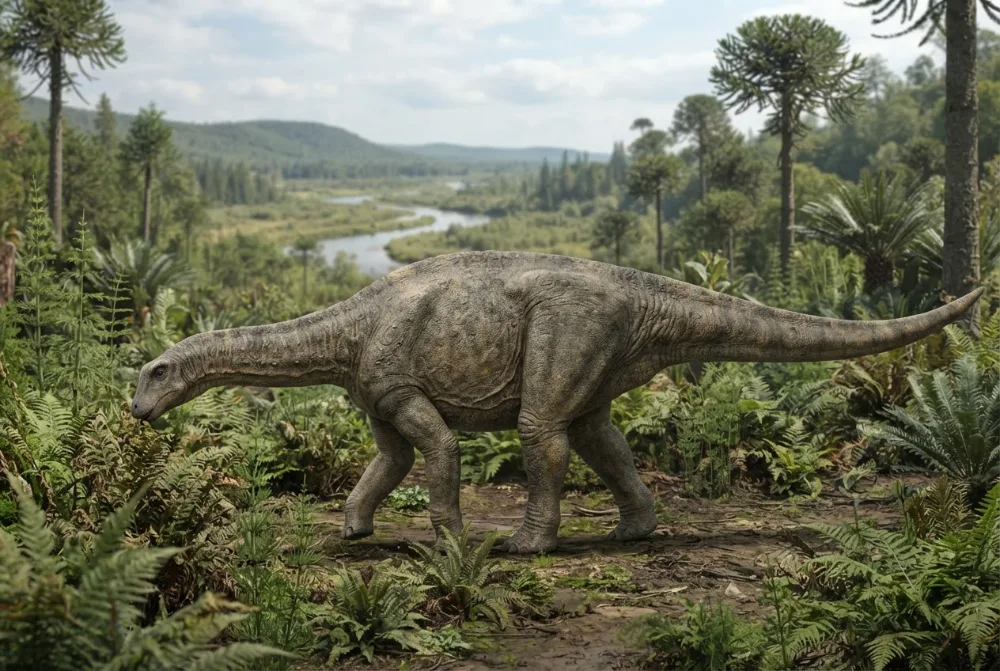
Xiangyunloong was a big, plant-eating dinosaur that lived in what is now China. It had a short neck but a very long and strong tail, which helped it balance its heavy body. This dinosaur shows that not all early long-necked dinosaurs had long necks!2
Wanneer het dit geleef?
Hoe groot was dit?
Hoe lank was dit?
Hoe hoog was dit?
skatting
 so lank soos 2 motors in 'n ry geparkeer🍌so lank soos 56 piesangs punt aan punt🏃kon 100 meter in 16 sekondes hardloop (die vinnigste mens het 9,6 nodig)
Hoe groot was Xiangyunloong vergeleke met JOU?
Net wiskunde in jou blaaier. Niks word gestoor of êrens heen gestuur nie.
Hoe vinnig was dit?


Prettige feite
Xiangyunloong had a short neck but a very long and powerful tail, which is unusual for early sauropodomorphs.2
Its tail was so strong that it could act as a counterbalance, helping the dinosaur stand on two legs to feed.2
Scientists think Xiangyunloong represents an early stage of gigantism, or getting very big, in sauropodomorphs.2
Xiangyunloong lived about 200 million years ago during the Early Jurassic period.4
The fossil of Xiangyunloong was found about 200 kilometers west of the famous Lufeng dinosaur fossil sites in China.2
Xiangyunloong is known from a partial skeleton that includes neck bones, back bones, tail bones, and hip bones.2
Mees gevraagde vrae oor Xiangyunloong
?How big was Xiangyunloong?
About 9 to 10 metres long, making it one of the largest early sauropodomorph dinosaurs from China.12
?Did Xiangyunloong have a long neck?
No, it had a short neck, which is unusual for early sauropodomorphs. Instead, it had a very long and strong tail.23
?What did Xiangyunloong eat?
It was a plant eating dinosaur, like other sauropodomorphs.1
Mite-breker
Mite: Many people think all early sauropodomorphs had long necks like later sauropods.
Waarheid: Xiangyunloong had a short neck and a long, strong tail, showing that early sauropodomorphs had different body shapes.2
Vir dino-kenners
- Wetenskaplike naam
- Xiangyunloong
- Benoem deur
- Hu et al. 20264
- Groep
- Langnekke
- Familie / klade
- Massopoda4
- Klassifikasie
- Sauropodomorpha4
- Ouderdom van die rotse
- 201 tot 175 miljoen jaar (Hettangian / Toarcian)4
- Rotsformasies
- Fengjiahe4
- Lande
- China4
- Fossielrekords
- 1 in The Paleobiology Database4
- Ontdekking
- Xiangyunloong was named in 2026 by Hu and colleagues based on a partial skeleton found in the Fengjiahe Formation in Yunnan, China.2
- Steeds omstrede
- Scientists are still debating whether Xiangyunloong represents a new evolutionary path where the tail, not the neck, became long and strong.2
Waar die feite vandaan kom
- Xiangyunloong (en.wikipedia.org)
- A new sauropodomorph dinosaur from the Lower Jurassic Fengjiahe Formation of Dali of Yunnan Province, China | Royal Society Open Science | The Royal Society (royalsocietypublishing.org)
- Early Sauropodomorph Dinosaur Unearthed in China | Sci.News (sci.news)
- Xiangyunloong in The Paleobiology Database (CC BY 4.0): ouderdom, plekke, rotsformasies, klassifikasie.
Elke feit op hierdie bladsy het 'n nommer wat na sy bron wys. As ons iets verkeerd het, jammer, ons is dino-aanhangers, nie 'n wetenskapjoernaal nie. Laat weet ons by [email protected] en ons maak dit reg.
 Rex is honger! Dino Wiki is 'n pa se projek vir sy seun wat mal is oor dino's, gratis met geen advertensies en geen spoorsnyers nie. Grootmense kan vir Rex 'n peuselhappie gee om te help om dit aanlyn te hou.Voer Rex
 Brachiosaurus
 Diplodocus
 Brontosaurus
 Argentinosaurus
 Camarasaurus
 Morosaurus
 Dilophosaurus
 Stenopterygius
 Dorygnathus
 Scutellosaurus
 Sinosaurus
 Temnodontosaurus