 Watter dino is jy? Kwis
 Dinogeveg
 Dinoresies
 Dino-minispeletjies
 Plakkeralbum
 Dino TOP-lyste
 Verras my!
Zalmoxes
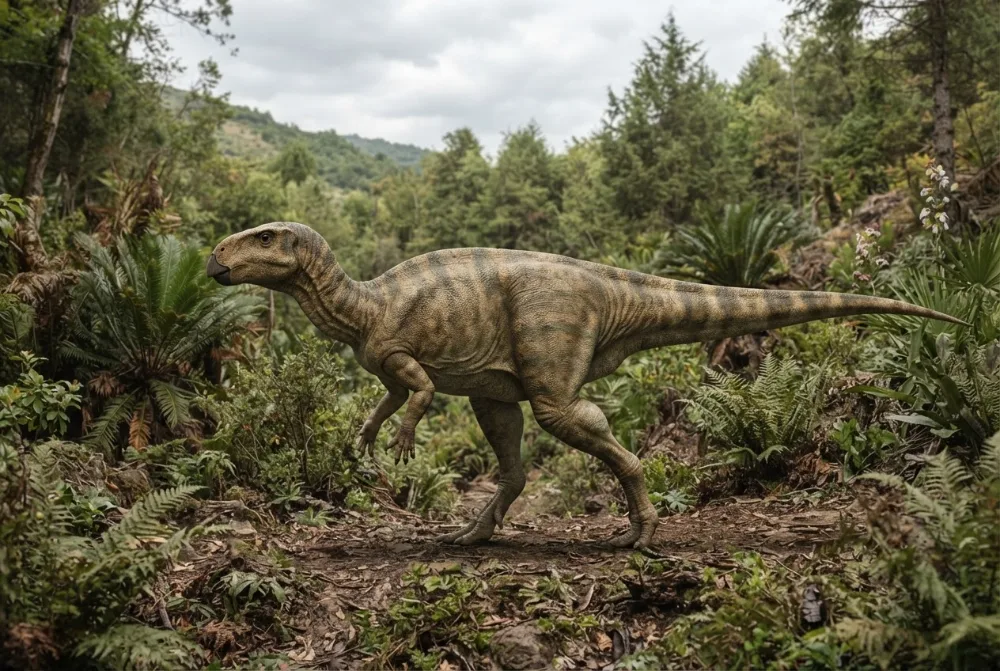
Zalmoxes was a small, plant-eating dinosaur that lived on an island called Hateg, in what is now Romania. It walked on two legs, had a beak, and ate tough plants. It was about the size of a small car, but some were even smaller!1
Wanneer het dit geleef?
Hoe groot was dit?
Hoe lank was dit?
Hoe hoog was dit?
skatting
Hoe swaar was dit?
 so lank soos 3 honde van neus tot stert🍌so lank soos 16 piesangs punt aan punt
 so swaar soos 11 huiskatte🍉so swaar soos 9 waatlemoene🧸so swaar soos 2,5 kleuterskoolkinders🎒so swaar soos 1,5 skoolkinders🏃kon 100 meter in 8,2 sekondes hardloop (die vinnigste mens het 9,6 nodig)
Hoe groot was Zalmoxes vergeleke met JOU?
Net wiskunde in jou blaaier. Niks word gestoor of êrens heen gestuur nie.
Hoe vinnig was dit?


Prettige feite
Zalmoxes had a slow growth rate and a long growth period, which is different from many other dinosaurs.1
It lived on an island, and scientists think it might have been smaller than its relatives because of island dwarfism, though some think it was already small.1
Zalmoxes had a large triangular head and a beak, which helped it eat tough plants.1
Fossils of Zalmoxes have been found in Austria and France too, not just Romania.4
One species of Zalmoxes, called Z. shqiperorum, was later reclassified as a different type of dinosaur, a ceratopsian, not an ornithopod.1
Zalmoxes was one of the most common vertebrates in Transylvania during the latest Cretaceous period.1
Mees gevraagde vrae oor Zalmoxes
?How big was Zalmoxes?
Zalmoxes was small, with adults of Z. robustus reaching about 2.5 metres (8.2 feet) long and weighing about 45 kilograms (99 pounds). An unnamed species grew to about 2.9 metres (9.5 feet) long.1
?What did Zalmoxes eat?
Zalmoxes ate tough, fibrous plants like soft shoots, horsetails, angiosperms, pteridophytes, and ferns. It had a beak and could process C3 plants.1
?When did Zalmoxes live?
Zalmoxes lived during the Maastrichtian age of the Late Cretaceous, about 70 to 66 million years ago. It was one of the most common vertebrates in Transylvania at that time.13
?Where was Zalmoxes found?
Fossils of Zalmoxes have been found in Romania, specifically in the Hateg Basin of Transylvania. Some sources also mention finds in Austria and France, but the main site is Romania.13
?Was Zalmoxes a dinosaur?
Yes, Zalmoxes was a dinosaur, specifically a small ornithopod. It is classified as a probable rhabdodontid ornithopod, not a ceratopsian, though one species was later reclassified.13
?Why was Zalmoxes small?
Scientists once thought Zalmoxes was small due to island dwarfism, but later studies suggest it was already close to the size of its ancestors. Some related species were larger or smaller due to island effects.1
Mite-breker
Mite: Some people think Zalmoxes was a dwarf dinosaur because it lived on an island.
Waarheid: Scientists now think Zalmoxes was already small, and its larger relative Rhabdodon had island gigantism, while a smaller relative Mochlodon had island dwarfism.1
Vir dino-kenners
- Wetenskaplike naam
- Zalmoxes
- Benoem deur
- Weishampel et al. 20034
- Groep
- Plantvreters met snawels
- Familie / klade
- Rhabdodontoidea4
- Klassifikasie
- Ornithischia > Ornithopoda > Iguanodontia4
- Ouderdom van die rotse
- 84 tot 66 miljoen jaar (Campanian / Maastrichtian)4
- Rotsformasies
- Sebeş, Sînpetru, Densuș-Ciula4
- Lande
- Roemenië, Oostenryk, Frankryk4
- Fossielrekords
- 44 in The Paleobiology Database4
- Ook bekend as
- Onychosaurus (ouer name tel nou as dieselfde dier)4
- Ontdekking
- The first fossils were named Mochlodon robustus by Baron Franz Nopcsa in 1899. In 2003, scientists renamed them Zalmoxes robustus after studying new remains.12
- Steeds omstrede
- Scientists still debate whether Zalmoxes was a dwarf species or just naturally small, and how it is related to other similar dinosaurs.1
Waar die feite vandaan kom
- Zalmoxes (en.wikipedia.org)
- Osteology and phylogeny of Zalmoxes (n. g.), an unusual Euornithopod dinosaur from the latest Cretaceous of Romania (tandfonline.com)
- Zalmoxes | Natural History Museum (nhm.ac.uk)
- Zalmoxes in The Paleobiology Database (CC BY 4.0): ouderdom, plekke, rotsformasies, klassifikasie.
Elke feit op hierdie bladsy het 'n nommer wat na sy bron wys. As ons iets verkeerd het, jammer, ons is dino-aanhangers, nie 'n wetenskapjoernaal nie. Laat weet ons by [email protected] en ons maak dit reg.
 Rex is honger! Dino Wiki is 'n pa se projek vir sy seun wat mal is oor dino's, gratis met geen advertensies en geen spoorsnyers nie. Grootmense kan vir Rex 'n peuselhappie gee om te help om dit aanlyn te hou.Voer Rex
 Iguanodon
 Tenontosaurus
 Thescelosaurus
 Camptosaurus
 Rhabdodon
 Nanosaurus
 Tyrannosaurus
 Triceratops
 Velociraptor
 Spinosaurus
 Ankylosaurus
 Parasaurolophus