 Woyɛ dino bɛn? Nsɛmmisa agoro
 Dino ko
 Dino mmirikatuo
 Dino agodie nketewa
 Stika nwoma
 Dino TOP nhyehyɛeɛ
 Ma me nwanwa!
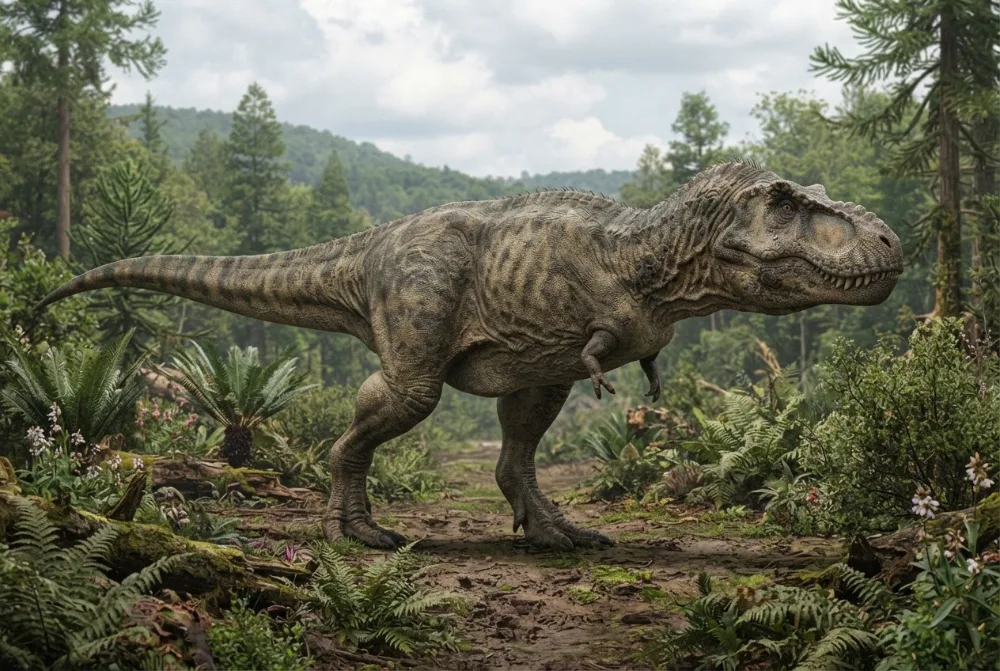
Tyrannosaurus
Tyrannosaurus rex was one of the biggest meat-eating dinosaurs that ever lived. It stomped across western North America about 69 to 66 million years ago, at the very end of the Age of Dinosaurs. With its huge skull, powerful legs, and tiny arms, it was the king of its prehistoric world.1
Berɛ bɛn na ɛtenaa ase?
Na ne kɛseɛ yɛ sɛn?
Na ne tenten yɛ sɛn?
Na ne korɔn yɛ sɛn?
Na ne mu yɛ duru sɛn?
 ne tenten te sɛ kaa 3 a wɔde agyina toatoa so🍌ne tenten te sɛ kwadu 72 a wɔde abɔ toatoa so
 ne mu duru te sɛ asono 1.5🍉ne mu duru te sɛ watamɛlɔn 1800🎒ne mu duru te sɛ sukuu klaas mũ 11 mu mmofra🐻❄️ne mu duru te sɛ polar bea 20🏃anka ɔbɛtumi atu mmirika mita 100 wɔ sikɛn 15 mu (onipa a ɔyɛ ntɛm sen biara hia 9.6)
Tyrannosaurus kɛseɛ yɛ sɛn sɛ wode toto WO ho a?
Akontaa nko ara wɔ wo browser mu. Yɛnkora biribiara so, na yɛmmfa biribiara nkɔ baabiara.
Na ɛyɛ ntɛm sɛn?


Nsɛm a ɛyɛ anigye
Tyrannosaurus had the most powerful bite of any land animal ever, with a force of 35,000 to 57,000 newtons in its back teeth.1
Its arms were very short but surprisingly strong, with two clawed fingers on each hand.1
The first Tyrannosaurus rex fossil was a tooth found in Colorado in 1874, but the animal wasn't named until 1905.1
A set of footprints from Wyoming shows that a young Tyrannosaurus walked at a speed of about 2.8 to 5 miles per hour.1
Tyrannosaurus lived on an island continent called Laramidia, which was separated by a shallow sea from the eastern part of North America.1
Nsɛm a wɔbisa bebree fa Tyrannosaurus ho
?How big was Tyrannosaurus?
About 12 to 13 metres (40 to 43 feet) long, 3.7 to 4 metres (12 to 13 feet) tall at the hip, and weighed up to 8.8 tonnes (9.7 tons).13
?What did Tyrannosaurus eat?
It was a meat-eater that hunted large dinosaurs like Edmontosaurus and Triceratops, and probably also scavenged. Its powerful jaws and serrated teeth could crush bone.43
?How fast could Tyrannosaurus run?
Up to about 24 km/h (15 mph), about as fast as a grown-up riding a bike. T. rex was too heavy to really run like a horse, so most scientists think it moved with a big, fast power walk. That was still fast enough to catch other large dinosaurs.43
?Why were Tyrannosaurus arms so small?
Nobody knows for sure. One idea is that as its head grew bigger, the arms got shorter to keep the dinosaur balanced. They were still very strong and had two claws.43
?When did Tyrannosaurus live?
It lived about 69 to 66 million years ago, at the very end of the Cretaceous Period, just before the dinosaurs went extinct.14
?Where did Tyrannosaurus live?
It lived in western North America, on an island continent called Laramidia. Fossils have been found in the United States (like Montana and Wyoming) and Canada.14
?Was Tyrannosaurus the biggest meat-eating dinosaur?
It was one of the largest land predators ever, but some other dinosaurs like Giganotosaurus and Spinosaurus were similar in size. T. rex was the biggest predator in its own time and place.41
?Did Tyrannosaurus have feathers?
Some scientists think young T. rex may have had a light covering of feathers, but adults probably had mostly scaly skin. No direct fossil feathers have been found on T. rex.1
?How strong was Tyrannosaurus bite?
It had the most powerful bite of any land animal ever, with a force of 35,000 to 57,000 newtons in its back teeth. That is a very strong bite.1
Atosɛm sɛefoɔ
Atosɛm: Tyrannosaurus rex was just a slow scavenger that only ate dead animals.
Nokorɛ: Most paleontologists now agree that T. rex was an active predator that hunted live prey, though it also scavenged when it had the chance.1
Ma dino ho animdefoɔ
- Nyansahu din
- Tyrannosaurus
- Obi a ɔtoo din
- Osborn 19055
- Kuo
- Tiranosɔɔ
- Abusua / kuo kɛseɛ
- Tyrannosauridae5
- Nkyekyɛmu
- Theropoda > Tyrannosauroidea > Tyrannosauridae5
- Abotan no mfeɛ
- mfeɛ ɔpepem 84 kɔsi 66 (Campanian / Maastrichtian)5
- Abotan nhyehyɛeɛ
- Hell Creek, Lance, Denver5
- Aman
- Amerika, Kanada, Rɔhyea, Mɛksiko, Kyaena5
- Fɔsil nkyerɛwee
- 87 wɔ The Paleobiology Database mu5
- Wɔsan frɛ no
- Dinotyrannus, Dynamosaurus, Manospondylus, Stygivenator (din dada no nso, yɛkan no sɛ aboa korɔ no ara)5
- Nhunumu
- Barnum Brown of the American Museum of Natural History found the first partial skeleton in Wyoming in 1900, and a more complete one in Montana in 1902. Henry Fairfield Osborn named it Tyrannosaurus rex in 1905.12
- Wɔda so gye ho akyinnye
- Scientists still debate whether some smaller tyrannosaur fossils belong to a separate genus called Nanotyrannus or are just young Tyrannosaurus rex.1
Baabi a nsɛm no firi
- Tyrannosaurus (en.wikipedia.org)
- Bulletin of the American Museum of Natural History/Volume 21/Tyrannosaurus and Other Cretaceous Carnivorous Dinosaurs - Wikisource, the free online library (en.wikisource.org)
- Dinosaur - Tyrannosaurus rex - The Australian Museum (australian.museum)
- si.edu (si.edu)
- Tyrannosaurus in The Paleobiology Database (CC BY 4.0): mfeɛ, mmeaeɛ, abotan nhyehyɛeɛ, nkyekyɛmu.
Asɛm biara a ɛwɔ krataafa yi so wɔ nɔma a ɛkyerɛ baabi a ɛfiri. Sɛ yɛfom biribi a, kafra, yɛyɛ dino dɔfoɔ, yɛnyɛ nyansahu nsɛmma krataa. Ka kyerɛ yɛn wɔ [email protected] na yɛbɛsiesie.
 Ɔkɔm de Rex! Dino Wiki yɛ agya bi adwuma a ɔyɛɛ maa ne babarima a ɔdɔ dino. Ɛyɛ kwa, dawurubɔ biara nni mu, akyidifoɔ biara nni mu. Mpanimfoɔ bɛtumi ama Rex aduane kakra, na aboa ama Dino Wiki atena intanɛt so.Ma Rex aduane
 Tarbosaurus
 Albertosaurus
 Daspletosaurus
 Gorgosaurus
 Alectrosaurus
 Dryptosaurus
 Triceratops
 Velociraptor
 Spinosaurus
 Ankylosaurus
 Parasaurolophus
 Pteranodon