
Amygdalodon
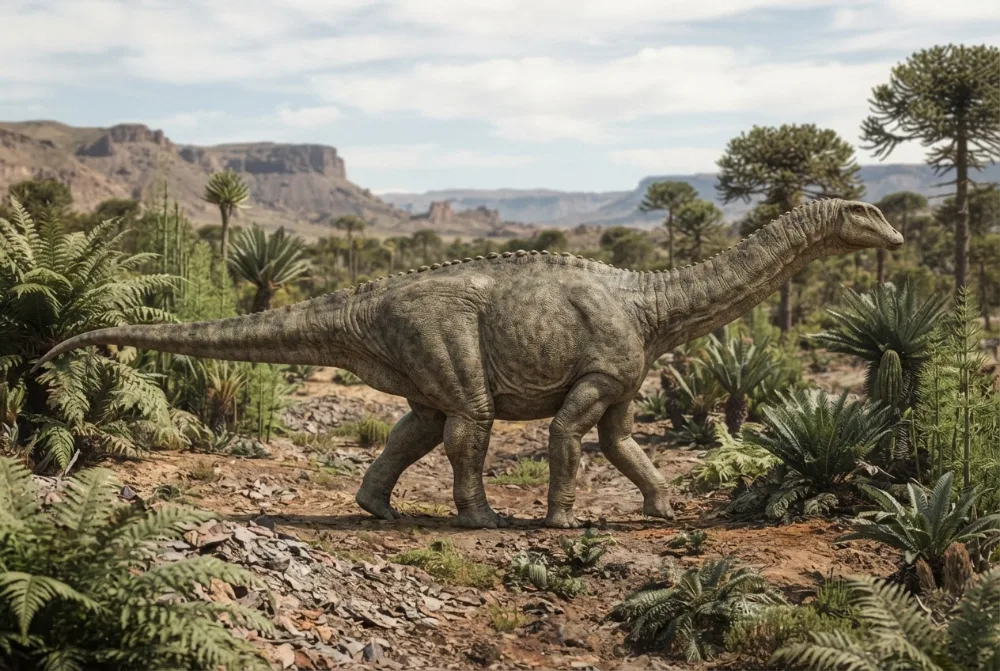
Amygdalodon was a huge, long-necked plant-eater that lived in Argentina during the Early Jurassic, about 180 million years ago. It was one of the very first sauropod dinosaurs ever found in South America, and scientists only know it from a single partial skeleton.12
When did it live?
How big was it?
How big was Amygdalodon compared to YOU?
Just maths in your browser. Nothing is saved or sent anywhere.
Fun facts
It was discovered in 1936 after a local scientist mentioned finding bones of a large reptile, and Dr. Tomás Suero went to look for more.1
The only known fossils include some vertebrae, ribs, teeth, and parts of the pelvis and shoulder blade.1
Amygdalodon lived about 180 to 172 million years ago, during the Toarcian stage of the Jurassic.1
It was a quadruped, meaning it walked on all four legs, like other sauropods.1
Scientists think Amygdalodon was a basal sauropod, meaning it was an early relative of the giant long-necked dinosaurs that came later.1
Some studies suggest it might be closely related to the Asian dinosaur Gongxianosaurus.1
Most asked questions about Amygdalodon
?How big was Amygdalodon?
Amygdalodon was about 12 metres (39 feet) long and 4 metres (13 feet) tall, and weighed over 5 tonnes (5.5 short tons). Estimates vary, with some sources suggesting a length of 15 metres (49 feet).12
?What did Amygdalodon eat?
Amygdalodon was a plant-eater, or herbivore. Its almond-shaped teeth show early signs of adapting for bulk feeding, which later sauropods used to eat lots of plants.12

Ask Rex about Amygdalodon
Rex only answers questions about this page. 3 questions a day.
Rex is an AI and can make mistakes. He runs on servers in the EU and questions are never saved. Never type your name or other personal things.
For dino experts
- Scientific name
- Amygdalodon
- Named by
- Cabrera 19473
- Group
- Long-necks
- Family / clade
- Gravisauria3
- Classification
- Sauropodomorpha > Sauropoda3
- Age of the rocks
- 193 to 183 million years (Pliensbachian / Toarcian)3
- Rock formations
- Cerro Carnerero3
- Countries
- Argentina3
- Fossil records
- 1 in the Paleobiology Database3
- Discovery
- Amygdalodon was named by Argentine paleontologist Ángel Cabrera in 1947, based on fossils found in 1936 by Dr. Tomás Suero in Chubut, Argentina.12
- Still debated
- Scientists are still debating exactly where Amygdalodon fits in the sauropod family tree, with some placing it as a very early sauropod and others as a more advanced eusauropod.1
Where the facts come from
- Amygdalodon (en.wikipedia.org)
- Amygdalodon | Natural History Museum (nhm.ac.uk)
- Amygdalodon in The Paleobiology Database (CC BY 4.0): age, places, rock formations, classification.
Every fact on this page has a number that points to its source. If we got something wrong, sorry, we are dino fans, not a science journal. Tell us at [email protected] and we will fix it.
Rex is hungry! Dino Wiki is a dad's project for his dino-loving son, free with no ads. Grown-ups can feed Rex a snack to help keep it online.Feed Rex Brachiosaurus
 Diplodocus
 Brontosaurus
 Argentinosaurus
 Camarasaurus
 Morosaurus
 Dilophosaurus
 Stenopterygius
 Dorygnathus
 Scutellosaurus
 Sinosaurus
 Temnodontosaurus