
Arthropterygius
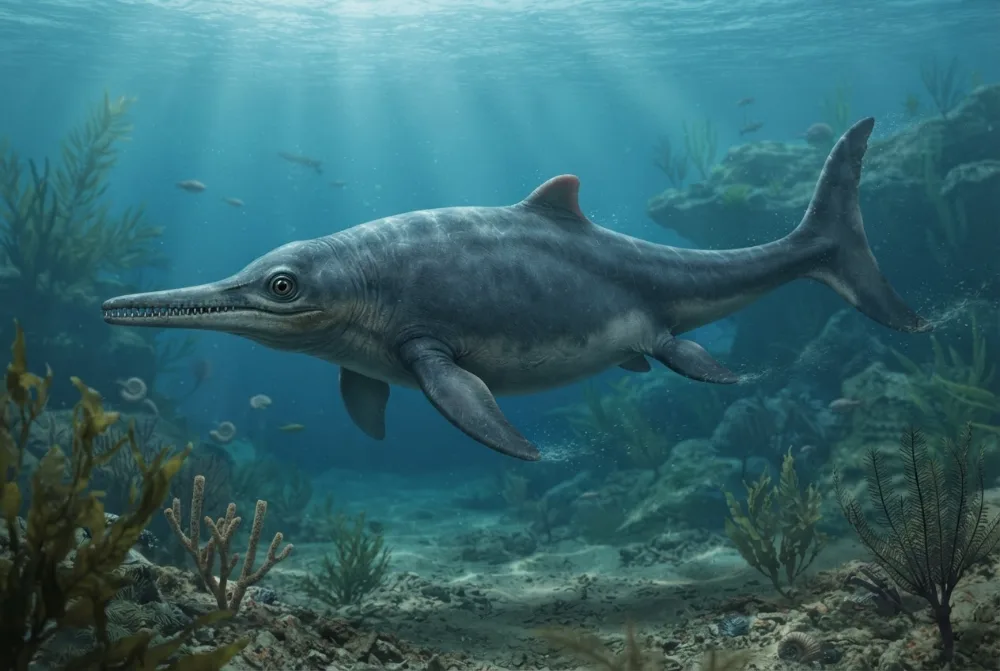
Arthropterygius was a large, fish-shaped marine reptile that swam in the oceans during the late Jurassic period. It had a long snout and strong flippers, and it was a fast hunter of fish and squid.13
When did it live?
How big was it?
How long was it?
How big was Arthropterygius compared to YOU?
Just maths in your browser. Nothing is saved or sent anywhere.
Fun facts
Arthropterygius had a special opening for the internal carotid artery on the back of its braincase, a feature unique among ichthyosaurs.2
Fossils of Arthropterygius have been found in both the Northern and Southern Hemispheres, showing it lived in warm and cold seas.12
One specimen from Svalbard, Norway, was about 3.8 to 4.3 metres (12 to 14 feet) long and was probably an adult.1
The name Arthropterygius means 'wing fin', referring to the shape of its flippers.1
Arthropterygius lived in shallow seas with methane seeps, where the seafloor was about 150 metres (490 feet) deep and had little oxygen.1
It belonged to a group called ophthalmosaurids, which were the last surviving ichthyosaurs before they went extinct.1
Most asked questions about Arthropterygius
?How big was Arthropterygius?
Arthropterygius was a relatively large ichthyosaur, with all species measuring between 3 and 5 metres (9.8 to 16.4 feet) long.1
?What did Arthropterygius eat?
It was a fast hunter of fish and squid, using its long snout and strong flippers to catch prey.1
?Was Arthropterygius a dinosaur?
No, Arthropterygius was an ichthyosaur, a type of marine reptile that lived in the oceans, not a dinosaur.1
?Where did Arthropterygius live?
Fossils of Arthropterygius have been found in Canada, Norway, Russia, and Argentina, showing it lived in both warm and cold seas across the Northern and Southern Hemispheres.1

Ask Rex about Arthropterygius
Rex only answers questions about this page. 3 questions a day.
Rex is an AI and can make mistakes. He runs on servers in the EU and questions are never saved. Never type your name or other personal things.
For dino experts
- Scientific name
- Arthropterygius
- Named by
- Maxwell 20103
- Group
- Ichthyosaurs
- Family / clade
- Ophthalmosauridae3
- Classification
- Ichthyosauria > Ichthyosauromorpha3
- Age of the rocks
- 162 to 143 million years (Oxfordian / Tithonian)3
- Rock formations
- Ringnes, Agardhfjellet, Vaca Muerta3
- Countries
- Canada, Norway, Argentina, Russia3
- Fossil records
- 8 in the Paleobiology Database3
- Discovery
- The first fossils of Arthropterygius were found on Melville Island, Canada, and were originally named Ophthalmosaurus chrisorum in 1993. In 2010, scientist Erin Maxwell gave them a new genus name, Arthropterygius.13
- Still debated
- Scientists are not sure if Arthropterygius lived into the earliest Cretaceous period, or if it went extinct at the end of the Jurassic.1
Where the facts come from
- Arthropterygius (en.wikipedia.org)
- Original article The genus Arthropterygius Maxwell (Ichthyosauria: Ophthalmosauridae) in the Late Jurassic of the Neuquén Basin, Argentina ☆ (sciencedirect.com)
- Arthropterygius in The Paleobiology Database (CC BY 4.0): age, places, rock formations, classification.
Every fact on this page has a number that points to its source. If we got something wrong, sorry, we are dino fans, not a science journal. Tell us at [email protected] and we will fix it.
 Rex is hungry! Dino Wiki is a dad's project for his dino-loving son, free with no ads. Grown-ups can feed Rex a snack to help keep it online.Feed Rex
 Ichthyosaurus
 Platypterygius
 Stenopterygius
 Khudiakovia
 Ophthalmosaurus
 Chonespondylus
 Brachiosaurus
 Diplodocus
 Allosaurus
 Brontosaurus
 Compsognathus
 Camarasaurus