
Barosaurus
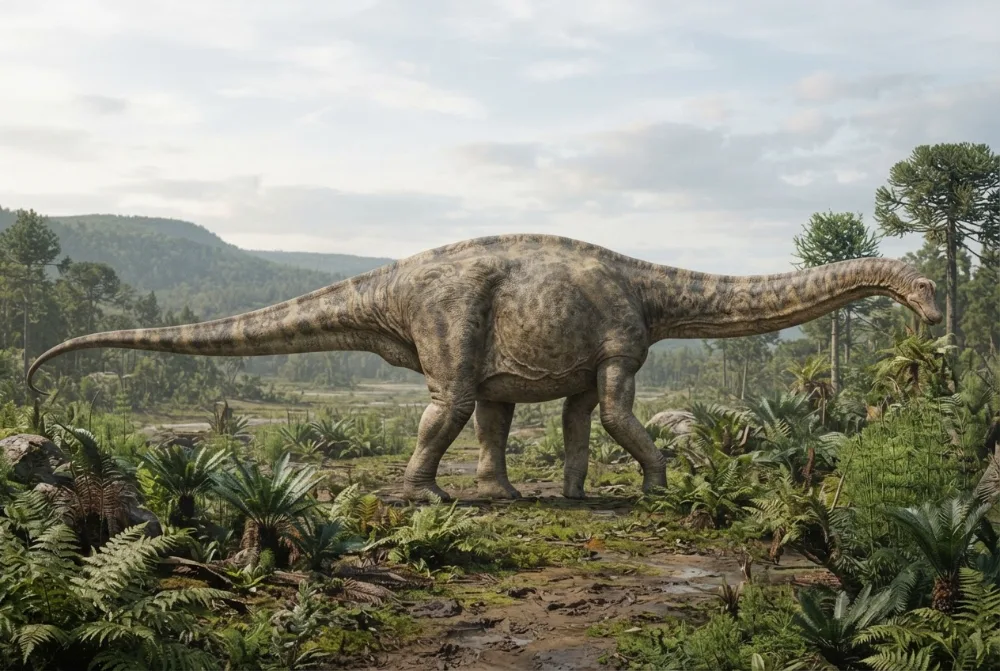
Barosaurus was a giant, long-necked plant eater that lived about 150 million years ago. It was one of the biggest animals of its time, with a neck so long it could reach high into the trees. But it probably kept its head low and swept its neck like a vacuum cleaner to munch on plants.12
When did it live?
How big was it?
How big was Barosaurus compared to YOU?
Just maths in your browser. Nothing is saved or sent anywhere.
Fun facts
Barosaurus had 16 neck bones, more than its close relatives Diplodocus and Apatosaurus, and some of those neck bones were up to 50% longer.1
Its tail made up about half of its total body length, even though its tail was shorter than Diplodocus's tail.1
Barosaurus had only 9 back bones, while Diplodocus and Apatosaurus had 10. Scientists think one back bone may have turned into a neck bone.1
A study from 2016 suggested that Barosaurus could bend its neck from side to side a lot, but not up and down much. So it probably fed on low plants, not high trees.1
Some scientists think a dinosaur this big would have needed a huge 1.6-ton heart, and maybe even extra 'helper hearts' in its neck to pump blood to its brain.1
Barosaurus lived alongside famous dinosaurs like Allosaurus, Stegosaurus, and Brontosaurus in the Morrison Formation.1
Most asked questions about Barosaurus
?How big was Barosaurus?
About 25 to 27 metres (82 to 89 feet) long and weighed 12 to 20 tonnes (13 to 22 short tons).1
?What did Barosaurus eat?
It was a plant eater (herbivore). It probably fed on low plants by sweeping its neck from side to side like a vacuum cleaner.12
?When did Barosaurus live?
It lived during the Late Jurassic period, about 152 to 150 million years ago.1
?Where was Barosaurus found?
Fossils have been found in the United States, especially in South Dakota, Utah, Montana, and possibly Colorado, Wyoming, and Oklahoma.1
?Is Barosaurus a dinosaur?
Yes, it is a dinosaur, a large sauropod dinosaur.1
?Was Barosaurus bigger than T. rex?
Yes, Barosaurus was much longer and heavier than Tyrannosaurus rex. Barosaurus reached 25 to 27 metres, while T. rex was about 12 metres long.1
?Did Barosaurus have feathers?
No one knows for sure, but no feathers have been found on Barosaurus fossils. A rare skin imprint shows scales, not feathers.3
?Could Barosaurus swim?
Probably not. It was a land animal with a long neck and tail, built for walking on land, not swimming.1

Ask Rex about Barosaurus
Rex only answers questions about this page. 3 questions a day.
Rex is an AI and can make mistakes. He runs on servers in the EU and questions are never saved. Never type your name or other personal things.
Myth buster
Myth: Some people think Barosaurus is the same as Brontosaurus or Diplodocus.
Truth: Barosaurus is a different genus, though it is closely related to Diplodocus. It had a longer neck and shorter tail than Diplodocus.1
For dino experts
- Scientific name
- Barosaurus
- Named by
- Marsh 18904
- Group
- Long-necks
- Family / clade
- Diplodocidae4
- Classification
- Sauropodomorpha > Sauropoda > Diplodocoidea4
- Age of the rocks
- 158 to 143 million years ()4
- Rock formations
- Morrison, Kadzi4
- Countries
- USA, Zimbabwe4
- Fossil records
- 19 in the Paleobiology Database4
- Also known as
- Gigantosaurus (older names now counted as the same animal)4
- Discovery
- The first Barosaurus fossils were found in 1889 in South Dakota by Isabella R. Ellerman, and then excavated by Othniel Charles Marsh and John Bell Hatcher. Marsh named it Barosaurus lentus in 1890.1
- Still debated
- Scientists still debate how Barosaurus held its neck and how blood reached its brain. Some think it held its neck low, while others think it could raise it high.1
Where the facts come from
- Barosaurus (en.wikipedia.org)
- Barosaurus | Natural History Museum (nhm.ac.uk)
- Barosaurus lentus - Dinosaur National Monument (U.S. National Park Service) (nps.gov)
- Barosaurus in The Paleobiology Database (CC BY 4.0): age, places, rock formations, classification.
Every fact on this page has a number that points to its source. If we got something wrong, sorry, we are dino fans, not a science journal. Tell us at [email protected] and we will fix it.
Rex is hungry! Dino Wiki is a dad's project for his dino-loving son, free with no ads. Grown-ups can feed Rex a snack to help keep it online.Feed Rex Brachiosaurus
 Diplodocus
 Brontosaurus
 Argentinosaurus
 Camarasaurus
 Morosaurus
 Allosaurus
 Compsognathus
 Camptosaurus
 Nanosaurus
 Rhamphorhynchus
 Ceratosaurus