
Ceratosaurus
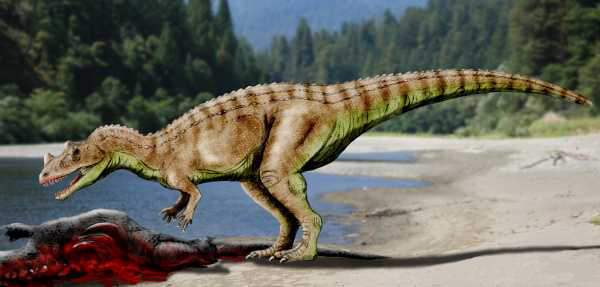
Ceratosaurus was a meat-eating dinosaur that lived in North America and Europe during the Late Jurassic Period. It had a horn on its snout and a row of small bony plates along its back. It was a rare hunter that lived alongside the more common Allosaurus.1
When did it live?
How big was it?
Fun facts
Ceratosaurus is the only known meat-eating dinosaur that had a horn on its snout.2
Unlike other large theropods, Ceratosaurus had only three teeth in its premaxilla (the front of the upper jaw).2
The first nearly complete skeleton was found in 1883 by a Colorado farmer named Marshall Parker Felch.1
Ceratosaurus fossils are much rarer than those of Allosaurus, which lived at the same time.1
Some scientists think Ceratosaurus may have eaten aquatic animals like fish and turtles.1
All known Ceratosaurus individuals were found alone, so there is no evidence they hunted in groups.1
Myth buster
Myth: Ceratosaurus hunted in packs like wolves.
Truth: All known Ceratosaurus fossils were found alone, so scientists think it was a solitary hunter.1
For dino experts
- Scientific name
- Ceratosaurus
- Named by
- Marsh 18843
- Group
- Other meat-eaters
- Family / clade
- Ceratosauria3
- Classification
- Theropoda > Ceratosauria3
- Age of the rocks
- 158 to 143 million years ()3
- Rock formations
- Morrison, Tendaguru, Lourinhã3
- Countries
- USA, Portugal, Tanzania, Uruguay3
- Fossil records
- 29 in the Paleobiology Database3
- Discovery
- The first Ceratosaurus fossil was found in 1883 by Colorado farmer Marshall Parker Felch. Scientist Othniel Charles Marsh studied the bones and named the dinosaur Ceratosaurus in 1884.13
- Still debated
- Scientists are not sure whether fossils found in Africa and South America truly belong to Ceratosaurus or to a different dinosaur.1
Where the facts come from
- Ceratosaurus | Natural History Museum (nhm.ac.uk)
- Ceratosaurus - Dinosaur National Monument (U.S. National Park Service) (nps.gov)
- Ceratosaurus in The Paleobiology Database (CC BY 4.0): age, places, rock formations, classification.
Every fact on this page has a number that points to its source. If we got something wrong, sorry, we are dino fans, not a science journal. Tell us at [email protected] and we will fix it.
 Rex is hungry! Dino Wiki is free with no ads. Grown-ups can feed Rex a snack to keep it that way.Feed Rex
 Allosaurus
 Carnotaurus
 Dilophosaurus
 Giganotosaurus
 Compsognathus
 Paronychodon
 Brachiosaurus
 Diplodocus
 Brontosaurus
 Camarasaurus
 Morosaurus
 Apatosaurus