
Cryopterygius
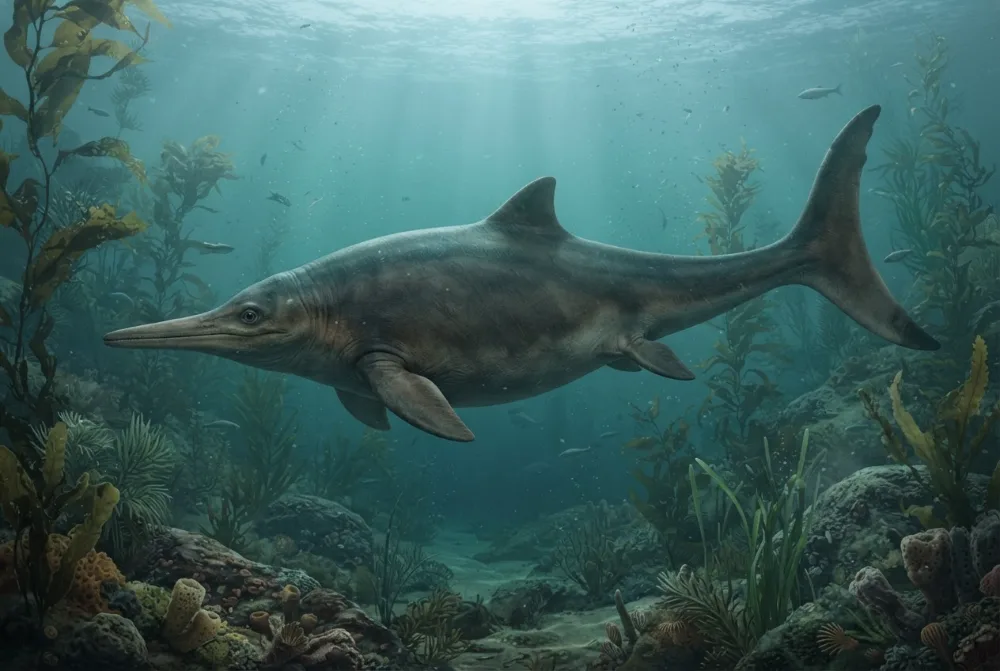
Cryopterygius was a large, fish-shaped marine reptile that lived in the chilly seas near the North Pole during the Late Jurassic. It was an ichthyosaur, not a dinosaur, and its fossil was dug out of permafrost, which is frozen ground.1
When did it live?
How big was it?
How long was it?
How big was Cryopterygius compared to YOU?
Just maths in your browser. Nothing is saved or sent anywhere.
Fun facts
The name Cryopterygius means 'cold fin' or 'frozen fin' because it was found in frozen ground in a very cold place.1
Its skeleton was nearly complete and still joined together, which is very rare for an ichthyosaur fossil.1
Cryopterygius had 52 vertebrae in front of its hips, which is a lot for an ichthyosaur.1
Its upper arm bone, the humerus, had only two bumps at the end where it connected to the rest of the fin.1
It lived in the Late Jurassic, about 149 to 143 million years ago, in the cold polar seas.4
Scientists found a complete left hip and leg, which helped them understand how ichthyosaurs moved their hind fins.1

Ask Rex about Cryopterygius
Rex only answers questions about this page. 3 questions a day.
Rex is an AI and can make mistakes. He runs on servers in the EU and questions are never saved. Never type your name or other personal things.
For dino experts
- Scientific name
- Cryopterygius
- Named by
- Druckenmiller et al. 20124
- Group
- Ichthyosaurs
- Family / clade
- Ophthalmosauridae4
- Classification
- Ichthyosauria > Ichthyosauromorpha4
- Age of the rocks
- 149 to 143 million years (Tithonian)4
- Rock formations
- Agardhfjellet, Kcynia4
- Countries
- Norway, Poland4
- Fossil records
- 2 in the Paleobiology Database4
- Discovery
- Cryopterygius was named in 2012 by Patrick Druckenmiller, Jørn Hurum, Espen Knutsen and Hans Nakrem. The nearly complete skeleton was found on the north side of Janusfjellet, near Longyearbyen, Svalbard, Norway.1
Where the facts come from
- Two new ophthalmosaurids (Reptilia: Ichthyosauria) from the Agardhfjellet Formation (Upper Jurassic: Volgian/Tithonian), Svalbard, Norway (njg.geologi.no)
- Two new ophthalmosaurids (Reptilia: Ichthyosauria) from the Agardhfjellet Formation (Upper Jurassic: Volgian/Tithonian), Svalbard, Norway (geologi.no)
- Cryopterygius (en.wikipedia.org)
- Cryopterygius in The Paleobiology Database (CC BY 4.0): age, places, rock formations, classification.
Every fact on this page has a number that points to its source. If we got something wrong, sorry, we are dino fans, not a science journal. Tell us at [email protected] and we will fix it.
 Rex is hungry! Dino Wiki is a dad's project for his dino-loving son, free with no ads. Grown-ups can feed Rex a snack to help keep it online.Feed Rex
 Ichthyosaurus
 Platypterygius
 Stenopterygius
 Khudiakovia
 Ophthalmosaurus
 Chonespondylus
 Brachiosaurus
 Diplodocus
 Allosaurus
 Brontosaurus
 Compsognathus
 Camarasaurus