
Dracovenator
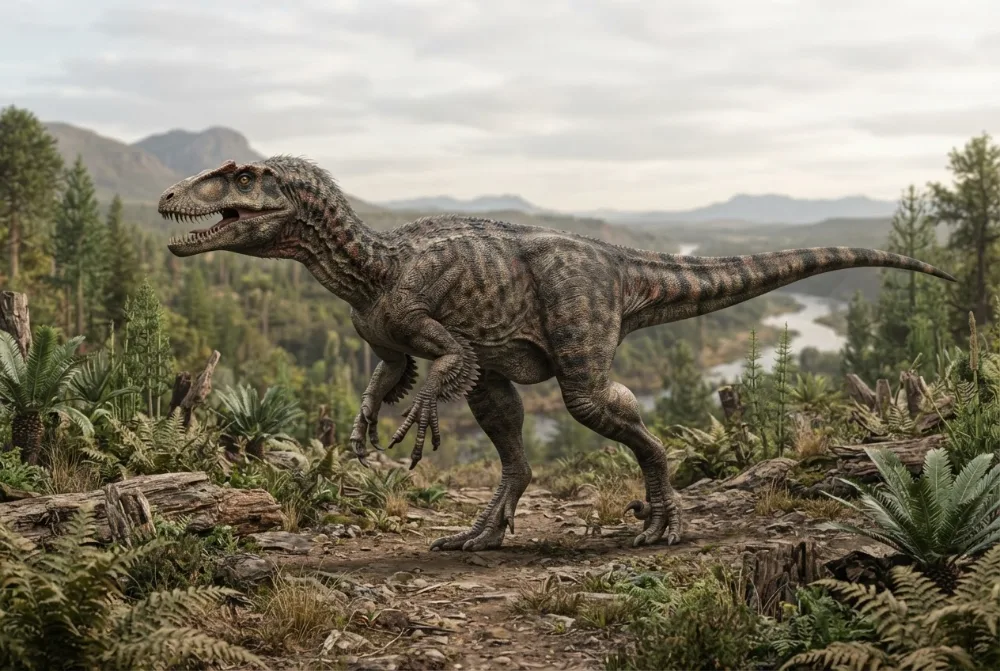
Dracovenator was a meat-eating dinosaur that lived in what is now South Africa. It was a fast, two-legged hunter with a kink in its upper jaw. Scientists think it hunted big plant-eaters like Massospondylus.1
When did it live?
How big was it?
How long was it?
How tall was it?
at the hips
How heavy was it?
How big was Dracovenator compared to YOU?
Just maths in your browser. Nothing is saved or sent anywhere.
Fun facts
Dracovenator had a kink in its upper jaw, between the maxilla and the premaxilla, similar to Dilophosaurus.1
The back of its lower jaw had lumps and bumps, a feature also seen in Dilophosaurus but smaller.1
The only fossils found so far are a partial skull and some jaw bones. The original skull was lost after being stored at a university.1
Dracovenator lived during the Early Jurassic, about 201 to 199 million years ago.1
Its name comes from the Drakensberg mountains, which means 'Dragon's Mountain' in Dutch.1
The species name regenti honors Regent 'Lucas' Huma, the field assistant who helped discover the fossils.1
Most asked questions about Dracovenator
?How big was Dracovenator?
About 5.5 to 6.5 metres (18 to 21 feet) long and weighed around 250 kilograms (550 pounds). Some footprints suggest it might have been up to 9 metres (30 feet) long, but that is not certain.1
?What did Dracovenator eat?
It was a meat-eater that hunted big plant-eating dinosaurs like Massospondylus.1
?When did Dracovenator live?
It lived during the Early Jurassic period, about 201 to 199 million years ago.1
?Where was Dracovenator found?
Its fossils were discovered in the Upper Drumbo Farm area of the Eastern Cape Province in South Africa.1
?Is Dracovenator related to Dilophosaurus?
Yes, scientists think Dracovenator was closely related to Dilophosaurus and another dinosaur called Zupaysaurus.1
?Why is it called Dracovenator?
Its name means 'dragon hunter' in Latin, because it was found near the Drakensberg mountains, which are called 'Dragon's Mountain' in Dutch.1
Ask Rex about Dracovenator
Rex only answers questions about this page. 3 questions a day.
Rex is an AI and can make mistakes. He runs on servers in the EU and questions are never saved. Never type your name or other personal things.
For dino experts
- Scientific name
- Dracovenator
- Named by
- Yates 20054
- Group
- Meat-eating dinos
- Family / clade
- Neotheropoda4
- Classification
- Theropoda4
- Age of the rocks
- 201 to 193 million years (Hettangian / Sinemurian)4
- Rock formations
- Elliot4
- Countries
- South Africa4
- Fossil records
- 2 in the Paleobiology Database4
- Discovery
- Dracovenator was named by Adam M. Yates in 2005. The first fossils were found by James Kitching and Regent Huma at Upper Drumbo Farm in South Africa.1
- Still debated
- Scientists are not sure exactly how Dracovenator is related to other early theropods. Some studies place it close to Dilophosaurus, but the evidence is not strong.2
Where the facts come from
- Dracovenator (en.wikipedia.org)
- A new theropod dinosaur from the Early Jurassic of South Africa and its implications for the early evolution of theropods (web.archive.org)
- Dracovenator: The Dragon Hunter of Early Jurassic (thedinosaurs.org)
- Dracovenator in The Paleobiology Database (CC BY 4.0): age, places, rock formations, classification.
Every fact on this page has a number that points to its source. If we got something wrong, sorry, we are dino fans, not a science journal. Tell us at [email protected] and we will fix it.
 Rex is hungry! Dino Wiki is a dad's project for his dino-loving son, free with no ads. Grown-ups can feed Rex a snack to help keep it online.Feed Rex
 Allosaurus
 Carnotaurus
 Dilophosaurus
 Giganotosaurus
 Compsognathus
 Paronychodon
 Stenopterygius
 Dorygnathus
 Lufengosaurus
 Scutellosaurus
 Yunnanosaurus
 Temnodontosaurus