
Europasaurus
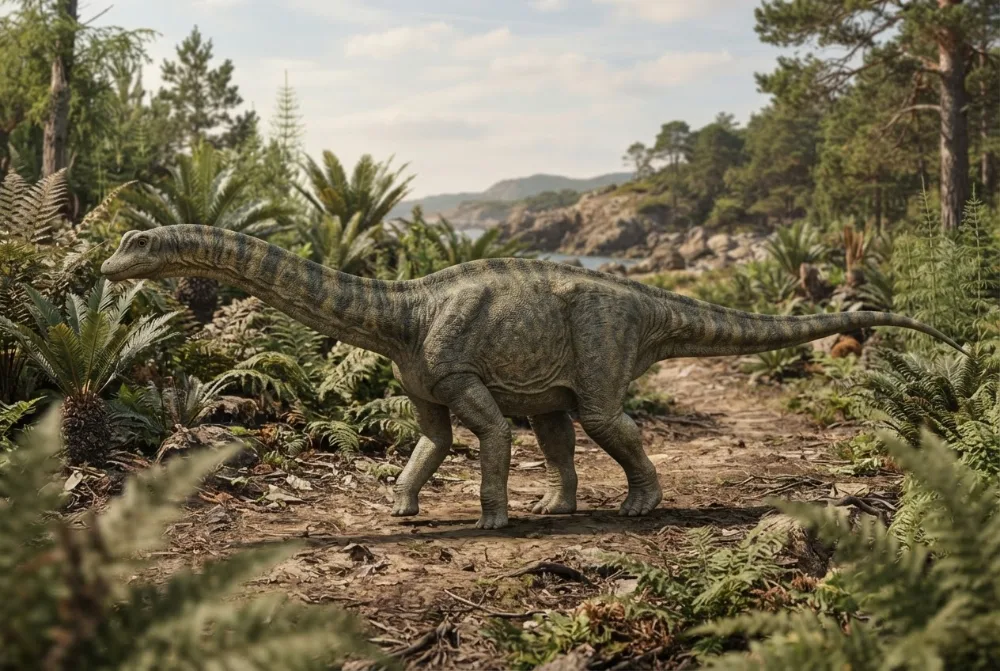
Europasaurus was a tiny sauropod dinosaur that lived on an island in what is now Germany. It was a dwarf, much smaller than its giant relatives like Brachiosaurus. Scientists think it shrank because food was limited on its island home.21
When did it live?
How big was it?
How long was it?
How heavy was it?
How big was Europasaurus compared to YOU?
Just maths in your browser. Nothing is saved or sent anywhere.
Fun facts
Europasaurus is one of the smallest known sauropods, only about as long as a car.1
It lived during the Late Jurassic, about 154 to 151 million years ago.1
The first fossil was a single tooth found by a private collector named Holger Lüdtke in 1998.1
Bone studies show that Europasaurus grew more slowly than its giant relatives, a sign of island dwarfism.2
About one third of the Europasaurus bones found have tooth marks, probably from fish or crocodile-like scavengers.1
Young Europasaurus had well-developed inner ears, meaning they could probably hear well and may have stayed close to adults for protection.1
Most asked questions about Europasaurus
?How big was Europasaurus?
About 5.7 to 6.2 metres long, weighing 750 to 2,100 kilograms as an adult. That is roughly as long as a car.13
?Why was Europasaurus so small?
It was a dwarf species due to insular dwarfism, meaning it shrank because it lived on an island with limited food. Bone studies show it grew more slowly than its giant relatives.21
?What did Europasaurus eat?
It was herbivorous, meaning it ate plants. Conifer cones and twigs from araucarian trees (like modern monkey puzzle trees) have been found at its fossil site.31
?Did Europasaurus live in herds?
Yes, fossils of at least 11 individuals were found together, suggesting they lived in groups. Scientists think a herd might have drowned while crossing a tidal zone.1
?When did Europasaurus live?
It lived during the Late Jurassic Period, about 154 to 151 million years ago.13
?Where was Europasaurus found?
Its fossils were found in a quarry at Langenberg Mountain in northern Germany. It lived on an island in the Lower Saxony basin.1
Ask Rex about Europasaurus
Rex only answers questions about this page. 10 questions a month.
Rex is an AI and can make mistakes. He runs on servers in the EU and questions are never saved. Never type your name or other personal things.
For dino experts
- Scientific name
- Europasaurus
- Named by
- Sander et al. 20064
- Group
- Long-necks
- Family / clade
- Camarasauromorpha4
- Classification
- Sauropodomorpha > Sauropoda > Macronaria4
- Age of the rocks
- 152 to 149 million years (Kimmeridgian)4
- Rock formations
- Süntel4
- Countries
- Germany4
- Fossil records
- 1 in the Paleobiology Database4
- Discovery
- The first fossils were found in 1998 by Holger Lüdtke in a quarry in Germany. After more bones were found, the species was named Europasaurus holgeri in 2006 by Sander and colleagues.1
- Still debated
- Scientists are not sure exactly why Europasaurus became so small, but they think it was because it lived on an island with limited food.2
Where the facts come from
- Europasaurus (en.wikipedia.org)
- nature.com (nature.com)
- Europasaurus | Natural History Museum (nhm.ac.uk)
- Europasaurus in The Paleobiology Database (CC BY 4.0): age, places, rock formations, classification.
Every fact on this page has a number that points to its source. If we got something wrong, sorry, we are dino fans, not a science journal. Tell us at [email protected] and we will fix it.
 Rex is hungry! Dino Wiki is a dad's project for his dino-loving son, free with no ads. Grown-ups can feed Rex a snack to help keep it online.Feed Rex
 Brachiosaurus
 Diplodocus
 Brontosaurus
 Argentinosaurus
 Camarasaurus
 Morosaurus
 Allosaurus
 Compsognathus
 Camptosaurus
 Nanosaurus
 Rhamphorhynchus
 Ceratosaurus