 Home
 All dinos
 Dino groups
 Explore
 Dinos by country
 Dino vs dino
 How big were they?
 Dinos A to Z
 Who ate what?
 What dino are you? Quiz
 Dino games
 Dino battle
 Dino race
 Dino mini-games
 Sticker album
 Dino TOP lists
 Timeline
 Surprise me!
 Language: English
 USA
When did it live?
Galeamopus: 155 to 143 million years ago

How big was it?
How long was it?
How tall was it?
estimate
 as long as 3 cars parked in a row🍌as long as 78 bananas end to end🏃could run 100 metres in 21 seconds (the fastest human needs 9.6)
How big was Galeamopus compared to YOU?
Just maths in your browser. Nothing is saved or sent anywhere.
How fast was it?


Fun facts
Galeamopus was named in 2015, but its fossils were first found in 1884.1
The name Galeamopus means 'helmet need', a joke about the brittle braincase of the type specimen.1
Galeamopus had a unique skull with a curved paroccipital process on the back of the head.1
It had thirteen unique features that set it apart from other diplodocid dinosaurs.1
The first Galeamopus skeleton was found by William H. Utterback in 1902 near Sheridan, Wyoming.1
One Galeamopus specimen, nicknamed 'Max', was discovered in 1995 at the Howe-Stephens Quarry.1
Most asked questions about Galeamopus
?How big was Galeamopus?
Scientists have not published a specific length or weight for Galeamopus, but as a diplodocid sauropod it was probably similar in size to other diplodocids, which could reach about 25 metres (82 feet) long.1
?When did Galeamopus live?
Galeamopus lived during the Late Jurassic, about 155 to 152 million years ago.13
?What did Galeamopus eat?
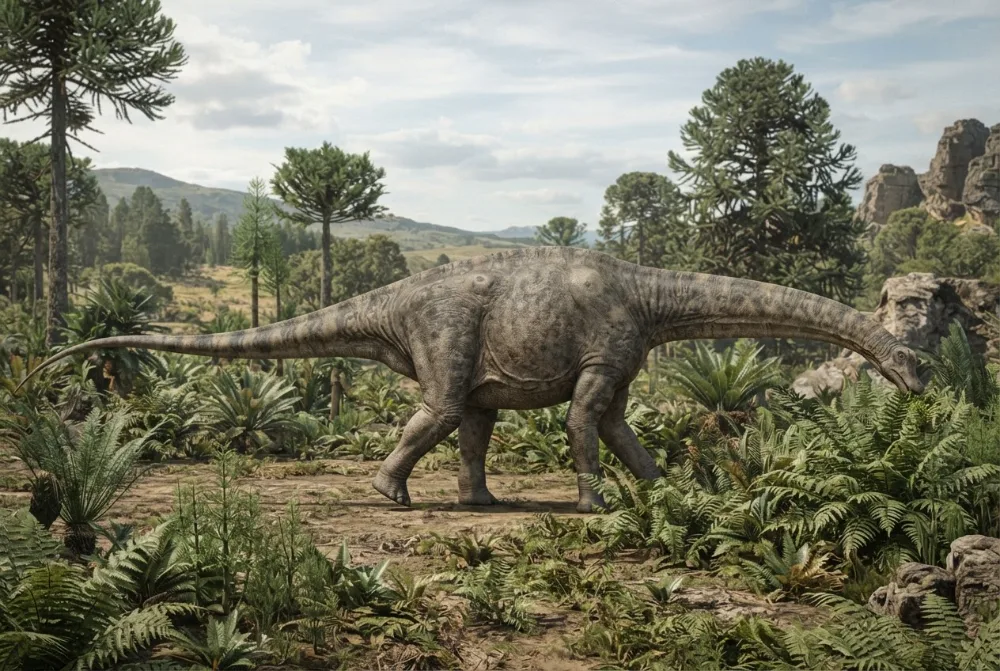
Galeamopus was a herbivore that ate plants like ferns, as mentioned in the page intro.1
For dino experts
- Scientific name
- Galeamopus
- Named by
- Tschopp et al. 20155
- Group
- Long-necks
- Family / clade
- Diplodocidae5
- Classification
- Sauropodomorpha > Sauropoda > Diplodocoidea5
- Age of the rocks
- 155 to 143 million years (Kimmeridgian / Tithonian)5
- Rock formations
- Morrison5
- Countries
- USA5
- Fossil records
- 6 in the Paleobiology Database5
- Discovery
- The first fossils of Galeamopus were collected in 1884 by Marshall P. Felch in Colorado, but the genus was named in 2015 by Emanuel Tschopp, Octávio Mateus, and Roger Benson.1
- Still debated
- Scientists are still debating whether some Galeamopus specimens belong to a separate species or are just variations of the same species.1
Where the facts come from
- Galeamopus (en.wikipedia.org)
- ncbi.nlm.nih.gov (ncbi.nlm.nih.gov)
- Paleo Profile: The "Need Helmet" Dinosaur | Scientific American (scientificamerican.com)
- PeerJ Osteology of Galeamopus pabsti sp. nov. (Sauropoda: Diplodocidae), with implications for neurocentral closure timing, and the cervico-dorsal transition in diplodocids (peerj.com)
- Galeamopus in The Paleobiology Database (CC BY 4.0): age, places, rock formations, classification.
Every fact on this page has a number that points to its source. If we got something wrong, sorry, we are dino fans, not a science journal. Tell us at hello@dinowiki.app and we will fix it.
 Rex is hungry! Dino Wiki is a dad's project for his dino-loving son, free with no ads and no cookies. Grown-ups can feed Rex a snack to help keep it online.Feed Rex
 Brachiosaurus
 Diplodocus
 Brontosaurus
 Argentinosaurus
 Camarasaurus
 Morosaurus
 Stegosaurus
 Allosaurus
 Compsognathus
 Camptosaurus
 Nanosaurus
 Rhamphorhynchus