
Hudiesaurus
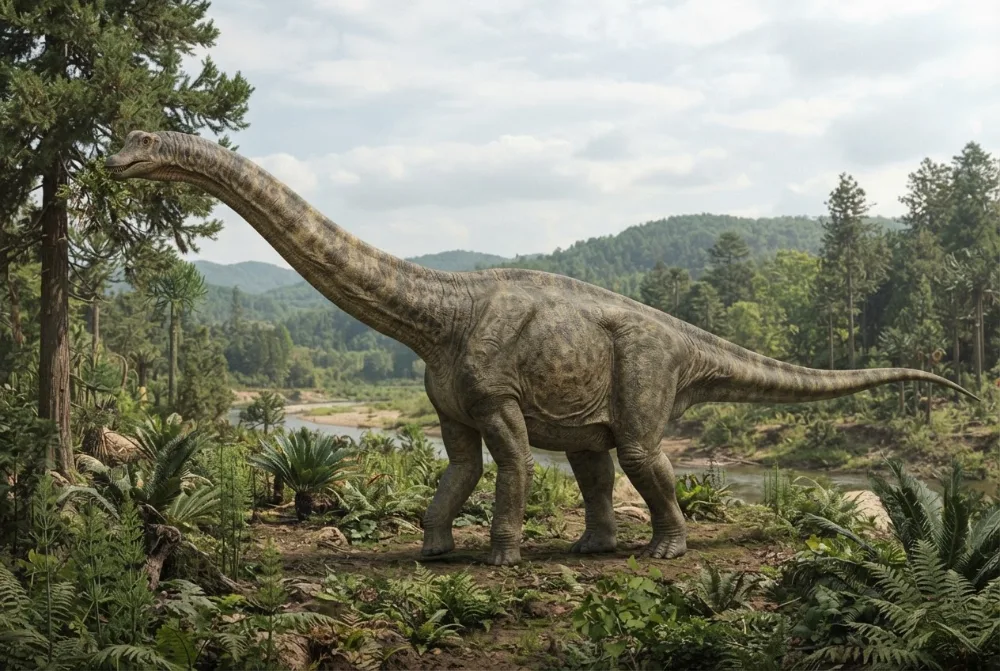
Hudiesaurus was a gigantic, long-necked plant-eater that stomped through Late Jurassic China. It was one of the biggest dinosaurs ever, with a neck so long it could probably reach high into the treetops. Its name comes from the butterfly-like split on its backbone spines.1
When did it live?
How big was it?
How long was it?
How tall was it?
shoulder height, estimate
How heavy was it?
How big was Hudiesaurus compared to YOU?
Just maths in your browser. Nothing is saved or sent anywhere.
Fun facts
Hudiesaurus might have been as long as three school buses parked end to end, reaching up to 32 metres (105 feet).1
Its backbone had a split spine at the top, which helped strong neck muscles attach. This gave it extra control over its long neck.1
The only definite fossil is a single backbone, but it was huge, measuring 55 centimetres (22 inches) long.1
Hudiesaurus lived about 154 to 143 million years ago, during the Late Jurassic period.1
Some bones that were once thought to be Hudiesaurus are now given to another dinosaur called Rhomaleopakhus.1
It had air-filled cavities in its backbone, which made its huge bones lighter, like a bird's bones.1
Most asked questions about Hudiesaurus
?How big was Hudiesaurus?
It was one of the largest dinosaurs, possibly reaching 32 metres in length and weighing 55 tonnes. Some estimates put it at 30.5 metres and 44 tonnes.1
?What did Hudiesaurus eat?
It was a plant-eater, eating leaves and other vegetation. As a sauropod with a long neck, it could reach high into trees or browse low plants.1
?When did Hudiesaurus live?
It lived during the Late Jurassic period, about 154 to 143 million years ago.1

Ask Rex about Hudiesaurus
Rex only answers questions about this page. 3 questions a day.
Rex is an AI and can make mistakes. He runs on servers in the EU and questions are never saved. Never type your name or other personal things.
Myth buster
Myth: Hudiesaurus is sometimes said to be a meat-eater because of its big teeth.
Truth: Actually, Hudiesaurus was a plant-eater. Its teeth were for stripping leaves, not for hunting.1
For dino experts
- Scientific name
- Hudiesaurus
- Named by
- Dong 19972
- Group
- Long-necks
- Family / clade
- Mamenchisauridae2
- Classification
- Sauropodomorpha > Sauropoda2
- Age of the rocks
- 152 to 143 million years (Kimmeridgian / Tithonian)2
- Rock formations
- Kalazha2
- Countries
- China2
- Fossil records
- 1 in the Paleobiology Database2
- Discovery
- Hudiesaurus was named by Chinese paleontologist Dong Zhiming in 1997, after the Sino-Japanese Silk Road Expedition found its fossils in 1993 near Qiketai, China.1
- Still debated
- Scientists still debate whether the single backbone came from the neck or the back, which changes the size estimate.1
Where the facts come from
- Hudiesaurus (en.wikipedia.org)
- Hudiesaurus in The Paleobiology Database (CC BY 4.0): age, places, rock formations, classification.
Every fact on this page has a number that points to its source. If we got something wrong, sorry, we are dino fans, not a science journal. Tell us at [email protected] and we will fix it.
 Rex is hungry! Dino Wiki is a dad's project for his dino-loving son, free with no ads. Grown-ups can feed Rex a snack to help keep it online.Feed Rex
 Brachiosaurus
 Diplodocus
 Brontosaurus
 Argentinosaurus
 Camarasaurus
 Morosaurus
 Allosaurus
 Compsognathus
 Camptosaurus
 Nanosaurus
 Rhamphorhynchus
 Ceratosaurus