
Irisosaurus
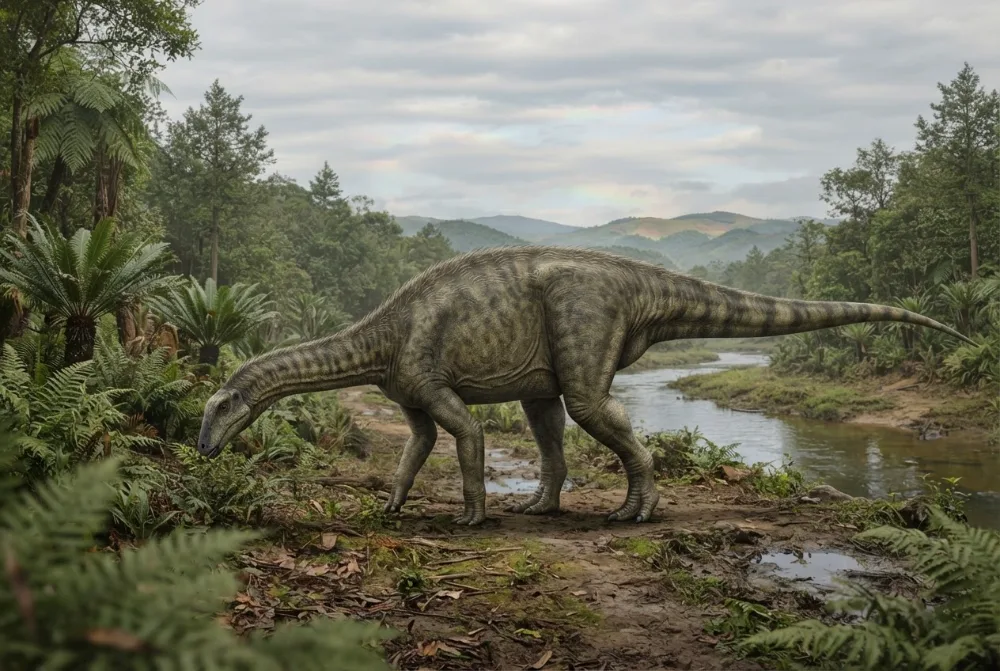
Irisosaurus was an early long-necked dinosaur that lived in what is now China. It walked on four legs and munched on plants with its small teeth. This dinosaur is named after the beautiful rainbow clouds that float over the region where its fossils were found.13
When did it live?
Fun facts
Irisosaurus is a sauropodiform, meaning it is an early relative of the giant long-necked sauropods like Brachiosaurus.1
The only known fossil of Irisosaurus is a partial skeleton called the holotype, found in 2018.1
Irisosaurus lived during the Early Jurassic Period, about 192 to 184 million years ago.3
Scientists think Irisosaurus was a close relative of Mussaurus, another early sauropodomorph.1

Ask Rex about Irisosaurus
Rex only answers questions about this page. 3 questions a day.
Rex is an AI and can make mistakes. He runs on servers in the EU and questions are never saved. Never type your name or other personal things.
For dino experts
- Scientific name
- Irisosaurus
- Named by
- Peyre de Fabrègues et al. 20203
- Group
- Long-necks
- Family / clade
- Sauropodiformes3
- Classification
- Sauropodomorpha3
- Age of the rocks
- 193 to 184 million years (Pliensbachian)3
- Rock formations
- Fengjiahe3
- Countries
- China3
- Fossil records
- 1 in the Paleobiology Database3
- Discovery
- Irisosaurus was named in 2020 by a team of scientists including Claire Peyre de Fabrègues. The fossils were found in the Fengjiahe Formation in Yimen County, China, during the summer of 2018.12
- Still debated
- Scientists are not sure exactly how large Irisosaurus grew, because only one partial skeleton has been found.1
Where the facts come from
- Irisosaurus (en.wikipedia.org)
- Author Correction: A new species of early-diverging Sauropodiformes from the Lower Jurassic Fengjiahe Formation of Yunnan Province, China | Scientific Reports (nature.com)
- Irisosaurus in The Paleobiology Database (CC BY 4.0): age, places, rock formations, classification.
Every fact on this page has a number that points to its source. If we got something wrong, sorry, we are dino fans, not a science journal. Tell us at [email protected] and we will fix it.
Rex is hungry! Dino Wiki is a dad's project for his dino-loving son, free with no ads. Grown-ups can feed Rex a snack to help keep it online.Feed Rex Brachiosaurus
 Diplodocus
 Brontosaurus
 Argentinosaurus
 Camarasaurus
 Morosaurus
 Dilophosaurus
 Stenopterygius
 Dorygnathus
 Scutellosaurus
 Sinosaurus
 Temnodontosaurus