
Jingiella
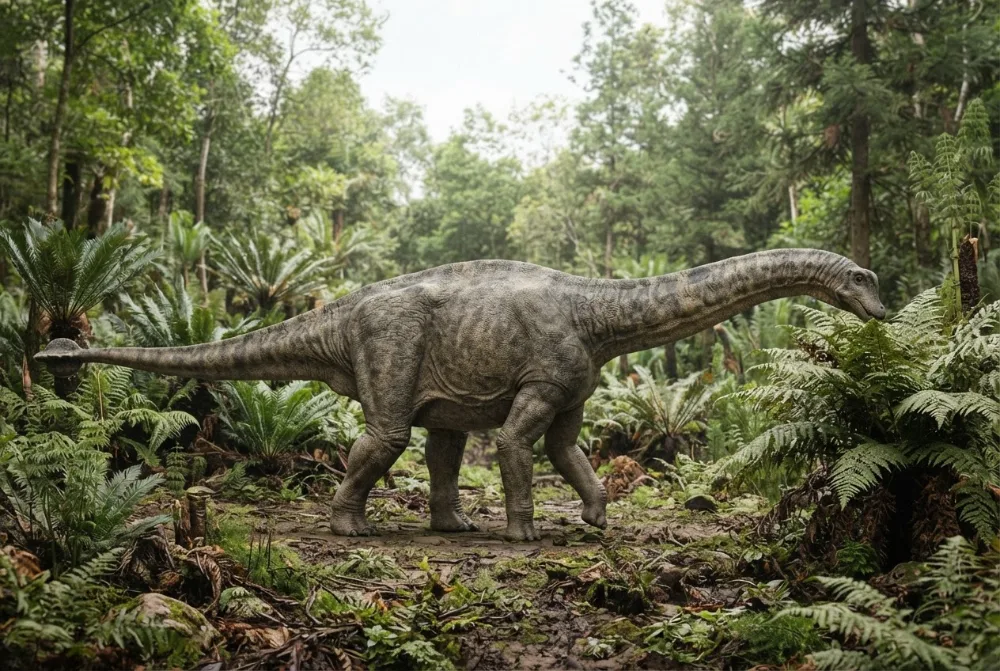
Jingiella was a long-necked sauropod dinosaur that lived in what is now southern China. It munched on plants and walked on four sturdy legs. This dinosaur was first thought to be called Jingia, but that name was already taken by a moth, so scientists changed it to Jingiella.1
When did it live?
How big was it?
How big was Jingiella compared to YOU?
Just maths in your browser. Nothing is saved or sent anywhere.
Fun facts
Jingiella lived about 154 to 149 million years ago, during the Late Jurassic period.2
Its fossils include parts of the backbone, hip bones, arm bones, and a thigh bone.1
Jingiella belongs to a group of sauropods called mamenchisaurids, which are known for their very long necks.1
The first name for this dinosaur, Jingia, was already used for a moth, so scientists renamed it Jingiella in 2024.1
Jingiella had tall and narrow spines on its back vertebrae, similar to its relative Mamenchisaurus.1
The tail vertebrae of Jingiella were concave on both ends, like in more primitive sauropods, but different from Mamenchisaurus.1

Ask Rex about Jingiella
Rex only answers questions about this page. 3 questions a day.
Rex is an AI and can make mistakes. He runs on servers in the EU and questions are never saved. Never type your name or other personal things.
For dino experts
- Scientific name
- Jingiella
- Named by
- Ren et al. 20243
- Group
- Long-necks
- Family / clade
- Mamenchisauridae3
- Classification
- Sauropodomorpha > Sauropoda3
- Age of the rocks
- 155 to 149 million years (Kimmeridgian)3
- Rock formations
- Dongxing3
- Countries
- China3
- Fossil records
- 1 in the Paleobiology Database3
- Discovery
- Jingiella was named in 2024 by Ren and colleagues based on fossils found in Dongxing, Guangxi, China. The bones were restored at the Chongzhou Tianyan Museum.1
- Still debated
- Scientists are not sure exactly how long Jingiella's neck was, because only a few neck bones have been found.1
Where the facts come from
- Jingiella (en.wikipedia.org)
- PBDB Taxon (paleobiodb.org)
- Jingiella in The Paleobiology Database (CC BY 4.0): age, places, rock formations, classification.
Every fact on this page has a number that points to its source. If we got something wrong, sorry, we are dino fans, not a science journal. Tell us at [email protected] and we will fix it.
Rex is hungry! Dino Wiki is a dad's project for his dino-loving son, free with no ads. Grown-ups can feed Rex a snack to help keep it online.Feed Rex Brachiosaurus
 Diplodocus
 Brontosaurus
 Argentinosaurus
 Camarasaurus
 Morosaurus
 Allosaurus
 Compsognathus
 Camptosaurus
 Nanosaurus
 Rhamphorhynchus
 Ceratosaurus