
Kaatedocus
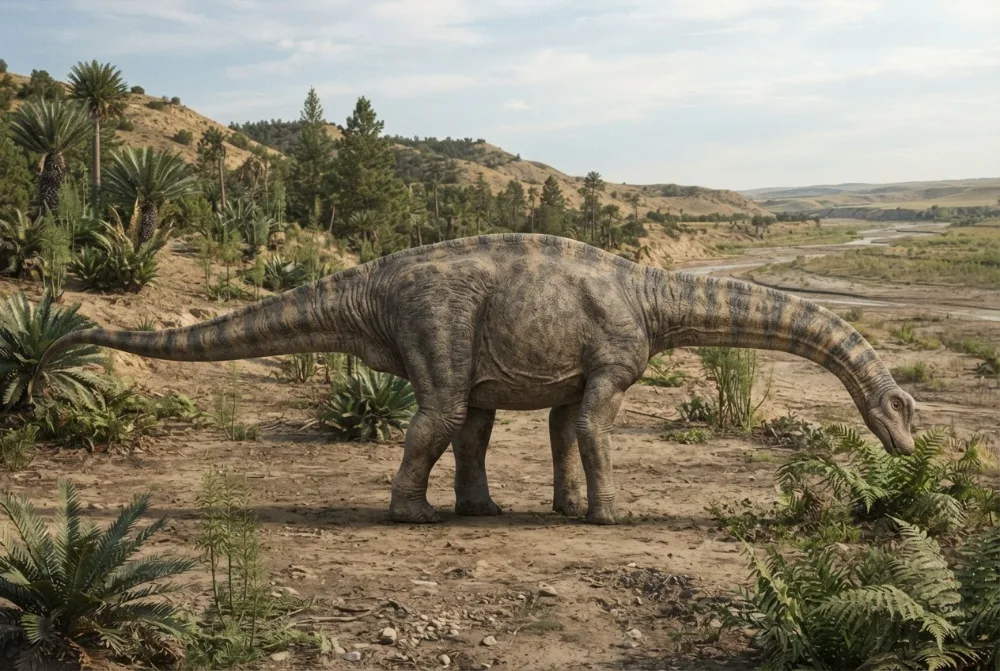
Kaatedocus was a long-necked sauropod that lived in what is now Wyoming during the Late Jurassic. It was smaller than many of its relatives, only about 14 metres long. Its well-preserved skull and neck helped scientists learn how sauropods held their heads.12
When did it live?
How big was it?
How long was it?
How big was Kaatedocus compared to YOU?
Just maths in your browser. Nothing is saved or sent anywhere.
Fun facts
Kaatedocus was named in 2012 by paleontologists Emanuel Tschopp and Octávio Mateus.1
Its name comes from the Crow Indian word 'kaate' meaning 'small' and 'docus' from Diplodocus, so 'small beam'.1
The only known specimen includes a nearly complete skull and a neck made of at least 14 vertebrae.1
The skull and neck together measured about 3.8 metres (12 feet) long.1
The fossils were originally thought to belong to Barosaurus or Diplodocus before being recognized as a new dinosaur.2
Scientists used CT scans and 3D printing to study Kaatedocus's neck vertebrae and learn how sauropods held their necks upright.1
Most asked questions about Kaatedocus
?How big was Kaatedocus?
About 14 metres (46 feet) long. That is smaller than many of its relatives like Diplodocus.12
?What did Kaatedocus eat?
Plants. It was a sauropod with peg-like teeth at the front of its mouth, good for stripping leaves.2
?When did Kaatedocus live?
It lived during the Late Jurassic, about 155 million years ago.1
?Why is it called Kaatedocus?
Its name comes from the Crow Indian word 'kaate' meaning 'small' and 'docus' from Diplodocus, so 'small beam'.1
Ask Rex about Kaatedocus
Rex only answers questions about this page. 3 questions a day.
Rex is an AI and can make mistakes. He runs on servers in the EU and questions are never saved. Never type your name or other personal things.
Myth buster
Myth: Some scientists thought Kaatedocus was just a young Barosaurus or Diplodocus.
Truth: Kaatedocus is now considered a distinct genus based on unique features in its skull and vertebrae.2
For dino experts
- Scientific name
- Kaatedocus
- Named by
- Tschopp and Mateus 20134
- Group
- Long-necks
- Family / clade
- Dicraeosauridae4
- Classification
- Sauropodomorpha > Sauropoda > Diplodocoidea4
- Age of the rocks
- 155 to 149 million years (Kimmeridgian)4
- Rock formations
- Morrison4
- Countries
- USA4
- Fossil records
- 1 in the Paleobiology Database4
- Discovery
- Fossils were first excavated in 1934 by Barnum Brown's team at Howe Quarry in Wyoming. The dinosaur was named Kaatedocus siberi in 2012 by Emanuel Tschopp and Octávio Mateus.1
- Still debated
- Scientists are not sure if Kaatedocus is a distinct genus or a juvenile of another sauropod like Barosaurus.2
Where the facts come from
- Kaatedocus (en.wikipedia.org)
- Jurassic Boneyard Yields Hidden Dinosaur | National Geographic (nationalgeographic.com)
- PBDB Taxon (paleobiodb.org)
- Kaatedocus in The Paleobiology Database (CC BY 4.0): age, places, rock formations, classification.
Every fact on this page has a number that points to its source. If we got something wrong, sorry, we are dino fans, not a science journal. Tell us at [email protected] and we will fix it.
 Rex is hungry! Dino Wiki is a dad's project for his dino-loving son, free with no ads. Grown-ups can feed Rex a snack to help keep it online.Feed Rex
 Brachiosaurus
 Diplodocus
 Brontosaurus
 Argentinosaurus
 Camarasaurus
 Morosaurus
 Allosaurus
 Compsognathus
 Camptosaurus
 Nanosaurus
 Rhamphorhynchus
 Ceratosaurus