
Leptonectes
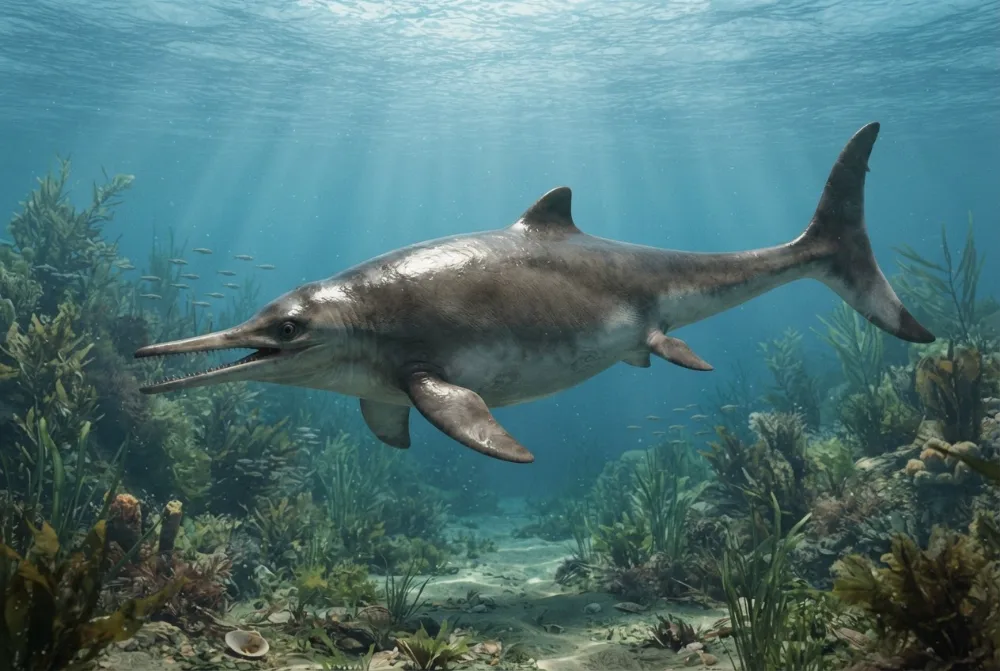
Leptonectes was a sleek, long-snouted marine reptile that swam in the seas during the time of the dinosaurs. It was not a dinosaur, but a type of ichthyosaur, with a body shaped like a fish and flippers for steering. It hunted small sea creatures with its slender jaws.12
When did it live?
How big was it?
How long was it?
How big was Leptonectes compared to YOU?
Just maths in your browser. Nothing is saved or sent anywhere.
Fun facts
Leptonectes had a very long and slender snout, which is why its name means 'slender swimmer'.1
The name Leptonectes was proposed in 1996 to replace the older name Leptopterygius, because that name was already used for another animal.1
Leptonectes lived from about 205.7 to 182.9 million years ago, during the Late Triassic and Early Jurassic periods.2
Its front flippers were longer than its back flippers, but not twice as long.2
Leptonectes had large eyes and a slightly raised area on its skull near the cheekbones.2
The bones in its flippers were rounded and spaced apart, which may have made its flippers flexible.2
Leptonectes gave birth to live young, just like other ichthyosaurs, instead of laying eggs.2
Most asked questions about Leptonectes
?How big was Leptonectes?
The biggest species, Leptonectes solei, was about 5 to 6 metres (16 to 20 ft) long. The type species, L. tenuirostris, reached 4 metres (13 ft), and L. moorei was about 3 metres (9.8 ft).3
?Was Leptonectes a dinosaur?
No, Leptonectes was not a dinosaur. It was an ichthyosaur, a marine reptile that lived in the sea at the same time as dinosaurs.3
?What did Leptonectes eat?
Leptonectes hunted small sea creatures with its long, slender jaws. Its sharp teeth helped it catch fish and other marine animals.3

Ask Rex about Leptonectes
Rex only answers questions about this page. 3 questions a day.
Rex is an AI and can make mistakes. He runs on servers in the EU and questions are never saved. Never type your name or other personal things.
Myth buster
Myth: Some people think Leptonectes was a dinosaur because it lived during the time of dinosaurs.
Truth: Leptonectes was not a dinosaur. It was a marine reptile called an ichthyosaur, which lived in the ocean.2
For dino experts
- Scientific name
- Leptonectes
- Named by
- McGowan 19964
- Group
- Ichthyosaurs
- Family / clade
- Neoichthyosauria4
- Classification
- Ichthyosauria > Ichthyosauromorpha4
- Age of the rocks
- 206 to 183 million years (Rhaetian / Toarcian)4
- Rock formations
- Charmouth Mudstone, Blue Lias, Posidonia Shale4
- Countries
- United Kingdom, Switzerland, Germany, Belgium, Austria4
- Fossil records
- 12 in the Paleobiology Database4
- Also known as
- Leptopterygius (older names now counted as the same animal)4
- Discovery
- The name Leptonectes was created by Chris McGowan in 1996 to replace the old name Leptopterygius. The first species, Leptonectes tenuirostris, was originally named by Conybeare in 1822.1
- Still debated
- Scientists still debate exactly which species belong to Leptonectes and how they are related to other ichthyosaurs.1
Where the facts come from
- The taxonomic status of Leptopterygius Huene, 1922 (Reptilia: Ichthyosauria) (cdnsciencepub.com)
- PBDB Taxon (paleobiodb.org)
- Leptonectes (en.wikipedia.org)
- Leptonectes in The Paleobiology Database (CC BY 4.0): age, places, rock formations, classification.
Every fact on this page has a number that points to its source. If we got something wrong, sorry, we are dino fans, not a science journal. Tell us at [email protected] and we will fix it.
 Rex is hungry! Dino Wiki is a dad's project for his dino-loving son, free with no ads. Grown-ups can feed Rex a snack to help keep it online.Feed Rex
 Ichthyosaurus
 Platypterygius
 Stenopterygius
 Khudiakovia
 Ophthalmosaurus
 Chonespondylus
 Dilophosaurus
 Dorygnathus
 Lufengosaurus
 Scutellosaurus
 Yunnanosaurus
 Sinosaurus