
 Get the Dino Wiki app
 Home
 All dinos
 Dino groups
 Explore
 Dinos by country
 Dino vs dino
 How big were they?
 Dinos A to Z
 Who ate what?
 What dino are you? Quiz
 Dino games
 Dino battle
 Dino race
 Dino mini-games
 Sticker album
 Dino TOP lists
 Timeline
 Surprise me!
 Language: English

Rhomaleopakhus
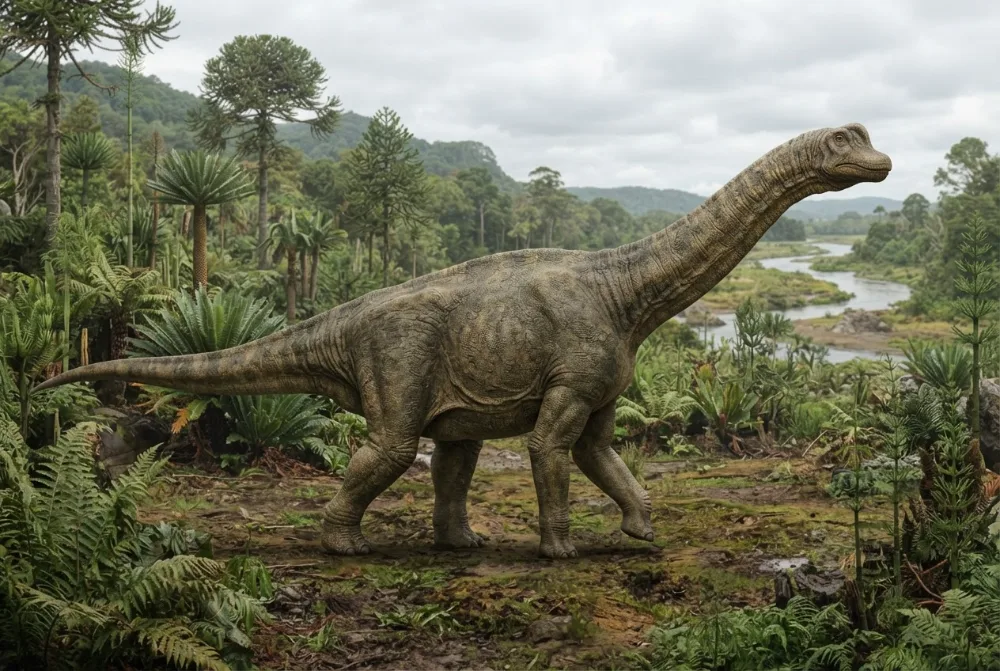
Rhomaleopakhus was a huge, long-necked plant-eater that lived in what is now China. Its front legs were extra strong and stocky, which is why its name means 'strong forearm'. It walked on four legs and used its long neck to reach leaves high up in trees.12
 China
When did it live?
Rhomaleopakhus: 152 to 143 million years ago
How big was it?
How long was it?
How tall was it?
estimate
 as long as 6 cars parked in a row🍌as long as 140 bananas end to end🏢tall enough to peek into a window on floor 2🏃could run 100 metres in 30 seconds (the fastest human needs 9.6)
How big was Rhomaleopakhus compared to YOU?
Just maths in your browser. Nothing is saved or sent anywhere.
How fast was it?


Fun facts
Rhomaleopakhus had one of the most robust (thick and strong) ulna bones of any known sauropod dinosaur.3
Its forearm bones were so strong that scientists think it evolved them separately from other sauropods, a process called convergent evolution.1
The only fossil found so far is a right forelimb, including the upper arm bone, two lower arm bones, a wrist bone, and a nearly complete hand.3
Rhomaleopakhus lived during the Late Jurassic period, about 152 to 143 million years ago.2
Its fossils were originally thought to belong to another dinosaur called Hudiesaurus, but scientists later realized they were from a different animal.1
Get the Dino Wiki app
Every dino, the quiz and the games on your phone or tablet. The full version also works offline in your language.




Most asked questions about Rhomaleopakhus
For dino experts
- Scientific name
- Rhomaleopakhus
- Named by
- Upchurch et al. 20215
- Group
- Long-necks
- Family / clade
- Mamenchisauridae5
- Classification
- Sauropodomorpha > Sauropoda5
- Age of the rocks
- 152 to 143 million years (Kimmeridgian / Tithonian)5
- Rock formations
- Kalazha5
- Countries
- China5
- Fossil records
- 1 in the Paleobiology Database5
- Discovery
- The first fossil of Rhomaleopakhus was found in 1993 by a Chinese-Japanese expedition near Qiketai in Xinjiang, China. It was named Rhomaleopakhus turpanensis in 2021 by Paul Upchurch and colleagues.13
- Still debated
- Scientists are not sure exactly how big Rhomaleopakhus was, because only its forelimb has been found. They also debate whether its strong forearms helped it walk or feed in a special way.1
Where the facts come from
- Rhomaleopakhus (en.wikipedia.org)
- PBDB Taxon (paleobiodb.org)
- Rhomaleopakhus turpanensis Upchurch, Mannion, Xu, and Barrett 2021 (gbif.org)
- New species of chunky sauropod with large funny bone from China (nhm.ac.uk)
- Rhomaleopakhus in The Paleobiology Database (CC BY 4.0): age, places, rock formations, classification.
Every fact on this page has a number that points to its source. If we got something wrong, sorry, we are dino fans, not a science journal. Tell us at hello@dinowiki.app and we will fix it.
 Brachiosaurus
 Diplodocus
 Brontosaurus
 Argentinosaurus
 Camarasaurus
 Morosaurus
 Stegosaurus
 Allosaurus
 Compsognathus
 Camptosaurus
 Nanosaurus
 Rhamphorhynchus