 Home
 All dinos
 Dino groups
 Explore
 Dinos by country
 Dino vs dino
 How big were they?
 Dinos A to Z
 Who ate what?
 What dino are you? Quiz
 Dino games
 Dino battle
 Dino race
 Dino mini-games
 Sticker album
 Dino TOP lists
 Timeline
 Surprise me!
 Language: English

Sclerocormus
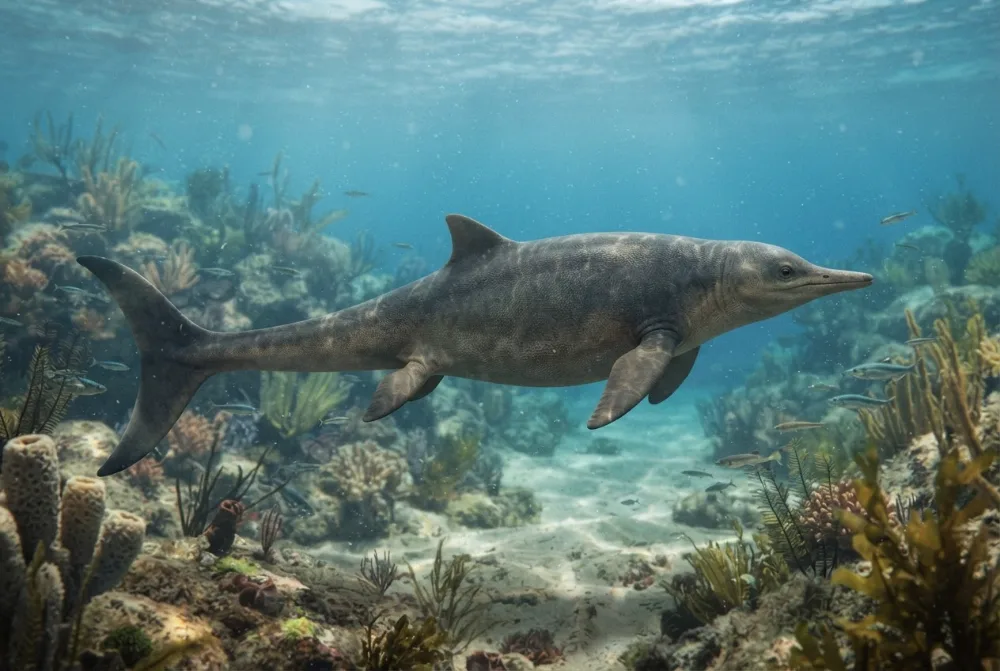
Sclerocormus was an early marine reptile that lived in the sea, not a dinosaur. It had a very tiny head and a long tail without a fluke, making it look different from later ichthyosaurs.1
 China
When did it live?
Sclerocormus: 249 to 247 million years ago
How big was it?
How long was it?
How heavy was it?
 as long as 3 house cats nose to tail🍌as long as 9 bananas end to end🍌as heavy as 120 bananas🏊could swim the length of a big swimming pool (50 m) in 6.2 seconds
How big was Sclerocormus compared to YOU?
Just maths in your browser. Nothing is saved or sent anywhere.
How fast was it?


Fun facts
Sclerocormus had an extremely small head that was only about 6.25% of its total body length, much smaller than other early marine reptiles like Chaohusaurus.1
Its tail was very long, making up about 58% of its total length, and it did not have a fluke like later ichthyosaurs.1
Sclerocormus had a heavily built body with flattened, overlapping belly ribs that formed a tight basket, similar to hupehsuchians.1
It lived during the Early Triassic period, about 248 to 247 million years ago, soon after the end-Permian mass extinction.41
Sclerocormus is one of the earliest known ichthyosauriforms, and its discovery shows that these marine reptiles evolved quickly within the first million years of their history.1
This reptile had large eyes with scleral plates, which are bony rings that help support the eye, like in many ichthyosaurs.1
Most asked questions about Sclerocormus
?How big was Sclerocormus?
Sclerocormus was about 1.6 metres (5.2 feet) long and weighed more than 15 kilograms (33 pounds).2
?What did Sclerocormus eat?
Sclerocormus was a suction feeder that used its narrow, toothless snout to suck in soft-bodied prey. Because its head and jaws were so small, it could only eat prey much smaller than itself.2
?Could Sclerocormus swim fast?
No, Sclerocormus was probably a slow swimmer. Its heavy build and body shape suggest it lived in shallow waters.2
?Is Sclerocormus a dinosaur?
No, Sclerocormus is not a dinosaur. It is an ichthyosauriform, a type of marine reptile that lived in the sea.2
For dino experts
- Scientific name
- Sclerocormus
- Named by
- Jiang et al. 20164
- Group
- Ichthyosaurs
- Family / clade
- Omphalosauridae4
- Classification
- Ichthyosauromorpha4
- Age of the rocks
- 249 to 247 million years ()4
- Rock formations
- Nanlinghu4
- Countries
- China4
- Fossil records
- 1 in the Paleobiology Database4
- Discovery
- Sclerocormus was named by Jiang and colleagues in 2016 based on a single fossil skeleton found in the Nanlinghu Formation in Anhui, China.41
- Still debated
- Scientists are not sure exactly what Sclerocormus ate, because it had no teeth, but they think it may have been a suction feeder.1
Where the facts come from
- A large aberrant stem ichthyosauriform indicating early rise and demise of ichthyosauromorphs in the wake of the end-Permian extinction | Scientific Reports (nature.com)
- Sclerocormus (en.wikipedia.org)
- A large aberrant stem ichthyosauriform indicating early rise and demise of ichthyosauromorphs in the wake of the end-Permian extinction | Scientific Reports (preview-www.nature.com)
- Sclerocormus in The Paleobiology Database (CC BY 4.0): age, places, rock formations, classification.
Every fact on this page has a number that points to its source. If we got something wrong, sorry, we are dino fans, not a science journal. Tell us at hello@dinowiki.app and we will fix it.
 Rex is hungry! Dino Wiki is a dad's project for his dino-loving son, free with no ads and no cookies. Grown-ups can feed Rex a snack to help keep it online.Feed Rex
 Ichthyosaurus
 Platypterygius
 Stenopterygius
 Khudiakovia
 Ophthalmosaurus
 Chonespondylus
 Corosaurus