
Segisaurus
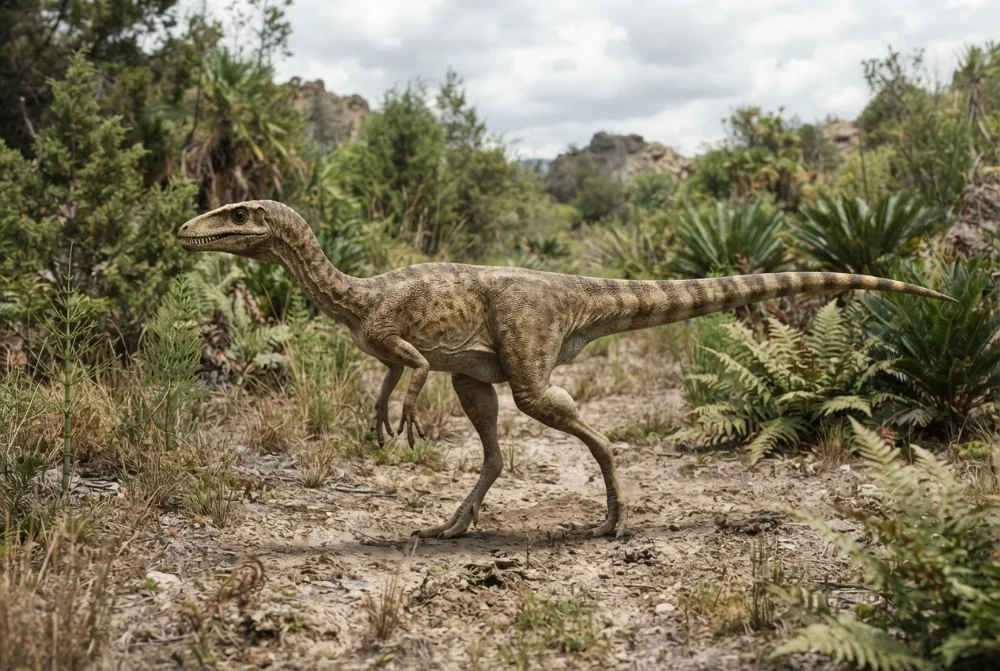
Segisaurus was a tiny, speedy meat-eater that lived in sandy deserts. It was about the size of a goose and probably snapped up insects and small prey. It is the only dinosaur ever found in its area of Arizona.21
When did it live?
How big was it?
How long was it?
How tall was it?
at the hips
How heavy was it?
How big was Segisaurus compared to YOU?
Just maths in your browser. Nothing is saved or sent anywhere.
Fun facts
Segisaurus had a wishbone, called a furcula, just like birds do. This was one of the first times such a bone was found in a non-bird dinosaur.2
Its bones were first thought to be solid, but a 2005 study showed they were actually hollow, like other theropods.2
The only known fossil was found by a Navajo man named Max Littlesalt in 1933, who was keeping livestock in the canyon.2
Segisaurus lived in an environment like modern sand dunes, and its fossil was buried in sandstone.2
It had a long tail and long forearms, and its legs were powerful and long compared to its body.2
Scientists think Segisaurus was closely related to Coelophysis, but it had some unusual features that made them question that at first.2
Most asked questions about Segisaurus
?How big was Segisaurus?
Segisaurus was about 1 metre (3.3 feet) long, half a metre (1.65 feet) tall, and weighed about 4 to 7 kilograms. That is roughly the size of a goose.2
?What did Segisaurus eat?
Segisaurus was a meat-eater, probably eating insects and small prey. It may also have scavenged meat.21
?When did Segisaurus live?
Segisaurus lived during the Early Jurassic period, about 200 to 174 million years ago.2
?Did Segisaurus have feathers?
The sources do not mention feathers on Segisaurus. It did have a wishbone, or furcula, like birds, which is a feature linked to birds.2
?Was Segisaurus a dinosaur?
Yes, Segisaurus was a small theropod dinosaur, a meat-eating dinosaur that walked on two legs.21
?Where was Segisaurus found?
The only Segisaurus fossil was found in Tsegi Canyon, Arizona, in the Navajo Sandstone. It was discovered by Max Littlesalt in 1933.2

Ask Rex about Segisaurus
Rex only answers questions about this page. 3 questions a day.
Rex is an AI and can make mistakes. He runs on servers in the EU and questions are never saved. Never type your name or other personal things.
Myth buster
Myth: Some people thought Segisaurus had solid bones and might not be a true theropod.
Truth: A 2005 re-examination showed its bones were hollow, and it is firmly classified as a coelophysoid theropod.2
For dino experts
- Scientific name
- Segisaurus
- Named by
- Camp 19363
- Group
- Meat-eating dinos
- Family / clade
- Coelophysidae3
- Classification
- Theropoda > Coelophysoidea3
- Age of the rocks
- 193 to 175 million years (Pliensbachian / Toarcian)3
- Rock formations
- Navajo Sandstone3
- Countries
- USA3
- Fossil records
- 2 in the Paleobiology Database3
- Discovery
- The fossil was discovered in 1933 by Max Littlesalt in Tsegi Canyon, Arizona. Paleontologist Charles Lewis Camp described and named it in 1936.21
- Still debated
- Because only a sub-adult skeleton has been found, scientists are not sure how big a full-grown Segisaurus could get.2
Where the facts come from
- Segisaurus | Natural History Museum (nhm.ac.uk)
- Segisaurus (en.wikipedia.org)
- Segisaurus in The Paleobiology Database (CC BY 4.0): age, places, rock formations, classification.
Every fact on this page has a number that points to its source. If we got something wrong, sorry, we are dino fans, not a science journal. Tell us at [email protected] and we will fix it.
 Rex is hungry! Dino Wiki is a dad's project for his dino-loving son, free with no ads. Grown-ups can feed Rex a snack to help keep it online.Feed Rex
 Allosaurus
 Carnotaurus
 Dilophosaurus
 Giganotosaurus
 Compsognathus
 Paronychodon
 Stenopterygius
 Dorygnathus
 Lufengosaurus
 Scutellosaurus
 Yunnanosaurus
 Temnodontosaurus