
Syntarsus
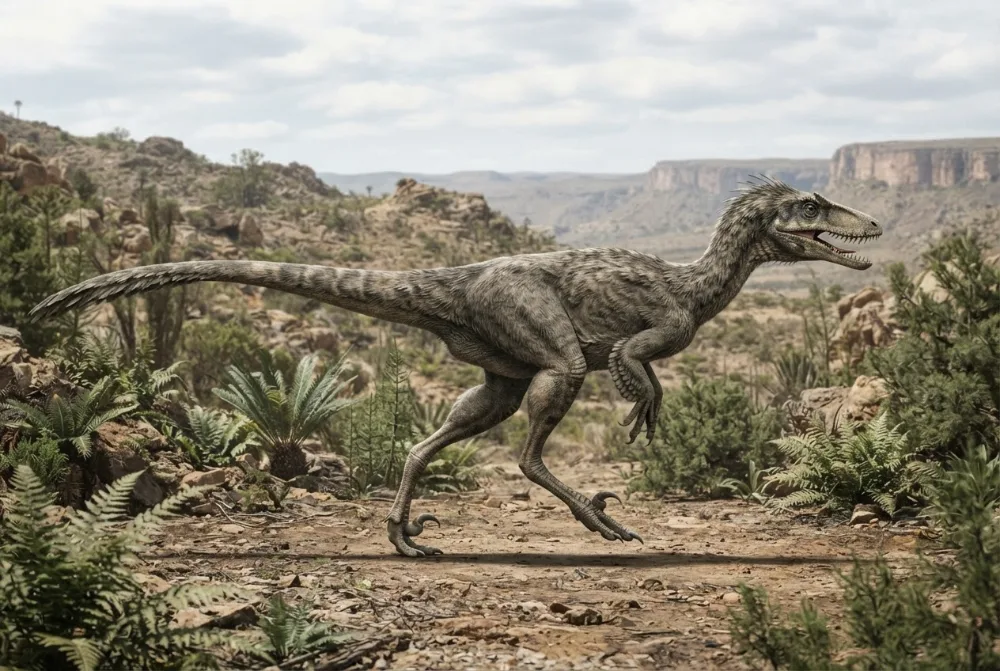
Syntarsus was a fast, meat-eating dinosaur that lived about 200 million years ago. It was a relative of Coelophysis and used its sharp teeth and long legs to chase down small prey. Some fossils show that it might have lived in groups.2
When did it live?
How big was it?
How big was Syntarsus compared to YOU?
Just maths in your browser. Nothing is saved or sent anywhere.
Fun facts
Syntarsus had a long, slim body and a tail that helped it keep balance while running fast.2
Fossils of Syntarsus have been found in Arizona in the Kayenta Formation and in South Africa in the Elliot Formation.22
The species Syntarsus kayentakatae was named by Timothy Rowe in 1989 from a partial skeleton found in Arizona.21
Syntarsus lived during the Early Jurassic, about 199 to 183 million years ago, in what is now the southwestern United States and southern Africa.2
Scientists think Syntarsus was a fast and agile hunter, using its long legs to chase after lizards and small dinosaurs.2
The name Syntarsus was first used by Michael Raath in 1969 for fossils found in Rhodesia (now Zimbabwe).2

Ask Rex about Syntarsus
Rex only answers questions about this page. 3 questions a day.
Rex is an AI and can make mistakes. He runs on servers in the EU and questions are never saved. Never type your name or other personal things.
For dino experts
- Scientific name
- Syntarsus
- Named by
- Raath 19692
- Group
- Other meat-eaters
- Family / clade
- Coelophysoidea2
- Classification
- Theropoda > Coelophysoidea2
- Age of the rocks
- 206 to 184 million years (Rhaetian / Pliensbachian)2
- Rock formations
- Kayenta, Elliot, Moenave2
- Countries
- USA, South Africa2
- Fossil records
- 11 in the Paleobiology Database2
- Discovery
- The first Syntarsus fossils were found in the Forest Sandstone of Rhodesia (now Zimbabwe) and named by Michael Raath in 1969. Another species, Syntarsus kayentakatae, was named by Timothy Rowe in 1989 from the Kayenta Formation in Arizona.221
- Still debated
- Scientists still debate whether Syntarsus should be called a separate genus or classified as a type of Coelophysis. Some researchers suggest the name Megapnosaurus instead.22
Where the facts come from
- : Rowe 1989 | Publication Details | MCZbase (mczbase.mcz.harvard.edu)
- Syntarsus in The Paleobiology Database (CC BY 4.0): age, places, rock formations, classification.
Every fact on this page has a number that points to its source. If we got something wrong, sorry, we are dino fans, not a science journal. Tell us at [email protected] and we will fix it.
Rex is hungry! Dino Wiki is a dad's project for his dino-loving son, free with no ads. Grown-ups can feed Rex a snack to help keep it online.Feed Rex Allosaurus
 Carnotaurus
 Dilophosaurus
 Giganotosaurus
 Compsognathus
 Paronychodon
 Stenopterygius
 Dorygnathus
 Lufengosaurus
 Scutellosaurus
 Yunnanosaurus
 Temnodontosaurus