
Wamweracaudia
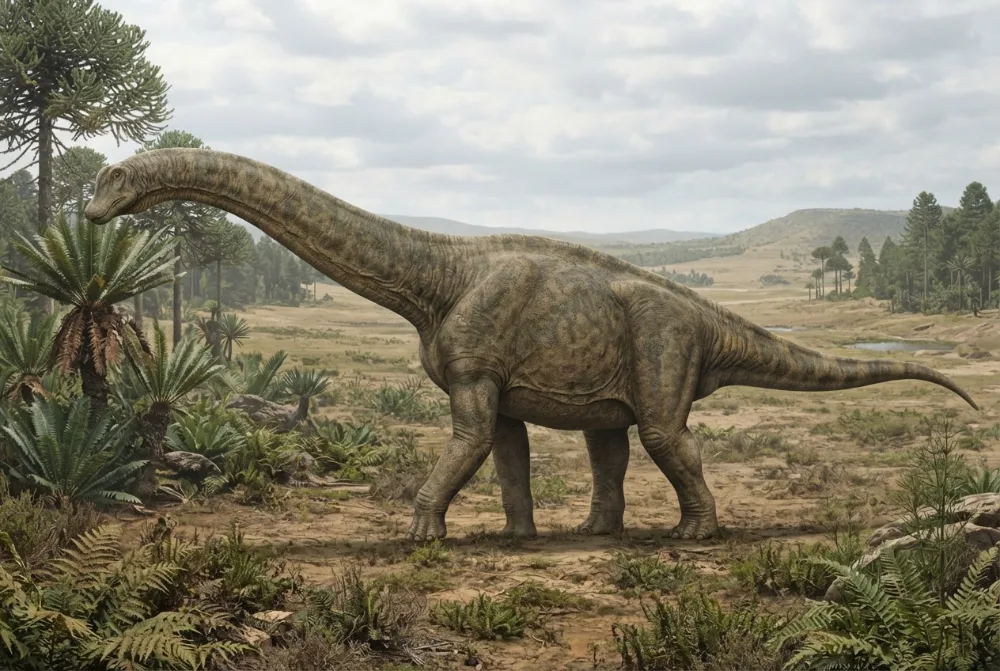
Wamweracaudia was a huge, long-necked plant-eating dinosaur that lived in what is now Africa. It walked on four legs and had a very long tail made of many bones.13
When did it live?
How big was it?
How big was Wamweracaudia compared to YOU?
Just maths in your browser. Nothing is saved or sent anywhere.
Fun facts
Wamweracaudia is known from a nearly complete series of thirty tail vertebrae, plus two chevrons and two neural spines.1
Its tail bones were procoelous, meaning they had a hollow at the front and a ball at the back, which made the tail flexible and strong.1
It was a close relative of Mamenchisaurus, a famous long-necked dinosaur from Asia, and scientists think it may be the first mamenchisaurid found outside Asia.1
The fossils were first dug up between 1909 and 1912 by German expeditions, but they were not given their own name until 2019.1
The name honors the Wamwera people who live near the find site, and the specific name keranjei honors Mohammadi Keranje, the foreman who led the excavation team.1
Wamweracaudia lived during the Late Jurassic, about 155 to 145 million years ago.1
Most asked questions about Wamweracaudia
?What did Wamweracaudia eat?
Wamweracaudia was a herbivore, meaning it ate plants. As a sauropod, it was a large quadrupedal herbivore.1
?When did Wamweracaudia live?
Wamweracaudia lived during the Late Jurassic, about 155 to 145 million years ago.1
?How big was Wamweracaudia?
Scientists don't know exactly, but it was a large sauropod. It is known from a nearly complete series of thirty tail vertebrae, which suggests a long tail.1
?Is Wamweracaudia related to Mamenchisaurus?
Yes, Wamweracaudia is a close relative of Mamenchisaurus. Scientists think it may be the first mamenchisaurid found outside Asia.1

Ask Rex about Wamweracaudia
Rex only answers questions about this page. 3 questions a day.
Rex is an AI and can make mistakes. He runs on servers in the EU and questions are never saved. Never type your name or other personal things.
Myth buster
Myth: Some people think Wamweracaudia was a titanosaur, a type of giant sauropod.
Truth: Scientists now think it was a mamenchisaurid, more closely related to Mamenchisaurus, because of its tail bone features.1
For dino experts
- Scientific name
- Wamweracaudia
- Named by
- Mannion et al. 20193
- Group
- Long-necks
- Family / clade
- Mamenchisauridae3
- Classification
- Sauropodomorpha > Sauropoda3
- Age of the rocks
- 149 to 143 million years (Tithonian)3
- Rock formations
- Tendaguru3
- Countries
- Tanzania3
- Fossil records
- 2 in the Paleobiology Database3
- Discovery
- The tail was found during German expeditions to Tendaguru in Tanzania between 1909 and 1912, supervised by paleontologist Werner Janensch. It was named Wamweracaudia keranjei in 2019 by Philip Mannion and colleagues.1
- Still debated
- Scientists are still unsure about the exact size of Wamweracaudia because only tail bones have been found, and the PBDB gives a very broad length estimate.2
Where the facts come from
- Wamweracaudia (en.wikipedia.org)
- PBDB Taxon (paleobiodb.org)
- Wamweracaudia in The Paleobiology Database (CC BY 4.0): age, places, rock formations, classification.
Every fact on this page has a number that points to its source. If we got something wrong, sorry, we are dino fans, not a science journal. Tell us at [email protected] and we will fix it.
Rex is hungry! Dino Wiki is a dad's project for his dino-loving son, free with no ads. Grown-ups can feed Rex a snack to help keep it online.Feed Rex Brachiosaurus
 Diplodocus
 Brontosaurus
 Argentinosaurus
 Camarasaurus
 Morosaurus
 Allosaurus
 Compsognathus
 Camptosaurus
 Nanosaurus
 Rhamphorhynchus
 Ceratosaurus